Review
. 2022 Jul 25;22(1):234.
doi: 10.1186/s12935-022-02654-3.

CRISPR/Cas9 system in breast cancer therapy: advancement, limitations and future scope

Affiliations
Review

CRISPR/Cas9 system in breast cancer therapy: advancement, limitations and future scope

Vamika Karn et al. Cancer Cell Int. .

Abstract

Cancer is one of the major causes of mortality worldwide, therefore it is considered a major health concern. Breast cancer is the most frequent type of cancer which affects women on a global scale. Various current treatment strategies have been implicated for breast cancer therapy that includes surgical removal, radiation therapy, hormonal therapy, chemotherapy, and targeted biological therapy. However, constant effort is being made to introduce novel therapies with minimal toxicity. Gene therapy is one of the promising tools, to rectify defective genes and cure various cancers. In recent years, a novel genome engineering technology, namely the clustered regularly interspaced short palindromic repeat (CRISPR)-associated protein-9 (Cas9) has emerged as a gene-editing tool and transformed genome-editing techniques in a wide range of biological domains including human cancer research and gene therapy. This could be attributed to its versatile characteristics such as high specificity, precision, time-saving and cost-effective methodologies with minimal risk. In the present review, we highlight the role of CRISPR/Cas9 as a targeted therapy to tackle drug resistance, improve immunotherapy for breast cancer.

Keywords: Breast cancer; CRISPR/Cas9; Diagnosis; Drug resistance; Gene editing; Immunotherapy.


Conflict of interest statement

Sanjay Kumar and Deepak Parashar are Associate Editor in Cancer Cell International Journal.

Figures
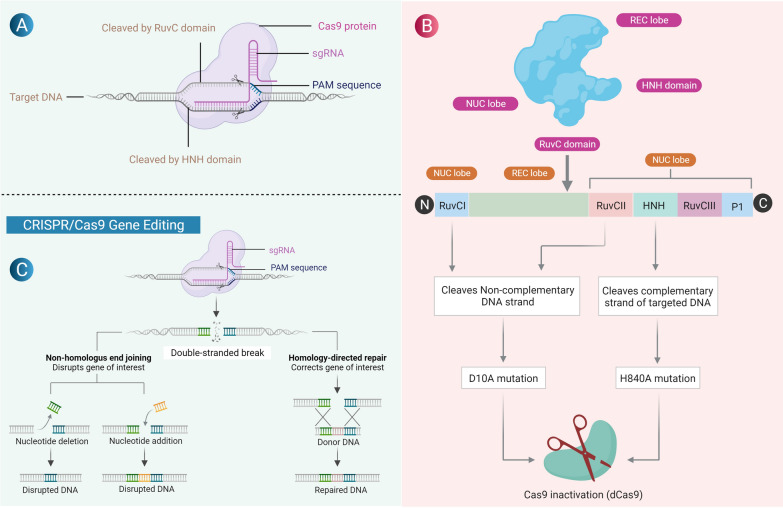
Fig. 1
Fig. 1
A Components of the CRISPR/Cas9 system: (i) Cas9 endonuclease which is responsible for cleavage of target DNA sequence, (ii) single guide (sg) RNA formed by the fusion of crRNA and tra-crRNA chimera, iii) protospacer adjacent motif (PAM) sequence required for Cas binding present in the target DNA sequence. B Cas9 protein is a bi-lobed structure consisting of the alpha lobe and the nuclease lobe. The nuclease lobe has two domains the HNH domain and RuvC domain which cleaves the complementary and the non-complementary strands of DNA respectively. Mutation at D10A in the RuvC domain and H840A of the HNH domain leads to the inactivation of Cas9 (dCas9). C Gene editing; Cas9-sgRNA complex targets the respective gene and causes double-strand breaks (DSBs) close to the PAM region. The damaged DNA is repaired either by non-homologous end joining (NHEJ) or the homologous DNA repair (HDR) pathway
Fig. 2
Fig. 2
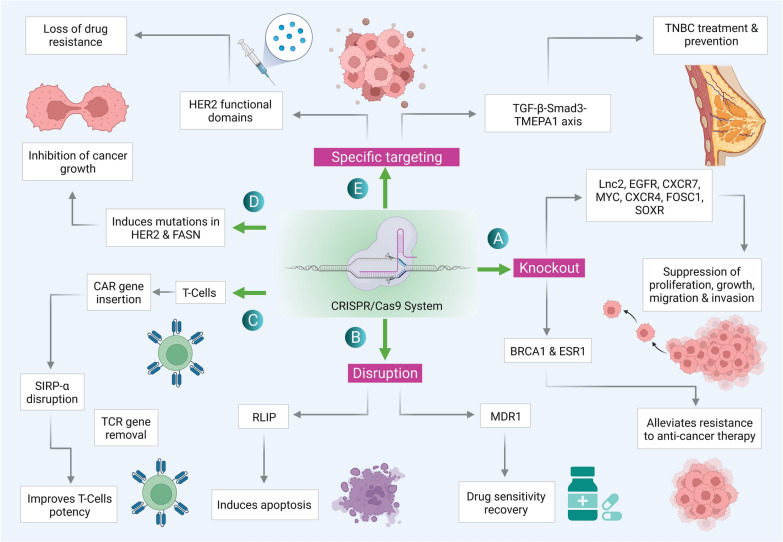
Application of CRISPR/Cas9 system in the treatment of cancer: A Knock-out of various oncogenes whose overexpression or dysregulation leads to either resistance to therapy or cancer proliferation. B Genes RLIP and MDR1 are responsible for drug resistance in BC are disrupted using CRISPR/Cas for restoration of drug sensitivity. C T-cells are used for immunotherapy in BC, CRISPR/Cas has been applied in T-cells for CAR gene insertion, TCR gene removal, and SIRP-α disruption and therefore improving its potency. D Mutation in HER2 (human epidermal growth factor receptor 2) and FASN (Fatty acid synthase) induced by CRISPR/Cas9, leads to inhibition of growth of cancer cells. E TGF-Smad3-TMEPAI axis plays a role in cancer cells by enabling them to escape TGF-mediated growth inhibition and the functional domains of HER2 are required for carcinogenic activity, hence their specific targeting through CRISPR/Cas results in TNBC treatment and loss of drug resistance respectively

References

    1. Jagadish N, Gupta N, Agarwal S, Parashar D, Sharma A, Fatima R, et al. Sperm-associated antigen 9 (SPAG9) promotes the survival and tumor growth of triple-negative breast cancer cells. Tumor Biol. 2016;37:13101–13110. doi: 10.1007/s13277-016-5240-6. - DOI - PubMed
    1. Siegel RL, Miller KD, Fuchs HE, Jemal A. Cancer statistics, 2022. CA Cancer J Clin. 2022;72:7–33. doi: 10.3322/caac.21708. - DOI - PubMed
    1. Curigliano G. New drugs for breast cancer subtypes: targeting driver pathways to overcome resistance. Cancer Treat Rev. 2012;38:303–310. doi: 10.1016/j.ctrv.2011.06.006. - DOI - PubMed
    1. Giuliano M, Hu H, Wang YC, Fu X, Nardone A, Herrera S, et al. Upregulation of ER signaling as an adaptive mechanism of cell survival in HER2-positive breast tumors treated with anti-HER2 therapy. Clin Cancer Res. 2015;21:3995–4003. doi: 10.1158/1078-0432.CCR-14-2728. - DOI - PMC - PubMed
    1. Minicozzi P, Bella F, Toss A, Giacomin A, Fusco M, Zarcone M, et al. Relative and disease-free survival for breast cancer in relation to subtype: a population-based study. J Cancer Res Clin Oncol. 2013;139:1569–1577. doi: 10.1007/s00432-013-1478-1. - DOI - PMC - PubMed

LinkOut - more resources