. 2022 Aug 3;14(8):evac119.
doi: 10.1093/gbe/evac119.

Phylogenomic Analyses of 2,786 Genes in 158 Lineages Support a Root of the Eukaryotic Tree of Life between Opisthokonts and All Other Lineages

Affiliations

Phylogenomic Analyses of 2,786 Genes in 158 Lineages Support a Root of the Eukaryotic Tree of Life between Opisthokonts and All Other Lineages

Mario A Cerón-Romero et al. Genome Biol Evol. .

Abstract

Advances in phylogenomics and high-throughput sequencing have allowed the reconstruction of deep phylogenetic relationships in the evolution of eukaryotes. Yet, the root of the eukaryotic tree of life remains elusive. The most popular hypothesis in textbooks and reviews is a root between Unikonta (Opisthokonta + Amoebozoa) and Bikonta (all other eukaryotes), which emerged from analyses of a single-gene fusion. Subsequent, highly cited studies based on concatenation of genes supported this hypothesis with some variations or proposed a root within Excavata. However, concatenation of genes does not consider phylogenetically-informative events like gene duplications and losses. A recent study using gene tree parsimony (GTP) suggested the root lies between Opisthokonta and all other eukaryotes, but only including 59 taxa and 20 genes. Here we use GTP with a duplication-loss model in a gene-rich and taxon-rich dataset (i.e., 2,786 gene families from two sets of 155 and 158 diverse eukaryotic lineages) to assess the root, and we iterate each analysis 100 times to quantify tree space uncertainty. We also contrasted our results and discarded alternative hypotheses from the literature using GTP and the likelihood-based method SpeciesRax. Our estimates suggest a root between Fungi or Opisthokonta and all other eukaryotes; but based on further analysis of genome size, we propose that the root between Opisthokonta and all other eukaryotes is the most likely.

Keywords: gene duplication; gene loss; gene tree parsimony; gene tree–species tree reconciliation; maximum likelihood; phylogenomics; root of eukaryotes.


Figures

Fig. 1.
Fig. 1.
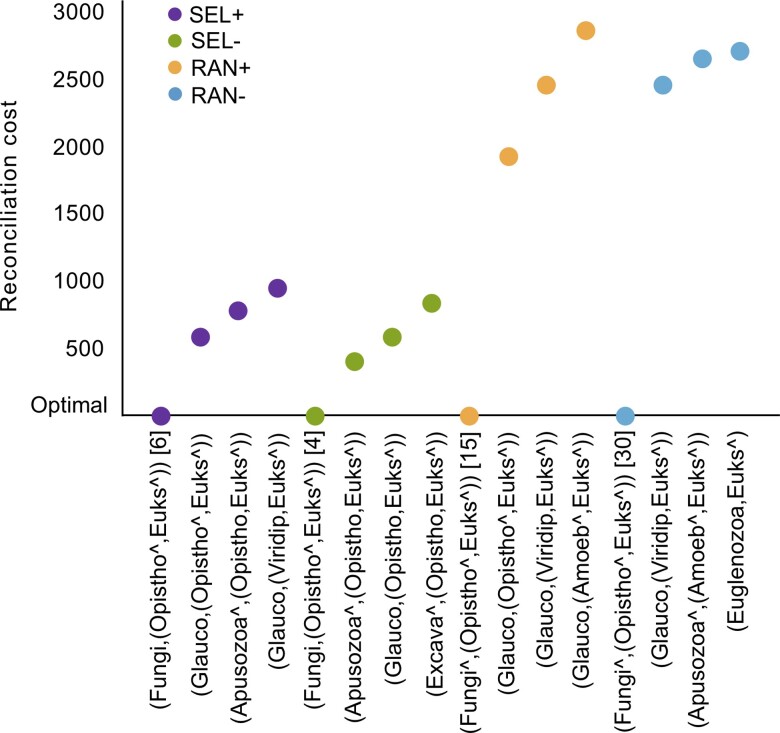
A root between fungi and all other eukaryotes is the most parsimonious hypothesis based on 100 iterations of iGTP using all four taxon sets. Here we report the four most parsimonious topologies in 100 iterations of the analysis and note the number of times the first hypothesis appeared before any alternative in square parenthesis (i.e. a fungal root was present in the six iterations of iGTP with the lowest reconciliation scores in the SEL+ analyses). The caret (^) implies a non-monophyletic clade. For example, in datasets SEL+ and RAN+, the microsporidians do not fall in the same clade as the rest of the opisthokonts. We show the relative reconciliation costs compared to the optimum (lowest value) for each dataset. After Fungi–others, other parsimonious roots involve clades underrepresented in our dataset such as Glaucophyta or Apusozoa (see also supplementary fig. S4, Supplementary Material online). SEL+, taxonomically informed taxa selection including microsporidians; SEL−, taxonomically informed taxa selection excluding the long-branch microsporidians; RAN+, random taxa selection including microsporidians; RAN−, random taxa selection excluding microsporidians.
Fig. 2.
Fig. 2.
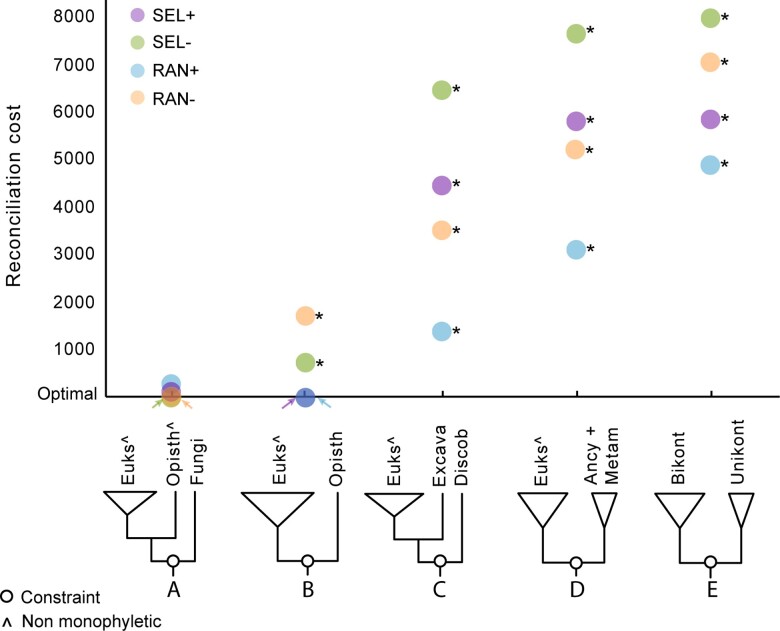
Constraining the species tree to match varying hypotheses of the root of EToL supports a root at or within Opisthokonta and is inconsistent with other hypotheses. We show the relative reconciliation costs compared to the optimum (lowest value) for each dataset. The five hypotheses here are as follows: (A) Fungi–others (our estimate from the previous analysis; see results and Fig. 1), (B) Opisthokonta–others (Stechmann and Cavalier-Smith 2002; Katz et al. 2012), (C) (Ancyromonadida + Metamonada)–others, (D) Discoba–others (He et al. 2014), and (E) Unikonta-Bikonta (Stechmann and Cavalier-Smith 2002; Derelle et al. 2015). The empty circles on the cartoon phylogenies indicate where in the tree the constraint was applied, and other notations are as in fig. 1. Overall, there are significant differences (asterisks) between Fungi–others and any other hypotheses in all datasets, except Opisthokonta–others in datasets SEL+ and RAN+ (supplementary tables S1 and S2, Supplementary Material online; significance level of 0.05). This result is consistent that Opisthokonta–others as the root and Fungi–others as a potential artifact.

References

    1. Adl SM, et al. . 2012. The revised classification of eukaryotes. J Eukaryot Microbiol 59:429–514. - PMC - PubMed
    1. Albalat R, Cañestro C. 2016. Evolution by gene loss. Nat Rev Genet 17:379–391. - PubMed
    1. Al Jewari C, Baldauf SL. 2022. Conflict over the eukaryote root resides in strong outliers, mosaics and missing data sensitivity of site-specific (CAT) mixture models. Syst Biol:syac029. - PubMed
    1. Baldauf SL, Palmer JD. 1993. Animals and fungi are each other’s closest relatives: congruent evidence from multiple proteins. Proc Natl Acad Sci U S A 90:11558–11562. - PMC - PubMed
    1. Baldauf SL, Palmer JD, Doolittle WF. 1996. The root of the universal tree and the origin of eukaryotes based on elongation factor phylogeny. Proc Natl Acad Sci 93:7749–7754. - PMC - PubMed

Publication types

Substances