


Fitness cost of target-site and metabolic resistance to pyrethroids drives restoration of susceptibility in a highly resistant Anopheles gambiae population from Uganda
- PMID: 35881658
- PMCID: PMC9321773
- DOI: 10.1371/journal.pone.0271347
Fitness cost of target-site and metabolic resistance to pyrethroids drives restoration of susceptibility in a highly resistant Anopheles gambiae population from Uganda
Abstract
Background: Insecticide resistance threatens the effectiveness of malaria vector control, calling for an urgent need to design suitable resistance management strategies. Here, we established the resistance profiling of an Ugandan Anopheles gambiae population to insecticides using WHO procedures and assessed the potential restoration of susceptibility in the hybrid line Mayuge/KISUMU in an insecticide-free environment for eighteen (18) generations.
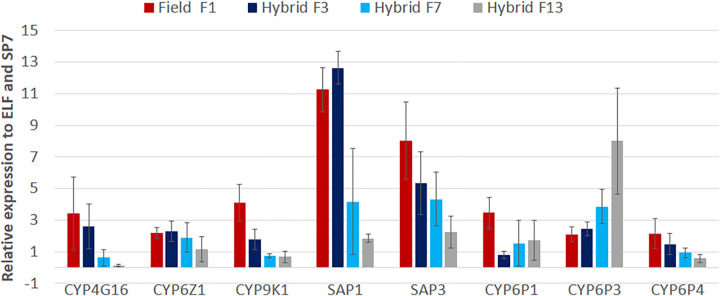
Results: This An gambiae population exhibited a very high intensity of resistance to permethrin, deltamethrin, and alphacypermethrin with a consistent loss of efficacy of all long-lasting insecticidal nets (LLINs) tested including PBO-based and new generation nets Interceptor G2 (IG2) and Royal guard. Molecular analysis revealed a fixation of the L1014S-kdr mutation together with the overexpression of some P450 metabolic genes (CYP6Z1, CYP9K1, CYP6P1, 3 & 4) besides the cuticular resistance-related genes (CYP4G16) and sensorial appendage proteins (SAP1, SAP2, and SAP3) but no GSTe2 overexpression. In the absence of selection pressure, the mortality rate after exposure to insecticides increased significantly over generations, and restoration of susceptibility was observed for most of the insecticides in less than 10 generations. Accordingly, a significant reduction in the frequency of KdrE was observed after 13 generations coupled with reduced expression of most metabolic resistance genes.
Conclusions: The results of this study show that the high intensity of pyrethroid resistance observed in An gambiae from Uganda associated with the loss of efficacy of LLINs could compromise vector control efforts. The study also highlights that an early rotation of insecticides could help manage resistance to insecticides by restoring the susceptibility. However, the persistence of Kdr mutation together with overexpression of some metabolic genes after many generations in the absence of selection pressure indicates the potential implication of modifiers alleviating the cost of resistance which needs to be further investigated.
Conflict of interest statement
The authors have declared that no competing interests exist.
Figures



References
-
- Ramphul U, Boase T, Bass C, Okedi LM, Donnelly MJ, Müller P. Insecticide resistance and its association with target-site mutations in natural populations of Anopheles gambiae from eastern Uganda. Transactions of the Royal Society of Tropical Medicine and Hygiene. 2009;103(11):1121–6. doi: 10.1016/j.trstmh.2009.02.014 - DOI - PubMed
-
- Verhaeghen K, Van Bortel W, Roelants P, Okello PE, Talisuna A, Coosemans M. Spatio-temporal patterns in kdr frequency in permethrin and DDT resistant Anopheles gambiae ss from Uganda. The American journal of tropical medicine and hygiene. 2010;82(4):566–73. doi: 10.4269/ajtmh.2010.08-0668 - DOI - PMC - PubMed
-
- Mulamba C, Irving H, Riveron JM, Mukwaya LG, Birungi J, Wondji CS. Contrasting Plasmodium infection rates and insecticide susceptibility profiles between the sympatric sibling species Anopheles parensis and Anopheles funestus s.s: a potential challenge for malaria vector control in Uganda. Parasit Vectors. 2014;7:71. doi: 10.1186/1756-3305-7-71 ; PubMed Central PMCID: PMC3937429. - DOI - PMC - PubMed
Publication types
MeSH terms
Substances
Grants and funding
LinkOut - more resources
Full Text Sources
Medical
