


Ca2+ imaging of self and other in medial prefrontal cortex during social dominance interactions in a tube test
- PMID: 35881809
- PMCID: PMC9353509
- DOI: 10.1073/pnas.2107942119
Ca2+ imaging of self and other in medial prefrontal cortex during social dominance interactions in a tube test
Abstract
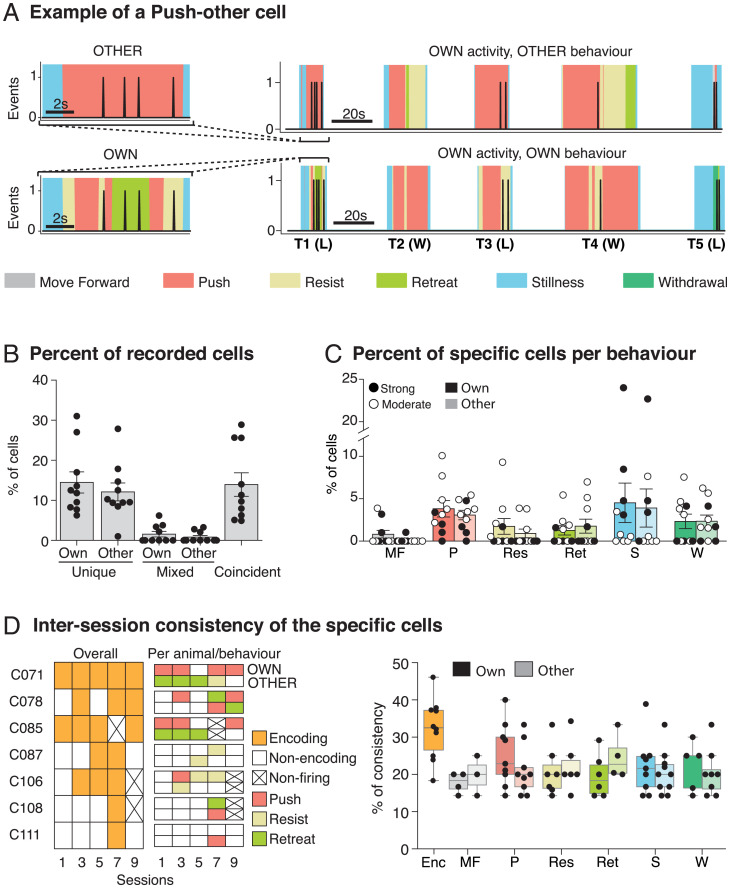
The study of social dominance interactions between animals offers a window onto the decision-making involved in establishing dominance hierarchies and an opportunity to examine changes in social behavior observed in certain neurogenetic disorders. Competitive social interactions, such as in the widely used tube test, reflect this decision-making. Previous studies have focused on the different patterns of behavior seen in the dominant and submissive animal, neural correlates of effortful behavior believed to mediate the outcome of such encounters, and interbrain correlations of neural activity. Using a rigorous mutual information criterion, we now report that neural responses recorded with endoscopic calcium imaging in the prelimbic zone of the medial prefrontal cortex show unique correlations to specific dominance-related behaviors. Interanimal analyses revealed cell/behavior correlations that are primarily with an animal's own behavior or with the other animal's behavior, or the coincident behavior of both animals (such as pushing by one and resisting by the other). The comparison of unique and coincident cells helps to disentangle cell firing that reflects an animal's own or the other's specific behavior from situations reflecting conjoint action. These correlates point to a more cognitive rather than a solely behavioral dimension of social interactions that needs to be considered in the design of neurobiological studies of social behavior. These could prove useful in studies of disorders affecting social recognition and social engagement, and the treatment of disorders of social interaction.
Keywords: endoscopic imaging; prefrontal cortex; rodents; social dominance; tube test.
Conflict of interest statement
The authors declare no competing interest.
Figures
References
-
- Ricceri L., Moles A., Crawley J., Behavioral phenotyping of mouse models of neurodevelopmental disorders: Relevant social behavior patterns across the life span. Behav. Brain Res. 176, 40–52 (2007). - PubMed
-
- Crawley J. N., What’s Wrong with My Mouse? Behavioral Phenotyping of Transgenic and Knockout Mice (Wiley, Hoboken, NJ, ed. 2, 2006).
-
- Lindzey G., Winston H., Manosevitz M., Social dominance in inbred mouse strains. Nature 191, 474–476 (1961). - PubMed
-
- Fan Z., et al. , Using the tube test to measure social hierarchy in mice. Nat. Protoc. 14, 819–831 (2019). - PubMed
-
- Wang F., et al. , Bidirectional control of social hierarchy by synaptic efficacy in medial prefrontal cortex. Science 334, 693–697 (2011). - PubMed
Publication types
MeSH terms
Substances
Grants and funding
LinkOut - more resources
Full Text Sources
Miscellaneous
