


The Rural Opioid Initiative Consortium description: providing evidence to Understand the Fourth Wave of the Opioid Crisis
- PMID: 35883197
- PMCID: PMC9321271
- DOI: 10.1186/s13722-022-00322-5
The Rural Opioid Initiative Consortium description: providing evidence to Understand the Fourth Wave of the Opioid Crisis
Abstract
Objective: To characterize and address the opioid crisis disproportionately impacting rural U.S. regions.
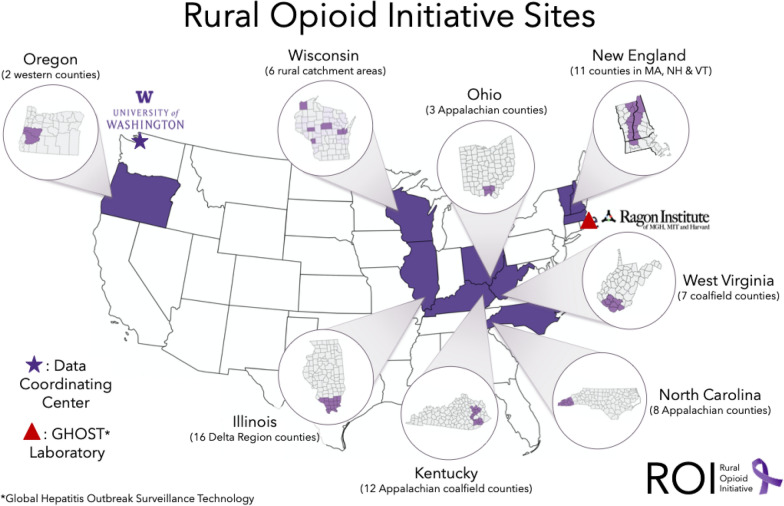
Methods: The Rural Opioid Initiative (ROI) is a two-phase project to collect and harmonize quantitative and qualitative data and develop tailored interventions to address rural opioid use. The baseline quantitative survey data from people who use drugs (PWUD) characterizes the current opioid epidemic (2018-2020) in eight geographically diverse regions.
Results: Among 3,084 PWUD, 92% reported ever injecting drugs, 86% reported using opioids (most often heroin) and 74% reported using methamphetamine to get high in the past 30 days; 53% experienced homelessness in the prior 6 months; and 49% had ever overdosed. Syringe service program use varied by region and 53% had ever received an overdose kit or naloxone prescription. Less than half (48%) ever received medication for opioid use disorder (MOUD).
Conclusions: The ROI combines data across eight rural regions to better understand drug use including drivers and potential interventions in rural areas with limited resources. Baseline ROI data demonstrate extensive overlap between opioid and methamphetamine use, high homelessness rates, inadequate access to MOUD, and other unmet needs among PWUD in the rural U.S. By combining data across studies, the ROI provides much greater statistical power to address research questions and better understand the syndemic of infectious diseases and drug use in rural settings including unmet treatment needs.
Keywords: Injection drug use; Methamphetamine; Opioids; Overdose; Rural; Substance use.
© 2022. The Author(s).
Conflict of interest statement
No conflict declared.
Figures
References
-
- Draus P, Siegal HA, Carlson RG, Falck RS, Wang J. Cracking the cornfields: Recruiting illicit stimulant drug users in rural Ohio. Sociol Q. 2005;46:165–89. doi: 10.1111/j.1533-8525.2005.00008.x. - DOI
Publication types
MeSH terms
Substances
Grants and funding
- UG3 DA044831/DA/NIDA NIH HHS/United States
- UG3 DA044825/DA/NIDA NIH HHS/United States
- UH3 DA044822/DA/NIDA NIH HHS/United States
- UH3 DA044798/DA/NIDA NIH HHS/United States
- UG3 DA044798/DA/NIDA NIH HHS/United States
- UH3 DA044826/DA/NIDA NIH HHS/United States
- U24 DA048538/DA/NIDA NIH HHS/United States
- UH3 DA044823/DA/NIDA NIH HHS/United States
- UH3 DA044830/DA/NIDA NIH HHS/United States
- UG3 DA044822/DA/NIDA NIH HHS/United States
- UH3 DA044829/DA/NIDA NIH HHS/United States
- UG3 DA044826/DA/NIDA NIH HHS/United States
- UG3 DA044823/DA/NIDA NIH HHS/United States
- UH3 DA044831/DA/NIDA NIH HHS/United States
- UG3 DA044830/DA/NIDA NIH HHS/United States
- UG3 DA044829/DA/NIDA NIH HHS/United States
LinkOut - more resources
Full Text Sources
Medical
Miscellaneous
