


Roles of Palmitoleic Acid and Its Positional Isomers, Hypogeic and Sapienic Acids, in Inflammation, Metabolic Diseases and Cancer
- PMID: 35883589
- PMCID: PMC9319324
- DOI: 10.3390/cells11142146
Roles of Palmitoleic Acid and Its Positional Isomers, Hypogeic and Sapienic Acids, in Inflammation, Metabolic Diseases and Cancer
Abstract
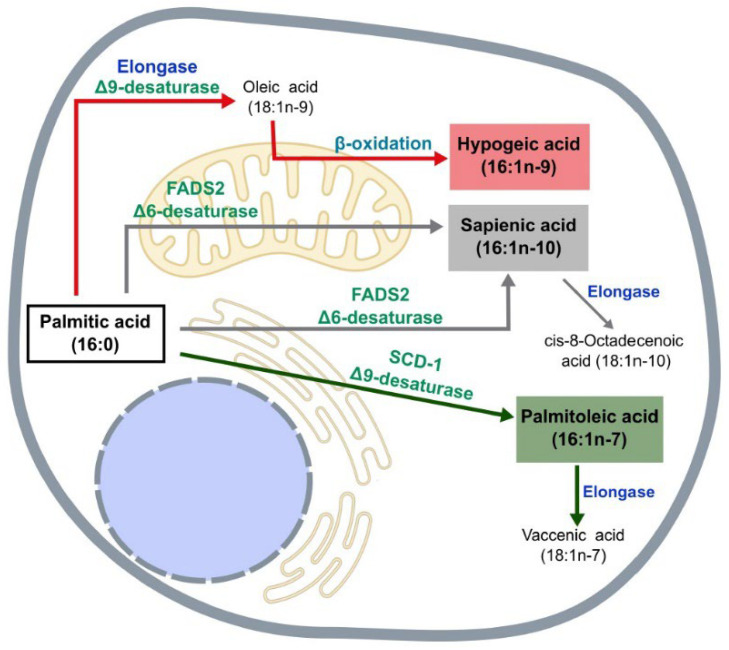
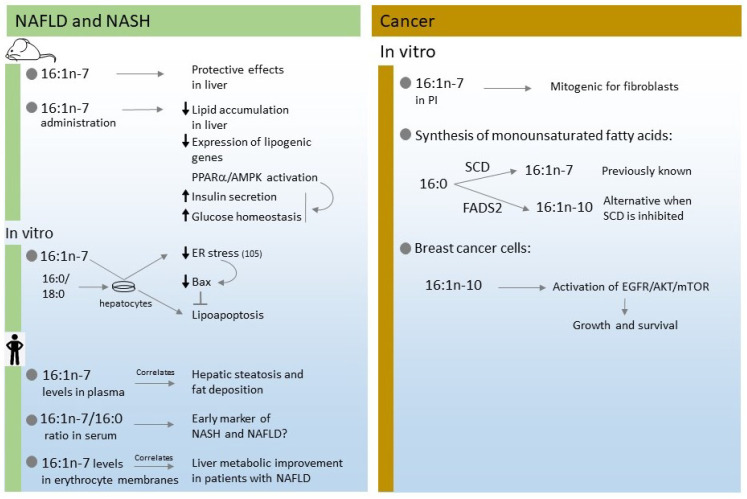
In the last few years, the monounsaturated hexadecenoic fatty acids are being increasingly considered as biomarkers of health with key functions in physiology and pathophysiology. Palmitoleic acid (16:1n-7) and sapienic acid (16:1n-10) are synthesized from palmitic acid by the action of stearoyl-CoA desaturase-1 and fatty acid desaturase 2, respectively. A third positional isomer, hypogeic acid (16:1n-9) is produced from the partial β-oxidation of oleic acid. In this review, we discuss the current knowledge of the effects of palmitoleic acid and, where available, sapienic acid and hypogeic acid, on metabolic diseases such as diabetes, cardiovascular disease, and nonalcoholic fatty liver disease, and cancer. The results have shown diverse effects among studies in cell lines, animal models and humans. Palmitoleic acid was described as a lipokine able to regulate different metabolic processes such as an increase in insulin sensitivity in muscle, β cell proliferation, prevention of endoplasmic reticulum stress and lipogenic activity in white adipocytes. Numerous beneficial effects have been attributed to palmitoleic acid, both in mouse models and in cell lines. However, its role in humans is not fully understood, and is sometimes controversial. Regarding sapienic acid and hypogeic acid, studies on their biological effects are still scarce, but accumulating evidence suggests that they also play important roles in metabolic regulation. The multiplicity of effects reported for palmitoleic acid and the compartmentalized manner in which they often occur, may suggest the overlapping actions of multiple isomers being present at the same or neighboring locations.
Keywords: cardiovascular disease; diabetes and obesity; hexadecenoic fatty acid; lipid compartmentalization; lipid signaling; liver disease.
Conflict of interest statement
The authors declare no conflict of interest. The funders had no role in the design of the study; in the collection, analyses, or interpretation of data; in the writing of the manuscript, or in the decision to publish the results.
Figures
References
-
- Klawitter J., Bek S., Zakaria M., Zeng C., Hornberger A., Gilbert R., Shokati T., Klawitter J., Christians U., Boernsen K.O. Fatty acid desaturation index in human plasma: Comparison of different analytical methodologies for the evaluation of diet effects. Anal. Bioanal. Chem. 2014;406:6399–6408. doi: 10.1007/s00216-014-8020-4. - DOI - PubMed
Publication types
MeSH terms
Substances
LinkOut - more resources
Full Text Sources
Medical
