. 2022 Jul 18;11(7):1386.
doi: 10.3390/antiox11071386.

Oxidative Stress and Psychiatric Disorders: Evidence from the Bidirectional Mendelian Randomization Study

Affiliations

Oxidative Stress and Psychiatric Disorders: Evidence from the Bidirectional Mendelian Randomization Study

Zhe Lu et al. Antioxidants (Basel). .

Abstract

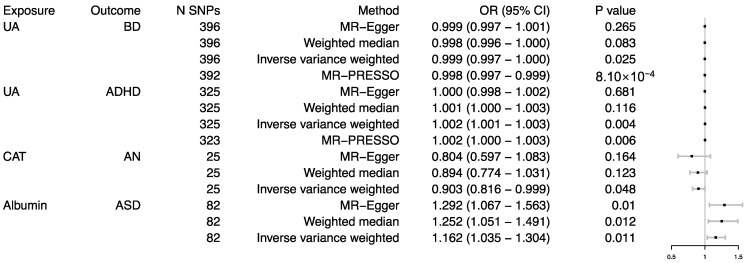
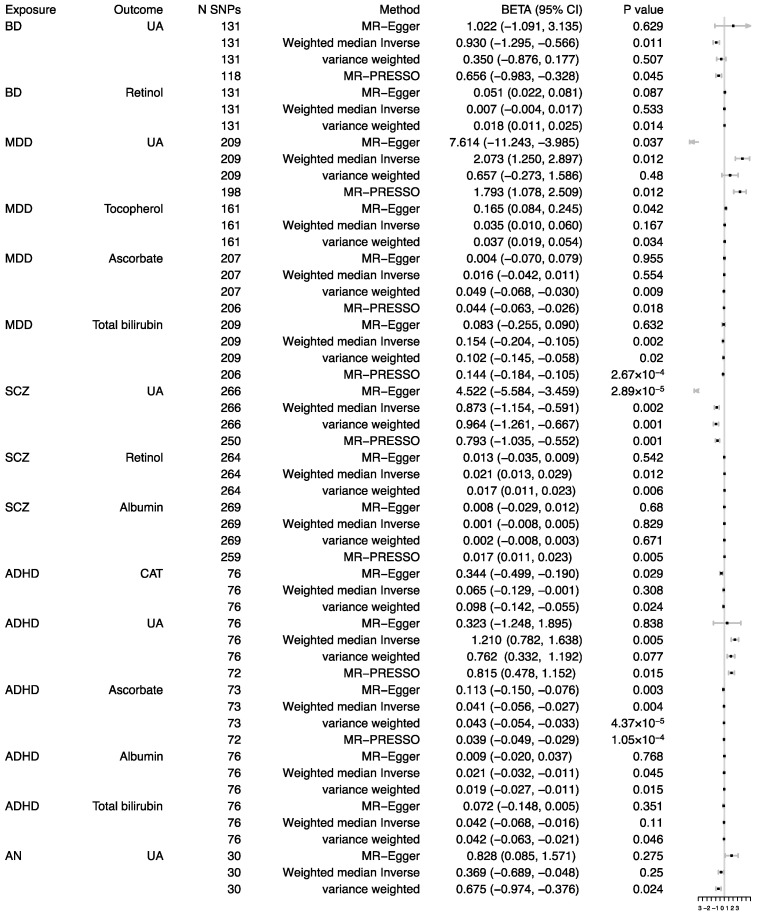
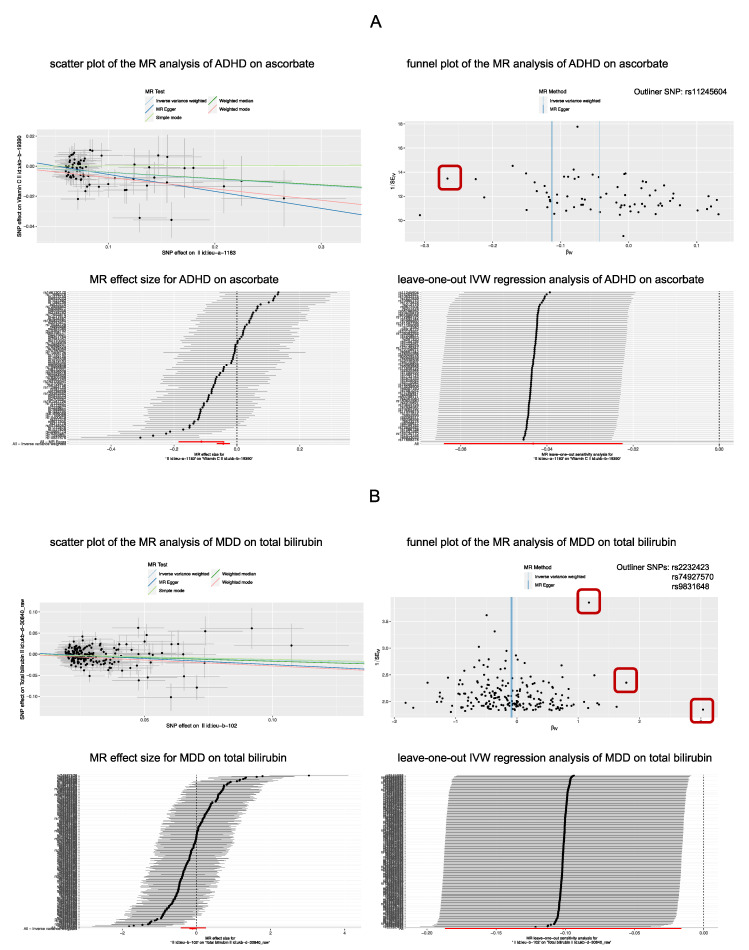
Observational studies have shown that oxidative stress is highly related to psychiatric disorders, while its cause−effect remains unclear. To this end, a Mendelian randomization study was performed to investigate the causal relationship between oxidative stress and psychiatric disorders. On the one hand, all causal effects of oxidative stress injury biomarkers (OSIB) on psychiatric disorders were not significant (p > 0.0006), while the findings suggested that part of OSIB was nominally associated with the risk of psychiatric disorders (causal OR of uric acid (UA), 0.999 for bipolar disorder (BD), and 1.002 for attention-deficit/hyperactivity disorder (ADHD); OR of catalase was 0.903 for anorexia nervosa (AN); OR of albumin was 1.162 for autism; p < 0.05). On the other hand, major depressive disorder (MDD) was significantly associated with decreased bilirubin (p = 2.67 × 10⁻⁴); ADHD was significantly associated with decreased ascorbate (p = 4.37 × 10⁻⁵). Furthermore, there were also some suggestively causal effects of psychiatric disorders on OSIB (BD on decreased UA and increased retinol; MDD on increased UA and decreased ascorbate; schizophrenia on decreased UA, increased retinol and albumin; ADHD on increased UA, and decreased catalase, albumin, and bilirubin; AN on decreased UA). This work presented evidence of potential causal relationships between oxidative stress and psychiatric disorders.

Keywords: Mendelian randomization study; oxidative stress; psychosis.


Conflict of interest statement

The authors declare no conflict of interest.

Figures

Figure 1
Figure 1
Flow chart of the bidirectional MR study design. GST, glutathione S-transferase; CAT, catalase; SOD, superoxide dismutase; GPX, glutathione peroxidase; UA, uric acid; SCZ, schizophrenia; BD, bipolar disorder; MDD, major depressive disorder; ADHD, attention-deficit/hyperactivity disorder; ASD, autism spectrum disorder; OCD, obsessive-compulsive disorder; AN, anorexia nervosa; IVW, inverse variance weighted method; SNP, single nucleotide polymorphism.
Figure 2
Figure 2
Associations between genetically predicted oxidative stress injury biomarkers and the risk of psychiatric disorders. CAT, catalase; UA, uric acid; BD, bipolar disorder; ADHD, attention-deficit/hyperactivity disorder; ASD, autism spectrum disorder; AN, anorexia nervosa; SNP, single nucleotide polymorphism.
Figure 3
Figure 3
Associations between genetically predicted psychiatric disorders and oxidative stress injury biomarkers. CAT, catalase; UA, uric acid; SCZ, schizophrenia; BD, bipolar disorder; MDD, major depressive disorder; ADHD, attention-deficit/hyperactivity disorder; AN, anorexia nervosa; SNP, single nucleotide polymorphism.
Figure 4
Figure 4
The significant causal effect of MDD on total bilirubin (A) and ADHD on ascorbate (B). (A) Significant causal effect of ADHD on ascorbate; (B) significant causal effect of MDD on total bilirubin. UA, uric acid; MDD, major depressive disorder; ADHD, attention-deficit/hyperactivity disorder.

References

    1. Carapetis J., Dadi A.F. Erratum: Global, regional, and national incidence, prevalence, and years lived with disability for 328 diseases and injuries for 195 countries, 1990–2016: A systematic analysis for the Global Burden of Disease Study 2016. Lancet. 2017;390:1211–1259. - PMC - PubMed
    1. Sutkowy P., Woźniak A., Mila-Kierzenkowska C., Szewczyk-Golec K., Wesołowski R., Pawłowska M., Nuszkiewicz J. Physical Activity vs. Redox Balance in the Brain: Brain Health, Aging and Diseases. Antioxidants. 2021;11:95. doi: 10.3390/antiox11010095. - DOI - PMC - PubMed
    1. Surgucheva I., Sharov V.S., Surguchov A. γ-Synuclein: Seeding of α-synuclein aggregation and transmission between cells. Biochemistry. 2012;51:4743–4754. doi: 10.1021/bi300478w. - DOI - PubMed
    1. Poljsak B., Šuput D., Milisav I. Achieving the balance between ROS and antioxidants: When to use the synthetic antioxidants. Oxidative Med. Cell. Longev. 2013;2013:956792. doi: 10.1155/2013/956792. - DOI - PMC - PubMed
    1. Valko M., Leibfritz D., Moncol J., Cronin M.T., Mazur M., Telser J. Free radicals and antioxidants in normal physiological functions and human disease. Int. J. Biochem. Cell. Biol. 2007;39:44–84. doi: 10.1016/j.biocel.2006.07.001. - DOI - PubMed

LinkOut - more resources