Review
. 2022 Jul 8;12(7):499.
doi: 10.3390/bios12070499.

Recent Advances in Early Diagnosis of Viruses Associated with Gastroenteritis by Biosensors

Affiliations
Review

Recent Advances in Early Diagnosis of Viruses Associated with Gastroenteritis by Biosensors

Abouzar Babaei et al. Biosensors (Basel). .

Abstract

Gastroenteritis, as one of the main worldwide health challenges, especially in children, leads to 3-6 million deaths annually and causes nearly 20% of the total deaths of children aged ˂5 years, of which ~1.5 million gastroenteritis deaths occur in developing nations. Viruses are the main causative agent (~70%) of gastroenteritis episodes and their specific and early diagnosis via laboratory assays is very helpful for having successful antiviral therapy and reduction in infection burden. Regarding this importance, the present literature is the first review of updated improvements in the employing of different types of biosensors such as electrochemical, optical, and piezoelectric for sensitive, simple, cheap, rapid, and specific diagnosis of human gastroenteritis viruses. The Introduction section is a general discussion about the importance of viral gastroenteritis, types of viruses that cause gastroenteritis, and reasons for the combination of conventional diagnostic tests with biosensors for fast detection of viruses associated with gastroenteritis. Following the current laboratory detection tests for human gastroenteritis viruses and their limitations (with subsections: Electron Microscope (EM), Cell Culture, Immunoassay, and Molecular Techniques), structural features and significant aspects of various biosensing methods are discussed in the Biosensor section. In the next sections, basic information on viruses causing gastroenteritis and recent developments for fabrication and testing of different biosensors for each virus detection are covered, and the prospect of future developments in designing different biosensing platforms for gastroenteritis virus detection is discussed in the Conclusion and Future Directions section as well.

Keywords: biosensor; viral gastroenteritis; virus detection.


Conflict of interest statement

The authors declare no conflict of interest.

Figures
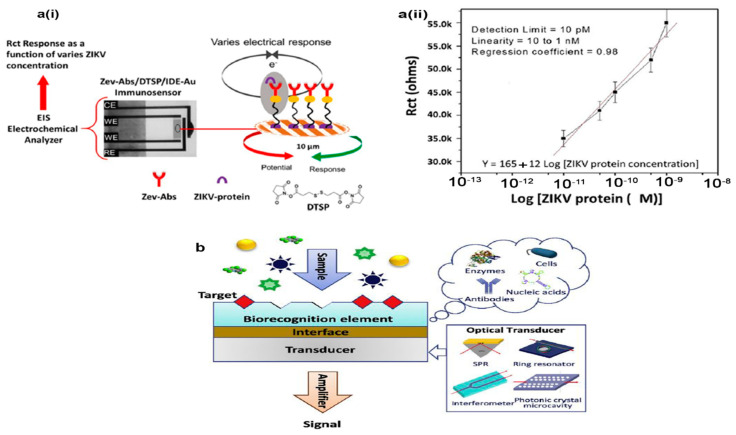
Figure 2
Figure 2
Schematics of the electrochemical (a(i) and a(ii)) and optical (b) sensors that are used for virus detection: a(i) picture of the impedance-based electrochemical immunosensor and a(ii); Dependence of the charge transfer resistance on the virus concentration from 10 pM to 1 nM. (b) Schematic diagram of optical biosensor constitution and its components. The figures were reprinted with permission from refs [96,108], Copyright 2019, Elsevier and Copyright 2020, Elsevier.
Figure 4
Figure 4
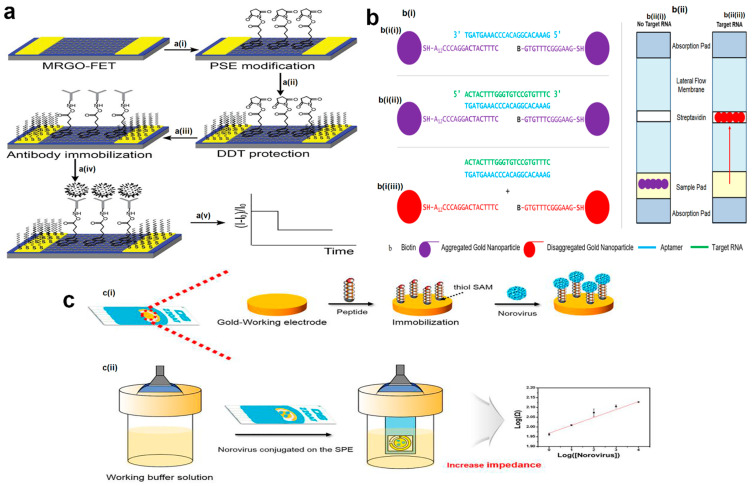
(a) Real-time detection of rotavirus antibodies using a micropatterned reduced graphene-oxide-based field-effect transistor. a(i) Connection of PSE on MRGO surface, a(ii) DDT treatment, a(iii) immobilization of rotavirus-specific antibodies, a(iv) rotavirus capture, and a(v) real-time monitoring of rotavirus by electrical signaling. (b) Schematic illustration of the gold-aptamer-nanoparticle-based biosensor with (b(i)) colorimetric and (b(ii)) lateral flow response. (b(i(i))) Nanoparticles are functionalized with Sequence A (SH-5′ A12CCC AGG ACT AC T TTC 3′) and Sequence B (biotin -5′ GTG TTT CGG GAA G 3′ -SH) then aggregate by aggregating oligonucleotide (aptamer). (b(i(ii))) Oligonucleotide hybridizes with target nucleic acid (conserved enterovirus sequence) which (b(i(iii))) makes the nanoparticles, disaggregates, and changes their colors into red. (b(ii(i))) Aggregated nanoparticles are not able to move up through the lateral flow membranes, while (b(ii(ii))) in disaggregated form, they flow via lateral flow and bind to streptavidin due to biotin functionalization. (c) Norovirus detection by use of an impedance electrochemical biosensor. (c(i)) Immobilization of peptide self-assembly monolayers (SAMs) on the Au-working electrode. (c(ii)) Affinity strength of dropped norovirus, conjugated with the peptide on the gold screen-printed electrode (SPE), is measured using electrochemical impedance spectroscopy analysis. The figures were reprinted with permission from refs. [116,128,145], Copyright 2013, Elsevier; Copyright 20211, Multidisciplinary Digital Publishing Institute (MDPI); and Copyright 2018, Elsevier, respectively.
Figure 1
Figure 1
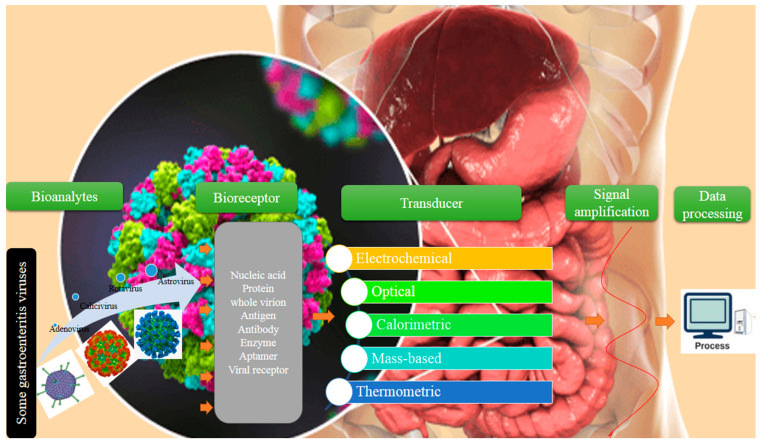
A schematic presentation of biosensor components applied for diagnosis of viruses associated with gastroenteritis. Biosensors are classified into electrochemical, optical, calorimetric, mass-based, and thermometric based on the types of their transducers and bioreceptors. The interaction of bioanalytes such as gastroenteritis viruses (rotavirus, calicivirus, astrovirus, and adenovirus) with different types of bioreceptor components including nucleic acid, protein, whole virus, antigen, etc., in various biosensing platforms produce a measurable signal through the transducer. Eventually, the signal is quantified using an analyzing system.
Figure 3
Figure 3
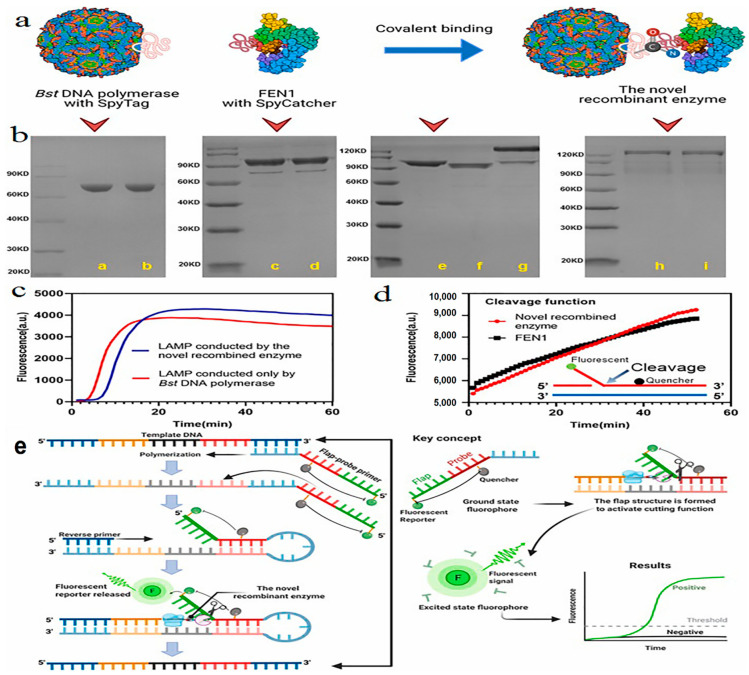
The recombinant FEN1-Bst DNA polymerase and a schematic illustration of flap-probe-based isothermal nucleic acid amplification method for rotavirus genome detection. (a) Schematic presentation of recombination through covalent binding of the SpyTag/SpyCatcher system. (b) SDS-PAGE confirmation of Bst DNA polymerase with SpyTag, FEN1 with SpyCatcher, and the new recombinant enzyme: lane a and b are reduced and non-reduced Bst DNA polymerase (SpyTag) protein, respectively; lane c is reduced FEN1 (SpyCatcher) protein while lane d is non-reduced one; Bst DNA polymerase (SpyTag) in lane e and FEN1 (SpyCatcher) in lane f form the novel recombinant enzyme protein (lane g); and lane h and i indicate novel recombinant enzyme protein. (c) Common LAMP reaction utilizing the novel recombinant enzyme. (d) Cleavage reaction of the flap structure using the novel recombinant enzyme to release fluorescent reporter that can be detected in real-time. (e) Overview of the mechanism and key concepts such as polymerization, flap structure creation, cleavage to release the fluorescent reporter, and real-time detection by analyzing fluorescent signal. Notes: LAMP, loop-mediated isothermal amplification. This figure was reprinted with permission from ref [115] Copyright 2022, Elsevier.
Figure 5
Figure 5
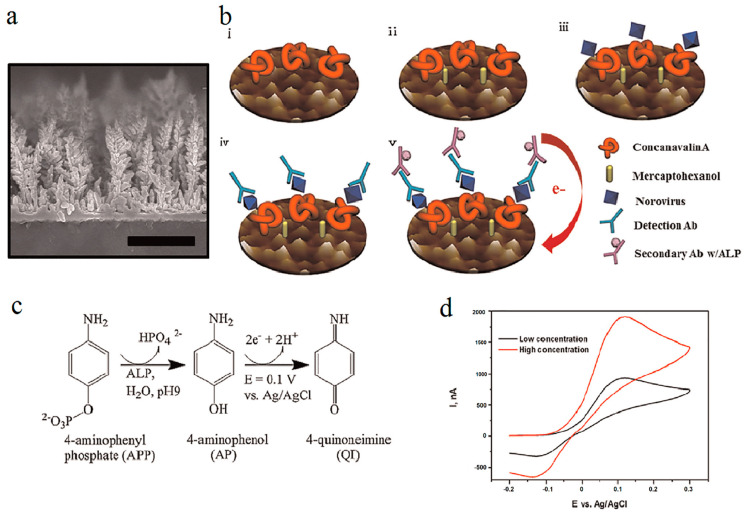
Preparation and characterization of concanavalin A (ConA)-based electrochemical biosensor. (a) The scanning electron microscope (SEM) image. (b) Schematic illustration of biosensor: (b(i)) after fixation of ConA, (b(ii)) after blocking using mercaptoethanol (MCH), (b(iii)) after norovirus fixation, (b(iv)) after fixation of first Ab, and (b(v)) after fixation of secondary Ab using (c) ALP-labeled antibody transforms APP to AP, which is then oxidized and produces a current at the electrode that is identical to the quantity of NoV bound to the sensor surface. (d) Signal reading by use of cyclic voltammetry (CV). The figure was reprinted with permission from ref. [146], Copyright 2014, Elsevier.
Figure 6
Figure 6
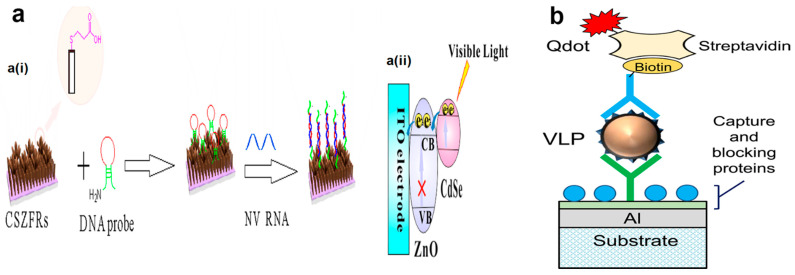
(a) A schematic presentation of (a(i)) the synthesis procedure and (a(ii)) electron transfer of CdSe–ZnO flower-rod core-shell structure (CSZFRs)-based photoelectrochemical (PEC) biosensor. (b) Schematic illustration of the surface of the V-trenches designed for detection of norovirus virus-like particle (VLP). The figures were reprinted with permission from refs. [148,149], Copyright 2018, Multidisciplinary Digital Publishing Institute (MDPI) and copyright 2017, Elsevier, respectively.

References

    1. Chow C.M., Leung A.K., Hon K.L. Acute gastroenteritis: From guidelines to real life. Clin. Exp. Gastroenterol. 2010;3:97–112. doi: 10.2147/CEG.S6554. - DOI - PMC - PubMed
    1. Wiegering V., Kaiser J., Tappe D., Weißbrich B., Morbach H., Girschick H.J. Gastroenteritis in childhood: A retrospective study of 650 hospitalized pediatric patients. Int. J. Infect. Dis. 2011;15:e401–e407. doi: 10.1016/j.ijid.2011.02.006. - DOI - PubMed
    1. Fletcher S.M., McLaws M.-L., Ellis J.T. Prevalence of Gastrointestinal Pathogens in Developed and Developing Countries: Systematic Review and Meta-Analysis. J. Public Health Res. 2013;2:e9–e53. doi: 10.4081/jphr.2013.e9. - DOI - PMC - PubMed
    1. Procop G.W. Gastrointestinal infections. Infect. Dis. Clin. 2001;15:1073–1108. doi: 10.1016/S0891-5520(05)70187-2. - DOI - PubMed
    1. Hartman S., Brown E., Loomis E., Russell H.A. Gastroenteritis in children. Am. Fam. Physician. 2019;99:159–165. - PubMed