. 2022 Jul 8;13(7):1219.
doi: 10.3390/genes13071219.

Peripheral Myelin Protein 22 Gene Mutations in Charcot-Marie-Tooth Disease Type 1E Patients

Affiliations

Peripheral Myelin Protein 22 Gene Mutations in Charcot-Marie-Tooth Disease Type 1E Patients

Na Young Jung et al. Genes (Basel). .

Abstract

Duplication and deletion of the peripheral myelin protein 22 (PMP22) gene cause Charcot-Marie-Tooth disease type 1A (CMT1A) and hereditary neuropathy with liability to pressure palsies (HNPP), respectively, while point mutations or small insertions and deletions (indels) usually cause CMT type 1E (CMT1E) or HNPP. This study was performed to identify PMP22 mutations and to analyze the genotype−phenotype correlation in Korean CMT families. By the application of whole-exome sequencing (WES) and targeted gene panel sequencing (TS), we identified 14 pathogenic or likely pathogenic PMP22 mutations in 21 families out of 850 CMT families who were negative for 17p12 (PMP22) duplication. Most mutations were located in the well-conserved transmembrane domains. Of these, eight mutations were not reported in other populations. High frequencies of de novo mutations were observed, and the mutation sites of c.68C>G and c.215C>T were suggested as the mutational hotspots. Affected individuals showed an early onset-severe phenotype and late onset-mild phenotype, and more than 40% of the CMT1E patients showed hearing loss. Physical and electrophysiological symptoms of the CMT1E patients were more severely damaged than those of CMT1A while similar to CMT1B caused by MPZ mutations. Our results will be useful for the reference data of Korean CMT1E and the molecular diagnosis of CMT1 with or without hearing loss.

Keywords: Charcot-Marie-Tooth disease type 1E (CMT1E); Korean; PMP22; point mutation; whole-exome sequencing.


Conflict of interest statement

The authors declare no conflict of interest.

Figures
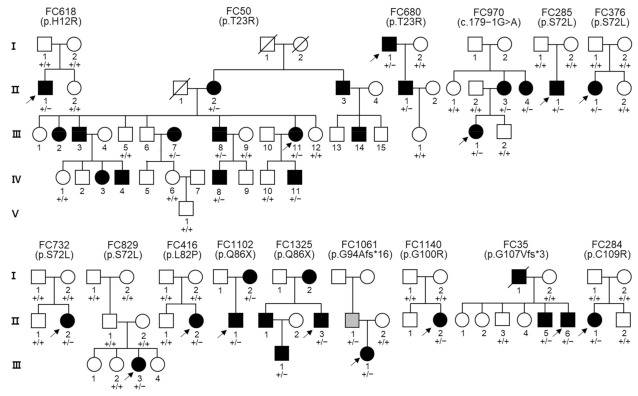
Figure 1
Figure 1
Charcot-Marie-Tooth disease type 1E families with PMP22 mutations. Genotypes of the PMP22 mutations are provided at the bottom of all examined individuals. Arrows indicate the proband and roman numerals at the left side indicate generation within each pedigree (unfilled symbols (□, ○): unaffected individuals; black-filled symbols (■, ●): affected individuals; gray-filled symbol: no symptomatic individual having mutation with mosaic condition; +: wild type allele; −: mutant allele).
Figure 2
Figure 2
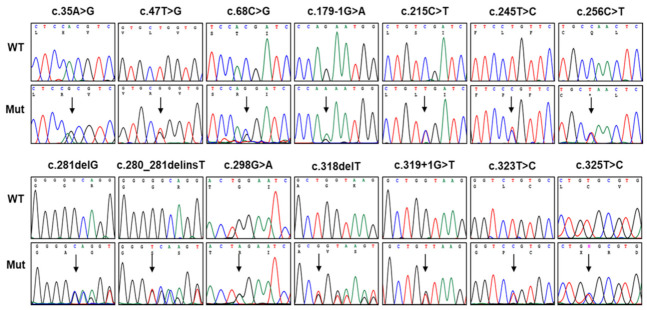
Chromatopherograms of the PMP22 mutations. They were obtained by Sanger sequencing, and the mutation sites are indicated by vertical arrows (WT: wild-type allele, Mut: mutant allele).
Figure 3
Figure 3
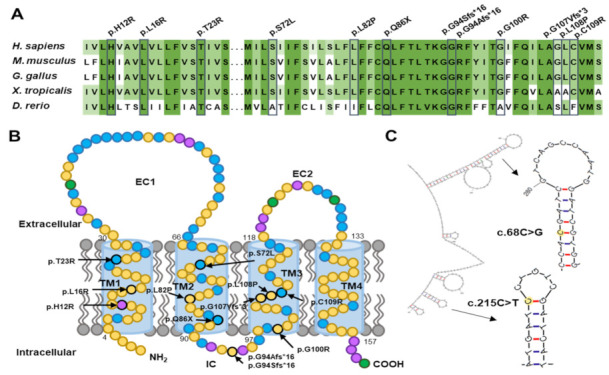
Conservation and location of mutation sites. (A) Conservation among species. Reference sequences are from NP_000295.1 (Homo sapiens), NP_001289184.1 (Mus musculus), NP_001264000.1 (Gallus gallus), NP_001025552.1 (Xenopus tropicalis), and NP_958468.1 (Danio rerio). (B) Location of mutations in a schematic PMP22 protein (EC: extracellular domain. IC: intracellular domain; TM1~4: transmembrane domain 1~4). Nonpolar, polar, basic, and acidic amino acids are indicated in yellow, blue, violet, and green, respectively. (C) Predicted secondary structures of single-strand DNA for flanking regions of c.68C>G and c.215C>T. Two nucleotides are indicated in yellow.
Figure 4
Figure 4
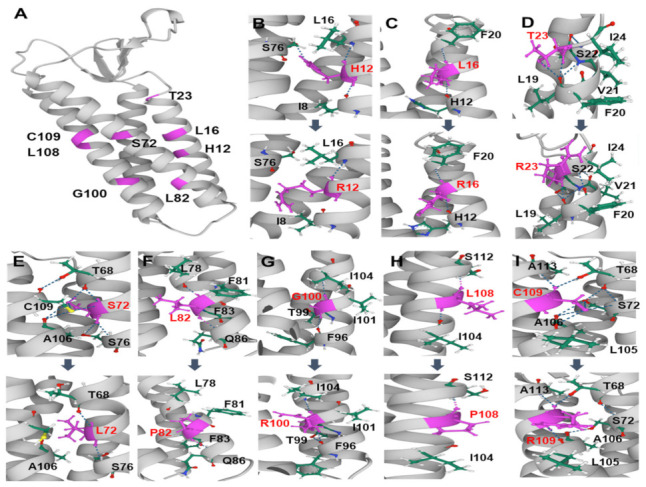
Predicted conformational changes of the PMP22 protein by mutations. The eight mutation sites are indicated in pink. Hydrogen bonds are indicated by blue dotted lines, and carbon, hydrogen, nitrogen, and oxygen are indicated in green, white, blue, and red, respectively. (A) Whole structure of the wild PMP22. (BI) Predicted conformational changes in the surrounding of the mutated residues. In each panel, the wild structure and mutant are arrayed top and bottom, respectively (B: p.H12R, C: p.L16R, D: p.T23R, E: p.S72L, F: p.L82P, G: p.G100R, H: L108P, and I: p.C109R).
Figure 5
Figure 5
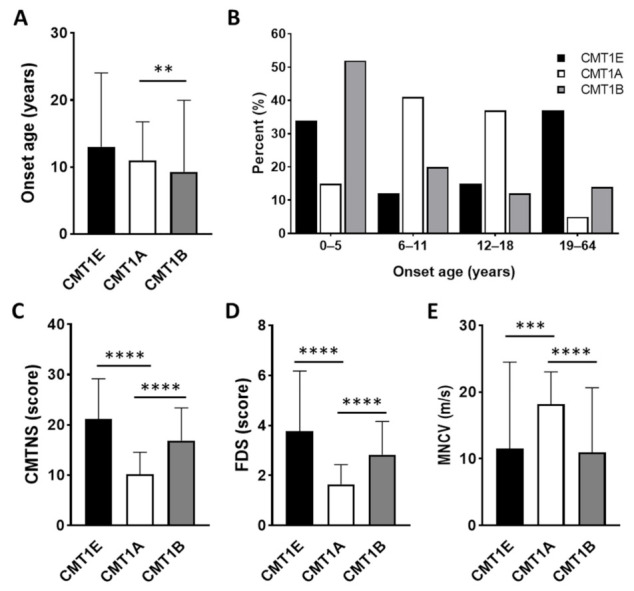
Comparison of clinical phenotypes among the Charcot-Marie-Tooth disease type 1 groups of CMT1E, CMT1A, and CMT1B (**: p ≤ 0.01, ***: p ≤ 0.001, and ****: p ≤ 0.0001). (A) Comparison of onset ages. (B) Distribution of patients by onset ages. (C) Comparison of CMTNS. (D) Comparison of FDS. (E) Comparison of median MNCV.
Figure 6
Figure 6
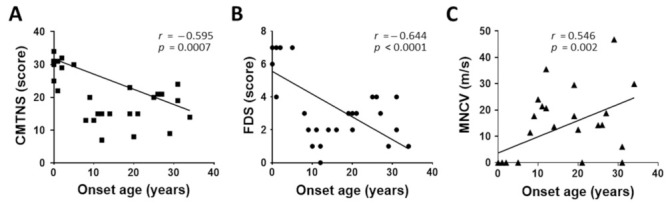
Correlations of clinical and electrophysiological phenotypes with onset ages. (A) CMTNS vs. onset age, (B) FDS vs. onset age, and (C) MNCV vs. onset age.

References

    1. Pareyson D., Scaioli V., Laurà M. Clinical and electrophysiological aspects of Charcot-Marie-Tooth disease. Neuromolecular Med. 2006;8:3–22. doi: 10.1385/NMM:8:1-2:3. - DOI - PubMed
    1. Pipis M., Rossor A.M., Laura M., Reilly M.M. Next-generation sequencing in Charcot-Marie-Tooth disease: Opportunities and challenges. Nat. Rev. Neurol. 2019;15:644–656. doi: 10.1038/s41582-019-0254-5. - DOI - PubMed
    1. Lupski J.R., Montes de Oca-Luna R., Slaugenhaupt S., Pentao L., Guzzetta V., Trask B.J., Saucedo-Cardenas O., Barker D.F., Killian J.M., Garcia C.A., et al. DNA duplication associated with Charcot-Marie-Tooth disease type 1A. Cell. 1991;66:219–232. doi: 10.1016/0092-8674(91)90613-4. - DOI - PubMed
    1. Chance P.F., Alderson M.K., Leppig K.A., Lensch M.W., Matsunami N., Smith B., Swanson P.D., Odelberg S.J., Disteche C.M., Bird T.D. DNA deletion associated with hereditary neuropathy with liability to pressure palsies. Cell. 1993;72:143–151. doi: 10.1016/0092-8674(93)90058-X. - DOI - PubMed
    1. Boerkoel C.F., Takashima H., Garcia C.A., Olney R.K., Johnson J., Berry K., Russo P., Kennedy S., Teebi A.S., Scavina M., et al. Charcot-Marie-Tooth disease and related neuropathies: Mutation distribution and genotype-phenotype correlation. Ann. Neurol. 2002;51:190–201. doi: 10.1002/ana.10089. - DOI - PubMed

Publication types

Supplementary concepts