. 2022 Jul 6;23(14):7492.
doi: 10.3390/ijms23147492.

The MexJK Multidrug Efflux Pump Is Not Involved in Acquired or Intrinsic Antibiotic Resistance in Pseudomonas aeruginosa, but Modulates the Bacterial Quorum Sensing Response

Affiliations

The MexJK Multidrug Efflux Pump Is Not Involved in Acquired or Intrinsic Antibiotic Resistance in Pseudomonas aeruginosa, but Modulates the Bacterial Quorum Sensing Response

Rafael Amieva et al. Int J Mol Sci. .

Abstract

Multidrug efflux pumps are critical elements in both intrinsic and acquired antibiotic resistance of bacterial populations. Consequently, most studies regarding these protein machineries focus on this specific phenotype. Nevertheless, different works show that efflux pumps participate in other aspects of bacterial physiology too. Herein, we study the Pseudomonas aeruginosa multidrug efflux pump MexJK. Previous studies, using model strains lacking MexAB-OprM and MexCD-OprJ efflux pumps, support that MexJK can extrude erythromycin, tetracycline, and triclosan. However, the results here reported indicate that this potential increased extrusion, in a mutant overexpressing mexJK, does not alter the antibiotics susceptibility in a wild-type genetic background where all intrinsic multidrug efflux pumps remain functional. Nevertheless, a clear impact on the quorum sensing (QS) response, mainly in the Pqs-dependent QS regulation network and in the expression of Pqs-regulated virulence factors, was observed linked to mexJK overexpression. The production of the siderophore pyoverdine strongly depended on the level of mexJK expression, suggesting that MexJK might participate in P. aeruginosa pyoverdine-dependent iron homeostasis. All in all, the results presented in the current article support that the functions of multidrug efflux pumps, as MexJK, go beyond antibiotic resistance and can modulate other relevant aspects of bacterial physiology.

Keywords: MexJK; PQS; Pseudomonas aeruginosa; antibiotic resistance; pyoverdine; quorum sensing.


Conflict of interest statement

The authors declare no conflict of interest.

Figures
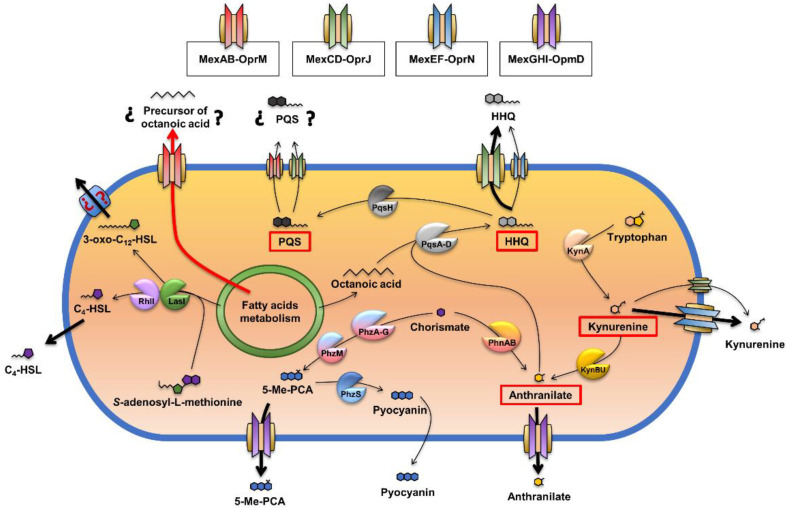
Figure 1
Figure 1
Schematic representation of the synthesis of QSSMs and their relationship with RND efflux activity in P. aeruginosa. Previous studies have shown that MexAB-OprM, MexCD-OprJ, and MexEF-OprN are efflux system able to extrude QS-related compounds, a feature that produces an impaired QS response and virulence factors production. Therefore, the overexpression of MexAB-OprM has been associated with an impaired production (not extrusion) of one of the immediate precursors of HHQ, octanoic acid, rather than with a nonphysiological extrusion of 3-oxo-C12-HSL as was initially stated [24,48]. In our work, we suggested that this lower availability of octanoic acid is probably due to the efflux of some of the intermediates in fatty acid metabolism that function as precursors of octanoate synthesis. With respect to MexCD-OprJ and MexEF-OprN, both of them are able to efflux HHQ and the AQs precursor kynurenine [23,25,49], but with different efficiency, being the extrusion of either HHQ or kynurenine most relevant in mutants that overexpress MexCD-OprJ or MexEF-OprN, respectively. Some other studies have also associated the activity of the MexGHI-OpmD efflux system with the QS network at two different levels: (i) extruding anthranilate, which is the other one immediate precursor of HHQ [26], and (ii) extruding 5-Me-PCA, the immediate precursor of pyocyanin, a QS-controlled virulence factor that in turns drives the expression of some other QS-related genes [50]. Altogether, these results support that RND efflux systems are a key element in the modulation of the QS response at different levels [19,20].
Figure 2
Figure 2
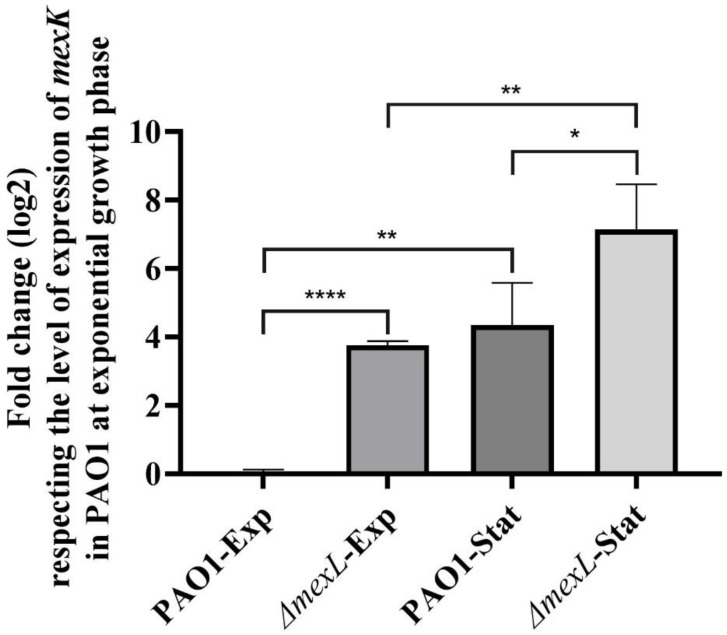
Effect of MexL and growth phase on mexJK expression. The expression of mexK was determined by RT-qPCR in both PAO1 and ΔmexL strains at stationary and exponential phases of growth. Fold change regarding the level of expression of mexK in PAO1 at exponential growth phase is presented. As shown, lack of MexL highly increased mexK expression, indicating that, in agreement with previous reports [59,60], MexL is a negative regulator of mexJK. In addition, expression was higher at stationary growth phase in both strains, indicating that growth-phase regulation of mexK expression is independent of MexL. Values that are significantly different by an unpaired two-tail t-test are indicated by asterisks as follows: * p < 0.05; ** p < 0.01; **** p < 0.0001.
Figure 3
Figure 3
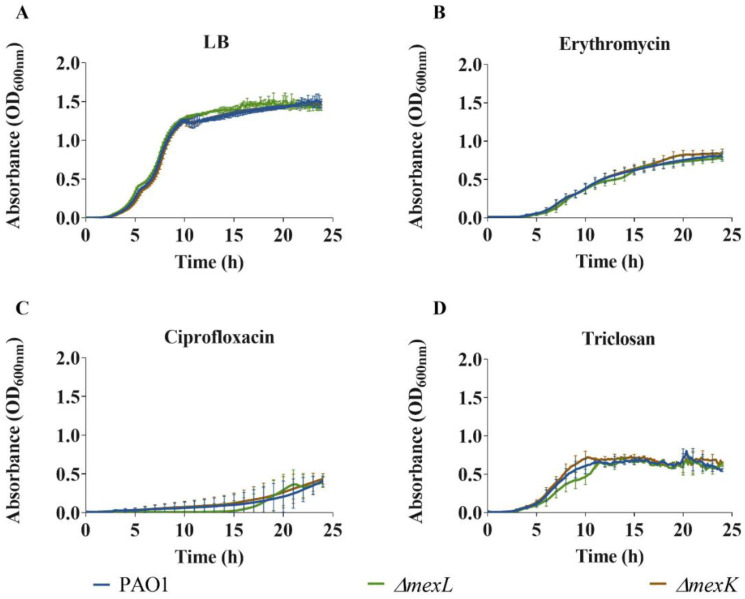
Analysis of growth in LB for PAO1, ΔmexL, and ΔmexK strains in (A) absence and in (BD) presence of antimicrobials. Growth (OD600) was measured for 24 h in the presence of compounds suggested to be MexJK substrates—(B) erythromycin and (C) triclosan—as well as in the presence of one antibiotic that has not been proved to be related to MexJK—(D) ciprofloxacin. The concentrations of the antimicrobials used were 64 μg/mL erythromycin, 0.06 μg/mL ciprofloxacin, and 109 μg/mL triclosan. Error bars indicate standard deviations for the results from three independent replicates. As shown, neither the absence nor the overexpression of mexJK produced any relevant effect on P. aeruginosa growth under the tested conditions. These data indicate that mexJK overexpression or the lack of this efflux pump does not produce a relevant effect on P. aeruginosa fitness and reinforce the idea that mexJK does not contribute to erythromycin, ciprofloxacin, or triclosan resistance in a wild-type genomic context.
Figure 4
Figure 4
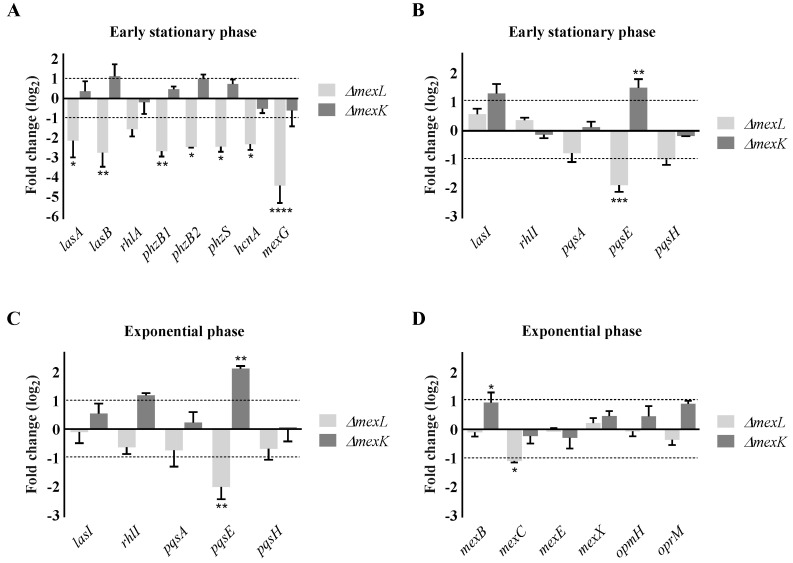
Overexpression of the MexJK efflux system affects the expression levels of QS signaling genes. Total RNA was extracted for PAO1, ΔmexL, and ΔmexK at (A,B) early stationary (OD600 = 2.5) and (C,D) exponential phases of growth (OD600 = 0.6). The expression was determined by RT-qPCR for (A) genes regulated by QS, (B,C) genes responsible for QSSMs production, and (D) genes belonging to various RND pumping systems. The figure represents the fold change of the expression of these genes in the ΔmexL or ΔmexK strains, with respect to the one observed in PAO1. Values that are significantly different by an unpaired two-tail t-test are indicated by asterisks as follows: * p < 0.05; ** p < 0.01; *** p < 0.001; **** p < 0.0001.
Figure 5
Figure 5
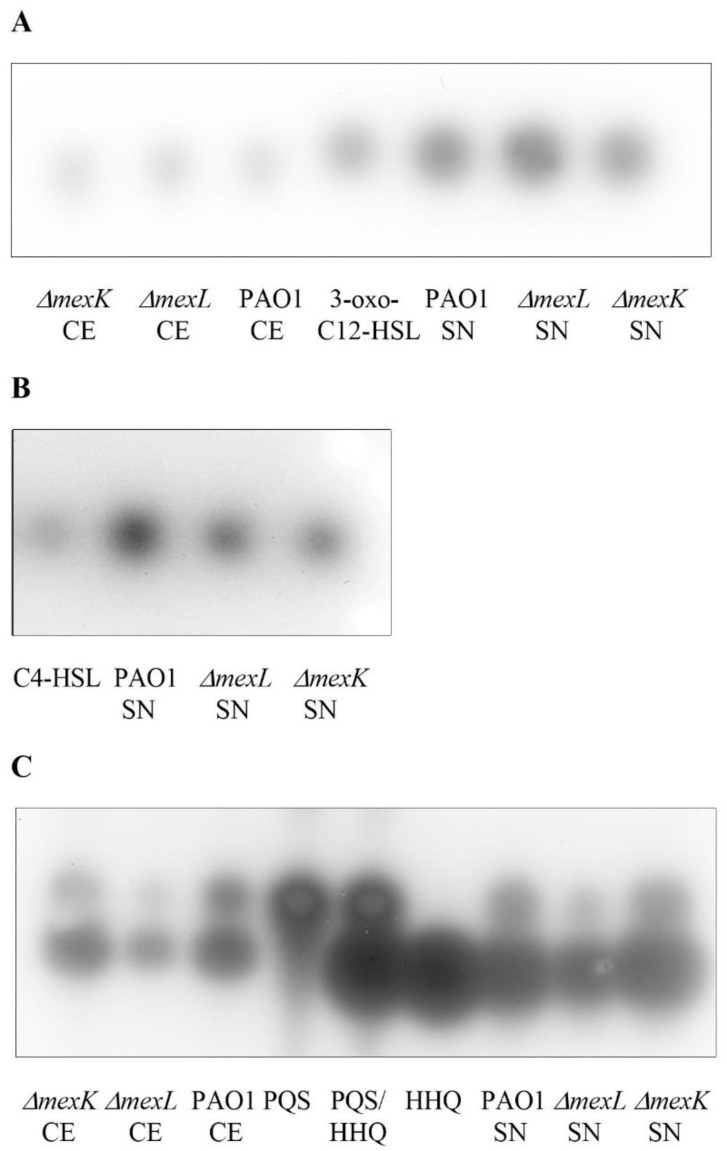
Accumulation of QSSMs both in supernatant and in cellular extracts of PAO1, ΔmexL, and ΔmexK strains grown in LB medium. Thin-layer chromatography analysis of both cell extracts (CEs) and supernatants (SNs) of PAO1, ΔmexL, and ΔmexK cultures grown to late exponential (AHLs; OD600 = 1.7) or early stationary phase (AQs; OD600 = 2.5) coupled to the growth of (A) LasR, (B) RhlR, or (C) PqsR-based biosensor strain. Since C4-HSL freely diffuses through the plasma membrane and hence should reach an equilibrium between the extracellular and intracellular levels [48], only supernatants were measured. No differences in 3-oxo-C12-HSL accumulation between the strains were observed. Although a decrease in C4-HSL accumulation was observed, this was found in both ΔmexL and ΔmexK strains, evidencing that MexJK has a minor impact on this phenotype. The lower PQS and HHQ accumulation in SN and CE of ΔmexL with respect to PAO1 and ΔmexK, was the most evident change associated with MexJK overproduction.
Figure 6
Figure 6
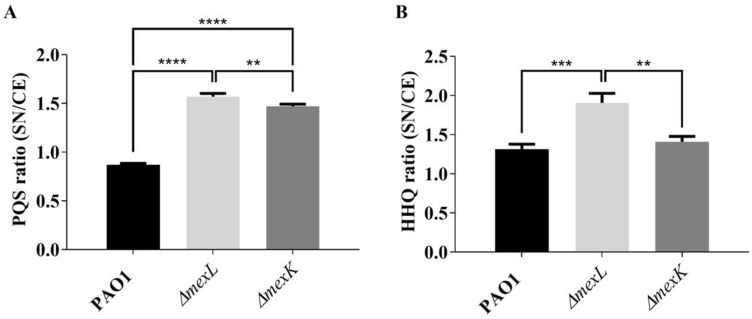
Determination of the ratio supernatant/cell extract (SN/CE) of PQS and HHQ. The TLC-spots corresponding to (A) PQS and (B) HHQ were quantified by densitometry using the ImageJ software, and the ratio between the HHQ and PQS present in the supernatant with respect to cell extract was calculated. The results showed that, although ΔmexL presented a higher PQS and HHQ ratio with respect to PAO1, only the HHQ ratio could be interpreted as a consequence of efflux pump overexpression. Values that are significantly different by an unpaired two-tail t-test are indicated by asterisks as follows: ** p < 0.01; *** p < 0.001; **** p < 0.0001.
Figure 7
Figure 7
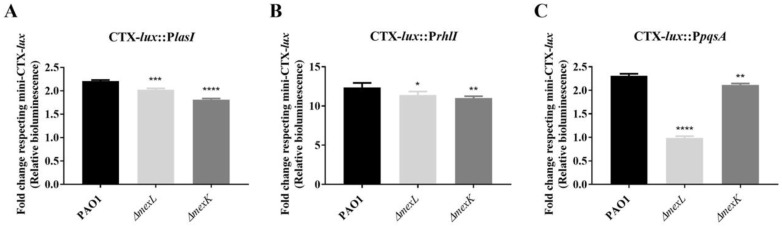
Analysis of the activation of promoters involved in QSSMs synthesis. Time-course of (A) PlasI, (B) PrhlI, and (C) PpqsA expression was analyzed in PAO1, ΔmexL, and ΔmexK strains growing in LB medium for 20 h, using a chromosomal insertion of the reporter construction of each promoter followed by the operon luxCDABE. The total area under the curve was quantified and is represented. As shown, luminesce driven by the pqsA promoter was strongly impaired in the strain that overproduces the MexJK efflux system. Values that are significantly different with respect to those obtained in the PAO1 strain by an unpaired two-tail t-test are indicated by asterisks as follows: * p < 0.05; ** p < 0.01; *** p < 0.001; **** p < 0.0001.
Figure 8
Figure 8
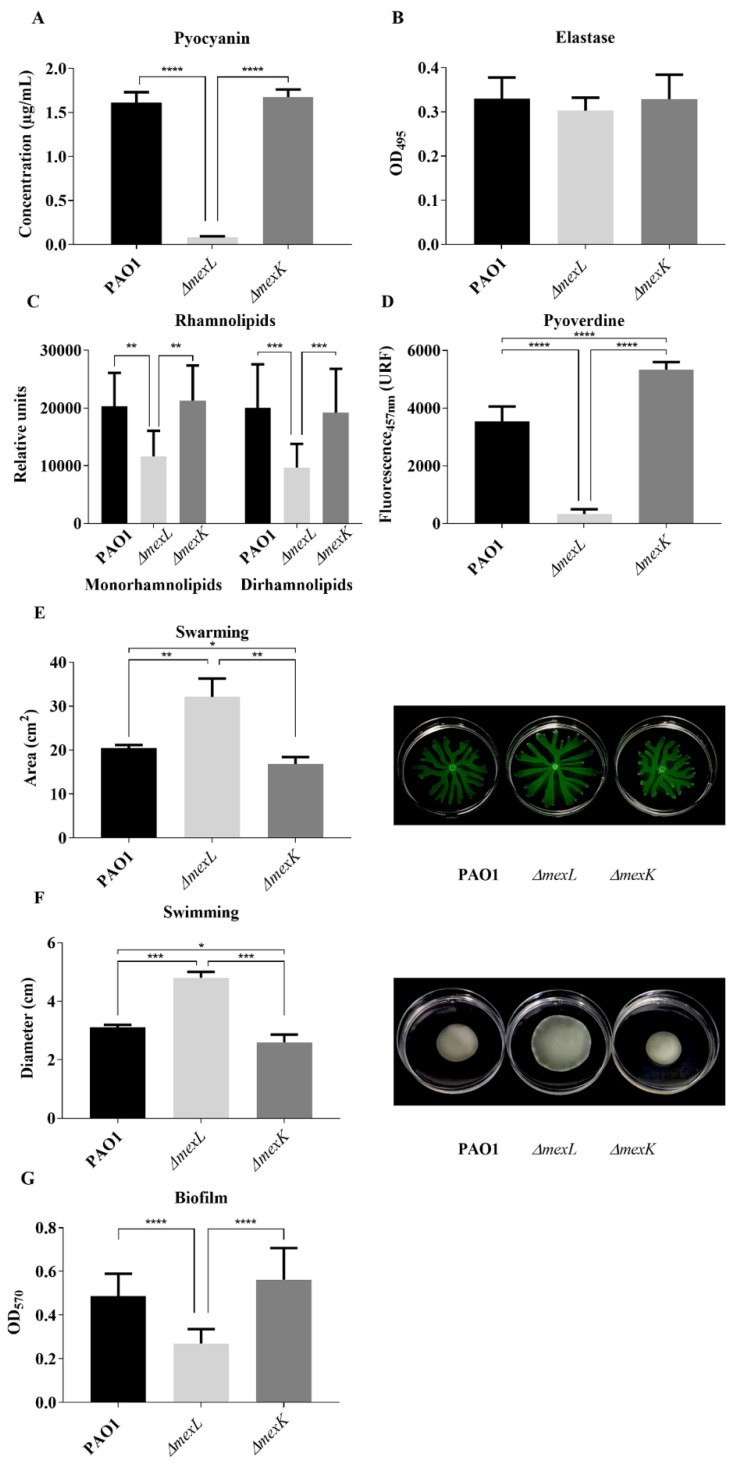
Analysis of the overexpression and deletion of the MexJK efflux pump in the production of different virulence factors regulated by QS. The production of (A) pyocyanin, (B) elastase, (C) rhamnolipids, and (D) pyoverdine was analyzed in supernatants of PAO1, ΔmexL, and ΔmexK strains grown in LB medium for 20 h. For (E) swarming and (F) swimming motility assays, a specific medium was used as described in Methods. For the analysis of (G) biofilm production, a modification of the Calgary device was used. Values that are significantly different by an unpaired two-tail t-test are indicated by asterisks as follows: * p < 0.05; ** p < 0.01; *** p < 0.001; **** p < 0.0001.

References

    1. Reynolds D., Kollef M. The Epidemiology and Pathogenesis and Treatment of Pseudomonas aeruginosa Infections: An Update. Drugs. 2021;81:2117–2131. doi: 10.1007/s40265-021-01635-6. - DOI - PMC - PubMed
    1. Martinez-Solano L., Macia M.D., Fajardo A., Oliver A., Martinez J.L. Chronic Pseudomonas aeruginosa infection in chronic obstructive pulmonary disease. Clin. Infect. Dis. 2008;47:1526–1533. doi: 10.1086/593186. - DOI - PubMed
    1. Talwalkar J.S., Murray T.S. The Approach to Pseudomonas aeruginosa in Cystic Fibrosis. Clin. Chest Med. 2016;37:69–81. doi: 10.1016/j.ccm.2015.10.004. - DOI - PubMed
    1. Sanz-García F., Gil-Gil T., Laborda P., Ochoa-Sánchez L.E., Martínez J.L., Hernando-Amado S. Coming from the Wild: Multidrug Resistant Opportunistic Pathogens Presenting a Primary, Not Human-Linked, Environmental Habitat. Int. J. Mol. Sci. 2021;22:15. - PMC - PubMed
    1. Laborda P., Sanz-García F., Hernando-Amado S., Martínez J.L. Pseudomonas aeruginosa: An antibiotic resilient pathogen with environmental origin. Curr. Opin. Microbiol. 2021;64:125–132. doi: 10.1016/j.mib.2021.09.010. - DOI - PubMed

MeSH terms

Substances

LinkOut - more resources