Review
. 2022 Jul 6;23(14):7499.
doi: 10.3390/ijms23147499.

Exploring the Links between Obesity and Psoriasis: A Comprehensive Review

Affiliations
Review

Exploring the Links between Obesity and Psoriasis: A Comprehensive Review

Gabriela Barros et al. Int J Mol Sci. .

Abstract

Obesity is a major public health issue worldwide since it is associated with the development of chronic comorbidities such as type 2 diabetes, dyslipidemias, atherosclerosis, some cancer forms and skin diseases, including psoriasis. Scientific evidence has indicated that the possible link between obesity and psoriasis may be multifactorial, highlighting dietary habits, lifestyle, certain genetic factors and the microbiome as leading factors in the progress of both pathologies because they are associated with a chronic pro-inflammatory state. Thus, inflammation management in obesity is a plausible target for psoriasis, not only because of the sick adipose tissue secretome profile but also due to the relationship of obesity with the rest of the immune derangements associated with psoriasis initiation and maintenance. Hence, this review will provide a general and molecular overview of the relationship between both pathologies and present recent therapeutic advances in treating this problem.

Keywords: adipokines; body mass index; cytokines; inflammation; microbiota; obesity; psoriasis.


Conflict of interest statement

The authors declare no conflict of interest.

Figures
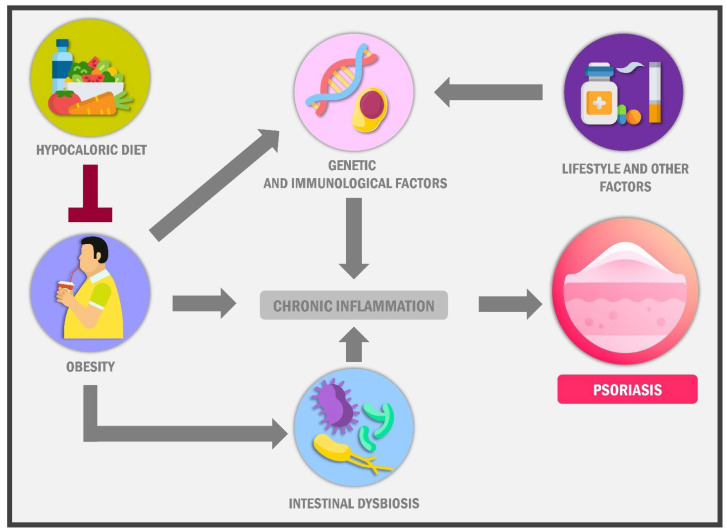
Figure 1
Figure 1
Biological factors involved in psoriasis pathophysiology. Obesity has been suggested as one of the mainstay factors of chronic inflammatory processes associated with psoriasis. Furthermore, it has been described how adipokines and pro-inflammatory cytokines contribute to psoriasis development from the sick adipose tissue. Obesity and a hypercaloric high-fat diet are linked to intestinal dysbiosis, leading to decreased intraluminal short-chain fatty acid production and local inflammation caused by the proliferation of “non-friendly” bacteria at gut epithelium leading to mucosal damage and increased permeability of gut mucosa. The damage to the gut mucosal layer subsequently causes pro-inflammatory cytokines release, leading to systemic inflammation. In turn, lifestyle factors and obesity alter gene expression and, thus, deregulation in critical immune cell functions like T-reg lymphocytes, Macrophages, and dendritic cells, exacerbating the inflammatory response. The persistence in this chronic not-solved systemic process plays a critical role in psoriasis pathogenesis.
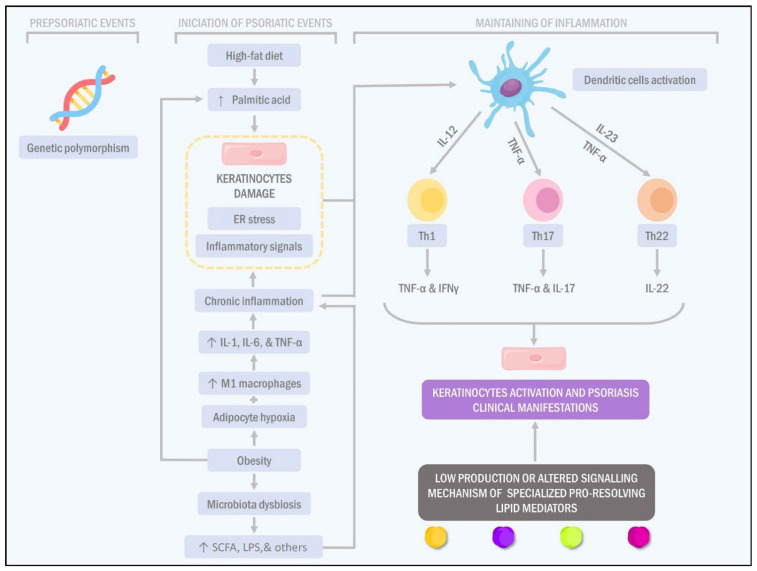
Figure 2
Figure 2
Role of obesity, high-fat diets, and inflammation in the pathophysiology of psoriasis. Psoriasis development has three stages: prior to the processes involved in the disease pathogenesis, the onset of psoriatic events and the maintenance of inflammation associated with psoriasis. Concerning the first stage, genetic polymorphisms play a crucial role. Regarding the onset of the psoriatic events, high-fat diets and obesity may increase palmitic acid levels, which is related to endoplasmic reticulum stress in keratinocytes and adipocytes, leading to a change in their secretory activity and, therefore, the establishment of inflammatory processes. In turn, obesity contributes to establishing a state of hypoxia in the adipose tissue that aggravates local inflammation, which, together with the activation of M1 macrophages, exacerbates the systemic inflammatory state. Obesity and high-fat diets are also associated with intestinal dysbiosis, which may contribute to increased intestinal permeability that allows the passage of pro-inflammatory toxic substances and immune system modulators into the bloodstream. Together, the aforementioned inflammatory processes cause damage to epithelial tissue and keratinocytes. In addition, these mechanisms are capable of activating cells of the immune lineage, such as dendritic cells and T-helper lymphocytes (Th1, Th17 and Th22). Systemic inflammation and exacerbated activation of keratinocytes cause the appearance of the psoriasis lesions. It is worth mentioning that, typically, these mechanisms tend to be resolved by the presence of inflammatory mediators such as specialised pro-resolving lipid mediators; however, their production and signalling mechanisms are altered under these conditions.

References

    1. Jensen P., Skov L. Psoriasis and Obesity. Dermatology. 2016;232:633–639. doi: 10.1159/000455840. - DOI - PubMed
    1. Su X., Cheng Y., Chang D. The Important Role of Leptin in Modulating the Risk of Dermatological Diseases. Front. Immunol. 2021;11:593564. doi: 10.3389/fimmu.2020.593564. - DOI - PMC - PubMed
    1. Kanda N., Hoashi T., Saeki H. Nutrition and Psoriasis. Int. J. Mol. Sci. 2020;21:5405. doi: 10.3390/ijms21155405. - DOI - PMC - PubMed
    1. Bonanad C., González-Parra E., Rivera R., Carrascosa J.M., Daudén E., Olveira A., Botella-Estrada R. Clinical, Diagnostic, and Therapeutic Implications in Psoriasis Associated With Cardiovascular Disease. Actas Dermosifiliogr. 2017;108:800–808. doi: 10.1016/j.ad.2016.12.023. - DOI - PubMed
    1. Timmins K.A., Leech R.D., Batt M.E., Edwards K.L. Running and Knee Osteoarthritis: A Systematic Review and Meta-analysis. Am. J. Sports Med. 2017;45:1447–1457. doi: 10.1177/0363546516657531. - DOI - PubMed