Review
. 2022 Jun 22;12(7):936.
doi: 10.3390/life12070936.

How Microbiomes Affect Skin Aging: The Updated Evidence and Current Perspectives

Affiliations
Review

How Microbiomes Affect Skin Aging: The Updated Evidence and Current Perspectives

Yanisa Ratanapokasatit et al. Life (Basel). .

Abstract

The skin has a multifactorial aging process, caused by both intrinsic and extrinsic factors. A major theory of aging involves cellular senescence or apoptosis resulting from oxidative damage as the skin's antioxidant system tends to weaken with age. The human microbiota is a complex ecosystem that is made up of microorganisms (bacteria, fungi, and viruses). Both gut and skin microbiota have essential roles in the protection against invading pathogens, mediating inflammatory conditions, and the modulation of the immune system which is involved in both innate and adaptive immune responses. However, the human microbiome could be changed during the life stage and affected by various perturbations. An alteration of the intestinal bacteria results in "microbial dysbiosis" which is associated with the influence of various diseases, including aging. The skin interactome is a novel integration of the "genome-microbiome-exposome" that plays a significant role in skin aging and skin health. Mitigating the negative impacts of factors influencing the skin interactome should be the future strategy to protect, prevent, and delay skin aging along with preserving healthy skin conditions. This review summarizes the current evidence on how human microbiomes affect skin aging and demonstrates the possible interventions, relating to human microbiomes, to modulate skin health and aging. Probiotics-based products are currently available mainly for the add-on treatment of many dermatologic conditions. However, at this point, there are limited clinical studies on skin anti-aging purposes and more are required as this evolving concept is on the rise and might provide an insight into future therapeutic options.

Keywords: aging; biology; dermatological and cosmetological treatments; dietary; microbiome; microbiota; mycobiome; pharmacology; probiotics.


Conflict of interest statement

All authors declare no personal or professional conflict of interest relating to this review article.

Figures
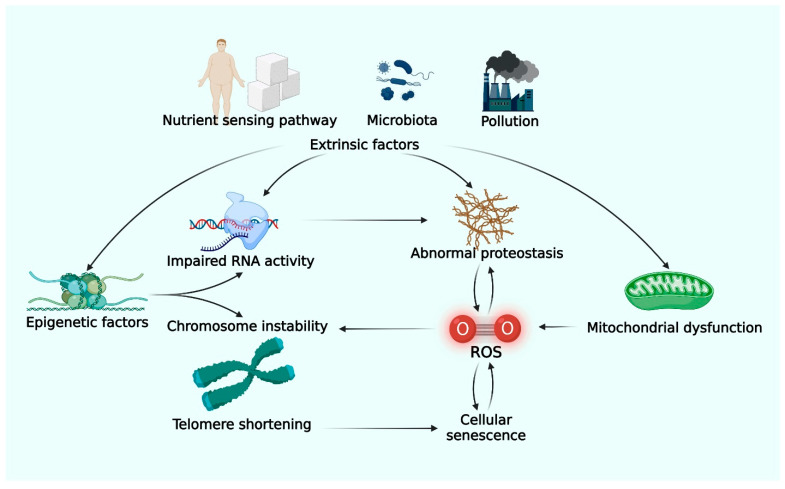
Figure 1
Figure 1
Molecular mechanism of aging. Intrinsic pathways believed to play a major role in aging are genetic and epigenetic alterations, accumulation of abnormal proteins, oxidative stress and mitochondrial dysfunction, and cellular senescence. Extrinsic factors such as pollutants, microbiota, and dietary nutrients also interact with intrinsic mechanisms and may accelerate or decelerate aging. (Created with BioRender.com) (accessed on 12 May 2022) Abbreviation: RNA; ribonucleic acid, ROS; reactive oxygen species.
Figure 2
Figure 2
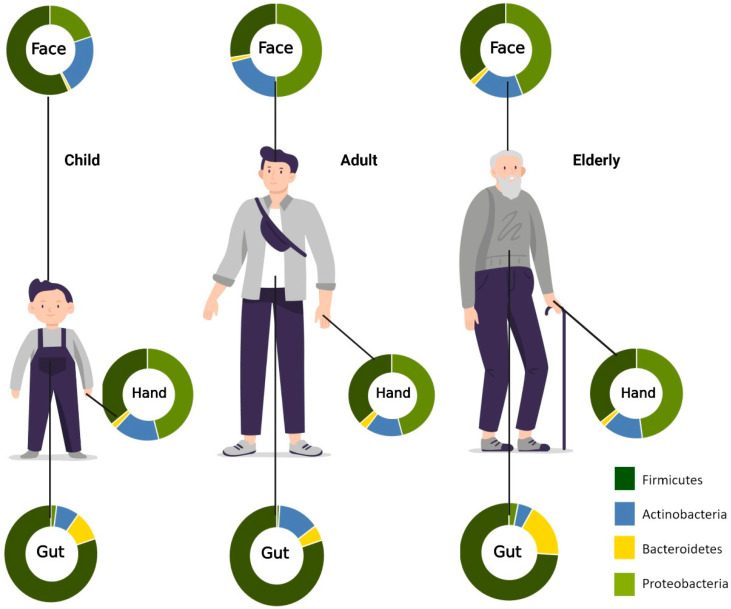
Aging-associated changes in skin and gut microbiota composition. Relative abundances of phyla on the face, hand, and gut. In the facial area, Firmicutes are most abundant in childhood, while Proteobacteria is most prominent in adulthood. For the hand microbiota, Proteobacteria was found to be the most predominant phylum from childhood to old age. Firmicutes, on the other hand, are most abundant in the gut across all age groups. (Created with BioRender.com) (accessed on 20 May 2022).
Figure 3
Figure 3
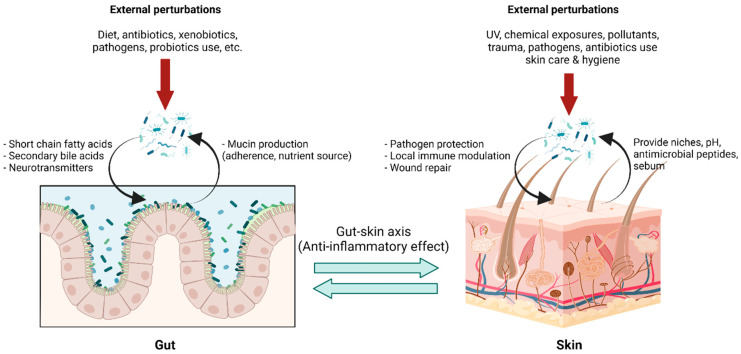
Gut-skin axis in a homeostatic state: The gut environment provides niches for gut microbiota with nutrients and optimal growth conditions, while gut microbiota carry out pleiotropic functions in maintaining body homeostasis. Microbial metabolites, for example, short-chain fatty acids, secondary bile acid, and several small molecules, not only locally maintain enterocyte functions but also exert systemic effects, including immune tolerance. This effect is linked to the skin via blood circulation, forming the so-called “gut-skin axis,” and provides an anti-inflammatory environment in the skin, optimizing interactions with skin microbiota. Skin microbiota in a homeostatic state help prevent pathogen colonization, modulating local immune responses and facilitating wound healing. Transient external perturbations, either cutaneous or mucosal, could disrupt microbiota composition, resulting in a transient dysbiosis state. The balanced microbiota could be recovered by perturbation removal, growth promotion of microbiota by proper diets, and, although in development, intervention with pro-and prebiotics. (Created with BioRender.com) (accessed on 12 May 2022). Abbreviation: pH, potential of hydrogen; UV, ultraviolet.
Figure 4
Figure 4
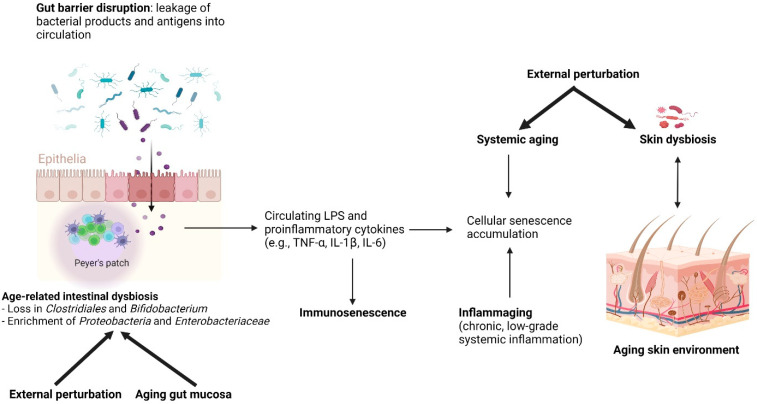
Age-related intestinal dysbiosis: Age-related intestinal dysbiosis is generally characterized by a decrease in short-chain fatty acid producers, for example, Clostridiales, and Bifidobacterium, and enrichment of pro-inflammatory Proteobacteria including the opportunistic Enterobacteriaceae. It is likely to be a result of aging gut mucosa and external factors, for example, drug use, diet, and behavioral changes. Gut dysbiosis leads to a state of “leaky gut,” described by increased permeability of the gut mucosa due to tight junction disruption, allowing a small but periodic translocation of bacterial contents into the systemic circulation. Bacterial antigen, especially lipopolysaccharide, is pro-inflammatory, increasing circulatory pro-inflammatory cytokines, for example, TNFα, IL-1β, and IL-6. Chronic exposures to pro-inflammatory bacterial antigens have been hypothesized to contribute to, in addition to the aging process, the accumulation of cellular senescence and immunosenescence, both of which lead to a state of chronic low-grade systemic inflammation called inflammaging. Inflammaging was thought to be the basis of age-related aberrant conditions, including the immune dysregulation of the skin, which consequently leads to skin microbiota dysbiosis. Skin dysbiosis is associated with several dermatological diseases, with a higher proportion of pathogen colonizers and pro-inflammatory microbiota. (Created with BioRender.com) (accessed on 18 April 2022). Abbreviation: IL, interleukin; LPS, lipopolysaccharide; TNF, tumor necrotic factor.
Figure 5
Figure 5
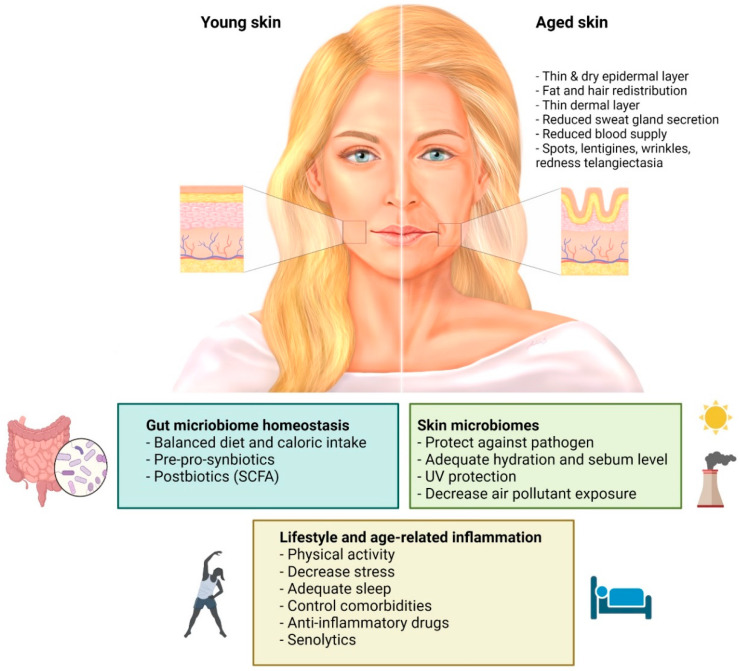
Possible microbiome-targeted intervention to prevent skin aging: Genome-microbiome-exposome play a significant role in skin aging and skin health. Age-related skin changes are attributed to combinations of internal factors, environmental factors, lifestyle factors, and skincare routines. The skin aging process results in changes in lipid composition, sebum secretion, and pH, affecting skin dryness, and collagen fragmentation, reducing the total amount of collagen and elastin, and influencing the skin microbiome. Modifying the factors that affect the skin aging process could be a possible intervention to improve skin health. Prebiotics and probiotics that act on the gut-skin axis possess many biological activities, including immunomodulatory and antioxidant activity, which can benefit skin conditions by increasing skin hydration, skin gloss, skin elasticity, and alleviating facial wrinkles. (Created with BioRender.com) (accessed on 12 May 2022). Abbreviation: SCFA, short-chain fatty acid; UV, ultraviolet radiation.

References

    1. Britannica E. Old Age. 2018. [(accessed on 19 March 2022)]. Available online: https://www.britannica.com/science/old-age.
    1. Lemoine M. The Evolution of the Hallmarks of Aging. Front. Genet. 2021;12:1511. doi: 10.3389/fgene.2021.693071. - DOI - PMC - PubMed
    1. Pyo I.S., Yun S., Yoon Y.E., Choi J.-W., Lee S.-J. Mechanisms of Aging and the Preventive Effects of Resveratrol on Age-Related Diseases. Molecules. 2020;25:4649. doi: 10.3390/molecules25204649. - DOI - PMC - PubMed
    1. Lord C.J., Ashworth A. The DNA damage response and cancer therapy. Nature. 2012;481:287–294. doi: 10.1038/nature10760. - DOI - PubMed
    1. López-Otín C., Blasco M.A., Partridge L., Serrano M., Kroemer G. The Hallmarks of Aging. Cell. 2013;153:1194–1217. doi: 10.1016/j.cell.2013.05.039. - DOI - PMC - PubMed

LinkOut - more resources