


B Vitamins and Incidence of Advanced Age-Related Macular Degeneration: The Alienor Study
- PMID: 35889778
- PMCID: PMC9318446
- DOI: 10.3390/nu14142821
B Vitamins and Incidence of Advanced Age-Related Macular Degeneration: The Alienor Study
Abstract
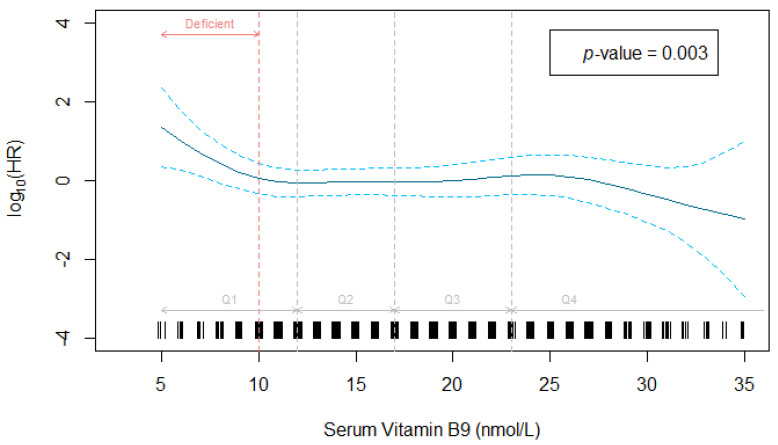
B vitamins may protect against age-related macular degeneration (AMD). We evaluated the associations of dietary intake and serum vitamins with the incidence of advanced AMD in the Alienor study. The Alienor study is a prospective population-based cohort of 963 residents of Bordeaux, France, who were 73 years or older at baseline (2006-2008). Examinations were performed every two years over an eight-year period. The incidence of AMD is based on retinal fundus photographs and spectral-domain optical coherence tomography examinations. Among the 861 included participants, 93 developed incident AMD during a median follow-up time of 9.8 years. Participants with normal serum folate (≥10 nmol/L) significantly had a 51% reduced risk for AMD in the fully adjusted Cox model (HR, 0.49 [95% CI, 0.25-0.95], p = 0.036). Participants with a higher dietary intake of B5 and B6 vitamins had a lower risk for developing AMD of up to 28% (HR, 0.72 for 1-SD increase [0.53-0.99], p = 0.049; HR, 0.90 [0.81-0.99], p = 0.049, respectively). This cohort study of older adults suggests a strong association between a normal serum folate status, a high dietary intake of B5 and B6 and a lower risk for developing advanced AMD. Adopting a healthy diet rich in B vitamins may help to reduce vision loss due to AMD.
Keywords: age-related macular degeneration; cohort; epidemiology; folate; nutrition; population; risk; vitamins B.
Conflict of interest statement
Bénédicte Merle: Travel fees from Thea Pharma. Stéphanie Barthès: none. Audrey Cougnard-Gregoire: Travel fees from Laboratoires Théa. Catherine Féart: consultant for Laboratoire Lescuyer and Synadiet, travel fees from Nutricia Research. Marie-Noëlle Delyfer: consultant for Allergan, Horus Pharma, Bayer, Laboratoires Théa, Novartis. Cécile Delcourt: consultant for Allergan, Bausch + Lomb, Laboratoires Théa, Novartis. Jean-François Korobelnik: consultant for Allergan, Bayer, Baush&Lomb, Beaver Visitec, Horus, Krys, Kanghong, NanoRetina, Novartis, Novonordisk, Oxurion, Roche, Thea. The funders had no role; in the collection, analyses, or interpretation of data; in the writing of the manuscript, or in the decision to publish the results.
Figures
References
-
- Seddon J.M., Ajani U.A., Sperduto R.D., Hiller R., Blair N., Burton T.C., Farber M.D., Gragoudas E.S., Haller J., Miller D.T., et al. Dietary carotenoids, vitamins A, C, and E, and advanced age-related macular degeneration. Eye Disease Case-Control Study Group. JAMA. 1994;272:1413–1420. doi: 10.1001/jama.1994.03520180037032. - DOI - PubMed
-
- Delcourt C., Carriere I., Delage M., Barberger-Gateau P., Schalch W., Group P.S. Plasma lutein and zeaxanthin and other carotenoids as modifiable risk factors for age-related maculopathy and cataract: The POLA Study. Invest. Ophthalmol. Vis. Sci. 2006;47:2329–2335. doi: 10.1167/iovs.05-1235. - DOI - PubMed
MeSH terms
Substances
Grants and funding
LinkOut - more resources
Full Text Sources
Medical
