. 2022 Jul 15;10(7):1125.
doi: 10.3390/vaccines10071125.

Assessment of Clinical Profile and Treatment Outcome in Vaccinated and Unvaccinated SARS-CoV-2 Infected Patients

Affiliations

Assessment of Clinical Profile and Treatment Outcome in Vaccinated and Unvaccinated SARS-CoV-2 Infected Patients

Ganesh Korishettar et al. Vaccines (Basel). .

Abstract

Vaccines against severe acute respiratory syndrome-corona virus-2 (SARS-CoV-2) infection, which causes coronavirus disease-19 (COVID-19) in humans, have been developed and are being tested for safety and efficacy. We conducted the cross-sectional prospective cohort study on 820 patients who were positive for SARS-CoV-2 and were admitted to Princess Krishnajammanni trauma care centre (PKTCC), Mysore, which was converted to a designated COVID hospital between April 2021 to July 2021. After obtaining the informed consent, RT-PCR report, vaccination certificate and patient history, patients were classified according to their vaccination status. Results from the study showed decreases in serum ferritin levels, clinical symptoms, improvement in oxygen saturation, early recovery in patients having diabetes and hypertension, and a substantial reduction in the overall duration of hospital stay in vaccinated patients compared to unvaccinated patients. Further, fully vaccinated patients showed better outcomes compared to single dose vaccinated and nonvaccinated patients. Taken together, our findings reaffirm the vaccine's effectiveness in reducing case fatality and promoting faster recovery compared to nonvaccinated patients. Efforts to increase the number of immunized subjects in the community help to achieve herd immunity and offer protection against the severity of COVID-19 and associated complications while minimizing the public health and economic burden.

Keywords: COVID-19; SARS-CoV-2; cross-sectional prospective cohort study; nonvaccinated; vaccinated.


Conflict of interest statement

The authors declare no conflict of interest.

Figures

Figure 1
Figure 1
Flow chart showing the study overview and classification of the total number of patients.
Figure 2
Figure 2
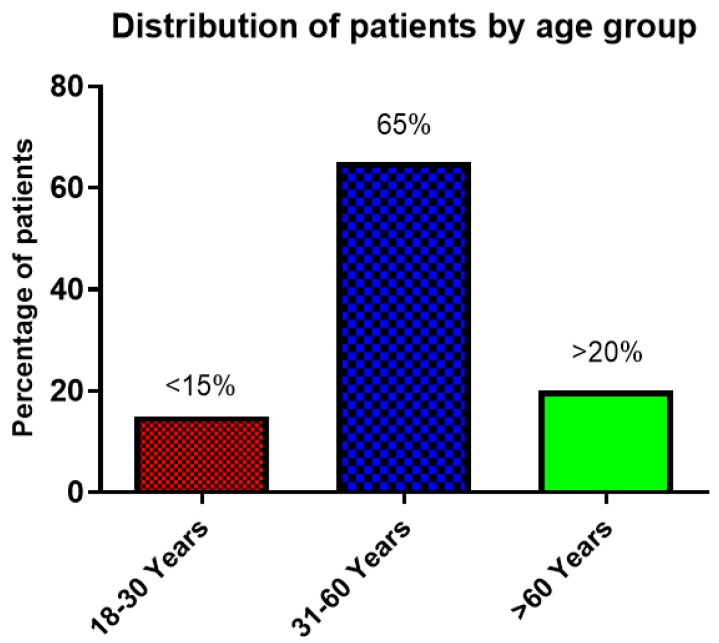
The graph shows the distribution of patients by age group.
Figure 3
Figure 3
Oxygen saturation in patients at the time of admission. The bar diagram represents the mean oxygen saturation in patients. The data is represented in Mean ± SD (Standard Deviation). Multiple comparisons were performed using one-way ANOVA with Tukey’s Post Hoc Test. * and *** represent significance (p-value < 0.05 and <0.0001) in single dose and fully vaccinated patients compared with unvaccinated patients.
Figure 4
Figure 4
The serum Ferritin levels in unvaccinated, single dose, and fully vaccinated patients. The bar diagram represents mean serum ferritin levels (Mean ± SD) in admitted patients. Multiple comparisons were performed using one-way ANOVA with Tukey’s Post Hoc Test. *** represents a significant increase (p < 0.0001) in unvaccinated patients compared to vaccinated patients.
Figure 5
Figure 5
Distribution of clinical features among unvaccinated, single dose, and fully vaccinated patients.
Figure 6
Figure 6
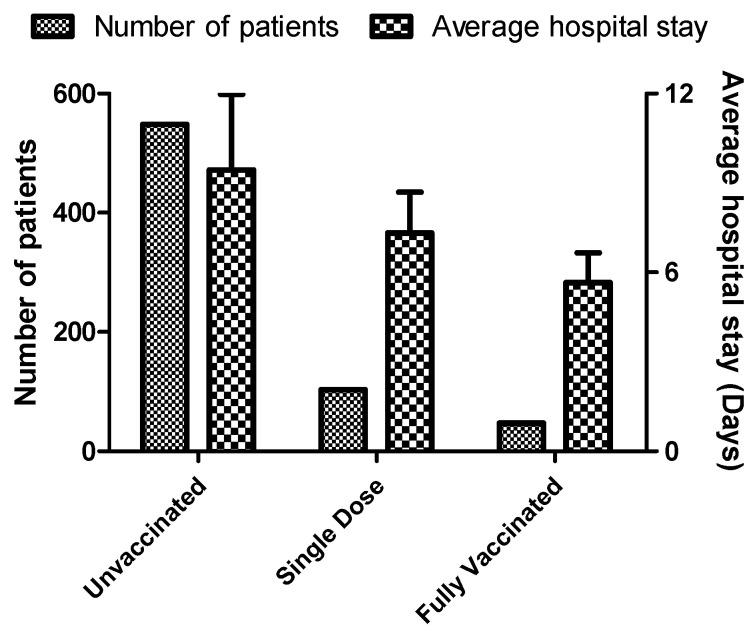
The average duration of hospital stays among vaccinated and unvaccinated patients. Data is represented in Mean ± SD.
Figure 7
Figure 7
Overall outcome in patients with diabetes and hypertension.

References

    1. Zhu N., Zhang D., Wang W., Li X., Yang B., Song J., Zhao X., Huang B., Shi W., Lu R. A novel coronavirus from patients with pneumonia in China, 2019. N. Engl. J. Med. 2020;382:727–733. doi: 10.1056/NEJMoa2001017. - DOI - PMC - PubMed
    1. World Health Organization WHO Coronavirus (COVID-19) Dashboard. [(accessed on 25 June 2022)]. Available online: https://covid19.who.int/data.
    1. Pan A., Liu L., Wang C., Guo H., Hao X., Wang Q., Huang J., He N., Yu H., Lin X. Association of public health interventions with the epidemiology of the COVID-19 outbreak in Wuhan, China. J. Am. Med. Assos. 2020;19:1915–1923. doi: 10.1001/jama.2020.6130. - DOI - PMC - PubMed
    1. Davies N.G., Klepac P., Liu Y., Prem K., Jit M., CMMID COVID-19 working group. Eggo R.M. Age-dependent effects in the transmission and control of COVID-19 epidemics. Nat. Med. 2020;26:1205–1211. doi: 10.1038/s41591-020-0962-9. - DOI - PubMed
    1. Duan L., Zheng Q., Zhang H., Niu Y., Lou Y., Wang H. The SARS-CoV-2 spike glycoprotein biosynthesis, structure, function, and antigenicity: Implications for the design of spike-based vaccine immunogens. Front. Immunol. 2020;11:576622. doi: 10.3389/fimmu.2020.576622. - DOI - PMC - PubMed

LinkOut - more resources