. 2022 Jul 12;14(7):1521.
doi: 10.3390/v14071521.

Impact of COVID-19 Lockdown on the Nasopharyngeal Microbiota of Children and Adults Self-Confined at Home

Affiliations

Impact of COVID-19 Lockdown on the Nasopharyngeal Microbiota of Children and Adults Self-Confined at Home

Muntsa Rocafort et al. Viruses. .

Abstract

The increased incidence of COVID-19 cases and deaths in Spain in March 2020 led to the declaration by the Spanish government of a state of emergency imposing strict confinement measures on the population. The objective of this study was to characterize the nasopharyngeal microbiota of children and adults and its relation to SARS-CoV-2 infection and COVID-19 severity during the pandemic lockdown in Spain. This cross-sectional study included family households located in metropolitan Barcelona, Spain, with one adult with a previous confirmed COVID-19 episode and one or more exposed co-habiting child contacts. Nasopharyngeal swabs were used to determine SARS-CoV-2 infection status, characterize the nasopharyngeal microbiota and determine common respiratory DNA/RNA viral co-infections. A total of 173 adult cases and 470 exposed children were included. Overall, a predominance of Corynebacterium and Dolosigranulum and a limited abundance of common pathobionts including Haemophilus and Streptococcus were found both among adults and children. Children with current SARS-CoV-2 infection presented higher bacterial richness and increased Fusobacterium, Streptococcus and Prevotella abundance than non-infected children. Among adults, persistent SARS-CoV-2 RNA was associated with an increased abundance of an unclassified member of the Actinomycetales order. COVID-19 severity was associated with increased Staphylococcus and reduced Dolosigranulum abundance. The stringent COVID-19 lockdown in Spain had a significant impact on the nasopharyngeal microbiota of children, reflected in the limited abundance of common respiratory pathobionts and the predominance of Corynebacterium, regardless of SARS-CoV-2 detection. COVID-19 severity in adults was associated with decreased nasopharynx levels of healthy commensal bacteria.

Keywords: COVID-19; SARS-CoV-2; adults; children; nasopharyngeal microbiota.


Conflict of interest statement

All other authors report no potential conflict. Conflicts that the editors consider relevant to the content of the manuscript have been disclosed. The funding sources had no role in writing the manuscript or in the decision to submit it for publication.

Figures
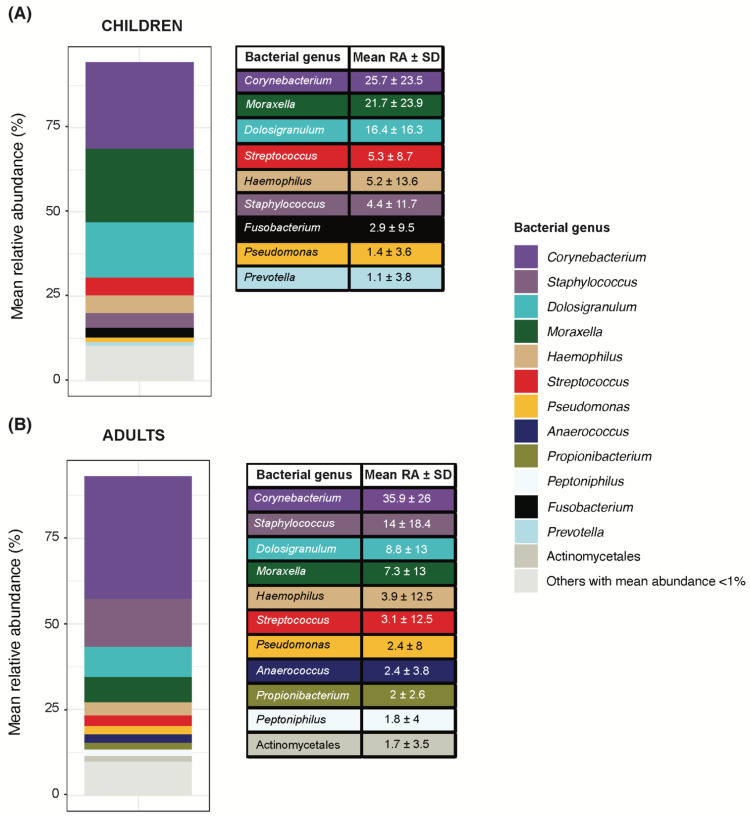
Figure 1
Figure 1
Bacterial genera composition in the nasopharynx of children and adults. Bacterial genera were filtered by a minimum of 0.01% relative abundance in at least 10% of samples within each study group (children in (A) and adults in (B)). Only bacterial genera with a mean abundance > 1% are shown in the table ranked from most to least abundant in each group. Same genera are properly identified by color coding as shown in the legend and kept consistent in the two groups. Bacterial genera whose mean relative abundance was <1% are grouped into “others”.
Figure 2
Figure 2
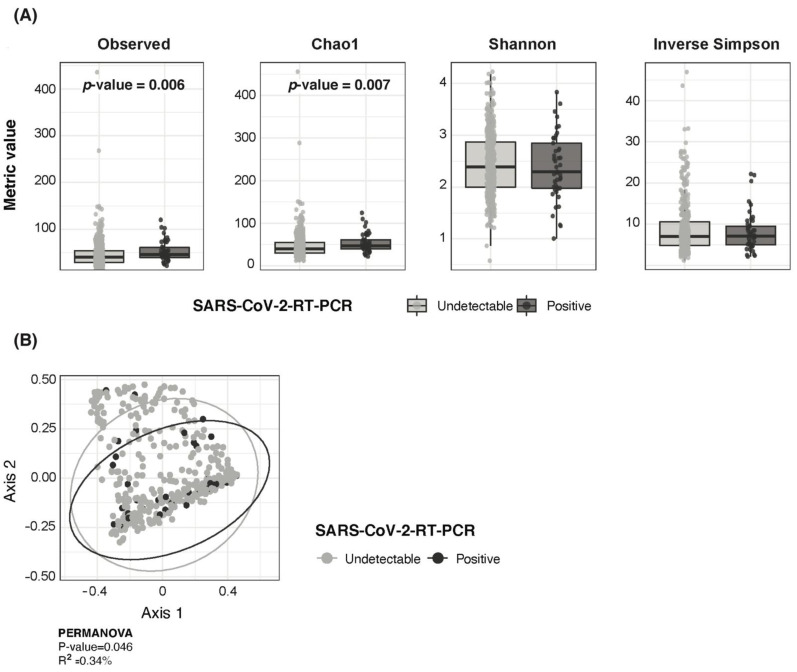
Pediatric SARS-CoV-2 infection associated with higher bacterial richness but similar diversity and overall microbiota composition. (A) Boxplots showing richness (Observed and Chao 1) diversity (Shannon and Inverse Simpson) metrics between SARS-CoV-2 RNA detection groups in children. (B) PCoA ordination analysis on Bray–Curtis ecological distance matrix showing distribution of SARS-CoV-2 positive and negative pediatric samples.
Figure 3
Figure 3
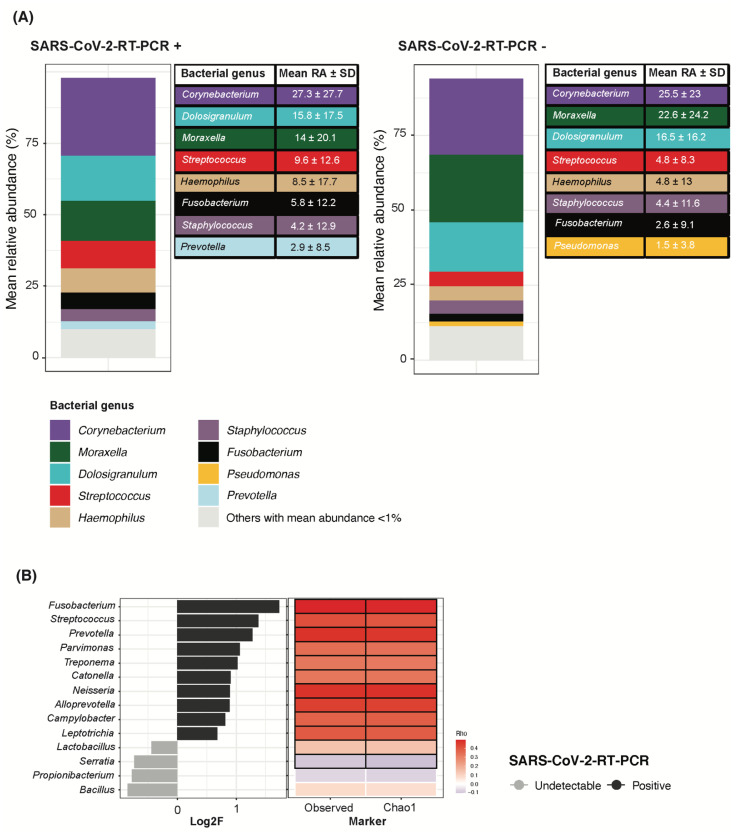
SARS-CoV-2 RNA detection in children associated to increased Fusobacterium, Streptococcus and Prevotella abundance, among others. (A) Bacterial genera were filtered by a minimum of 0.01% relative abundance in at least 10% of samples within each study group based on the SARS-CoV-2 RNA detection result. Only bacterial genera with a mean abundance > 1% are shown in the table ranked from most to least abundant in each group. Same genera are properly identified by color coding as shown in the legend and kept consistent in the two groups. Bacterial genera whose mean relative abundance was <1% are grouped into “others”. (B) Differential abundance analysis on bacterial genera. Log2F is shown along the X-axis and differential genera are colored based on the SARS-CoV-2 RNA detection group they relate to. On the right, Spearman correlations are shown between each differential bacterial genera and markers for bacterial richness. Red stands for positive correlation and blue for negative correlation. Significant Rho values are marked with a black square.
Figure 4
Figure 4
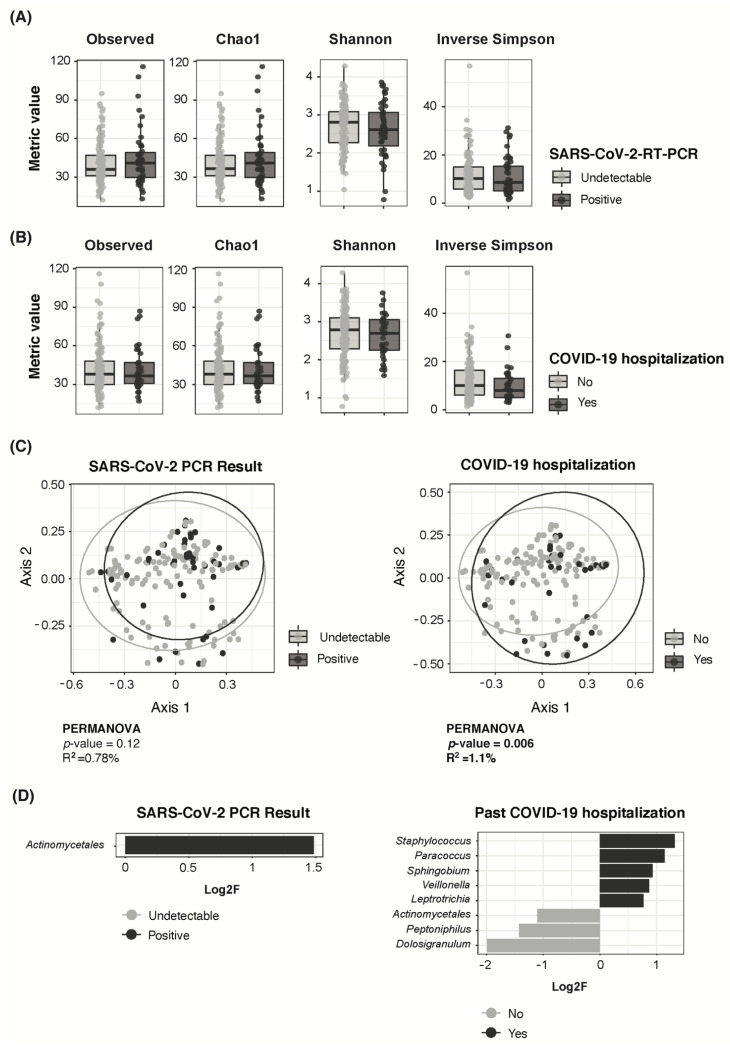
Nasopharyngeal microbiota composition in adults according to SARS-CoV-2 RNA persistence and COVID-19 severity. (A) Boxplots showing richness (Observed and Chao 1) and diversity (Shannon and Inverse Simpson) metrics between SARS-CoV-2 RNA persistence groups in adults. (B) Boxplots showing richness (Observed and Chao 1) and diversity (Shannon and Inverse Simpson) metrics by history of COVID-19-related hospitalization in adults. (C) PCoA ordination analysis on Bray–Curtis ecological distance matrix showing distribution of SARS-CoV-2 positive and negative adult samples on the left, and by history of COVID-19 hospitalization on the right. (D) Differential abundance analysis on bacterial genera by SARS-CoV-2 RNA persistence (left) or by history of COVID-19-related hospitalization (right). Log2F is shown along the X-axis and differential genera are colored based on the group they relate to.

References

    1. Zhu N., Zhang D., Wang W., Li X., Yang B., Song J., Zhao X., Huang B., Shi W., Lu R., et al. A Novel Coronavirus from Patients with Pneumonia in China, 2019. N. Engl. J. Med. 2020;382:727–733. doi: 10.1056/NEJMoa2001017. - DOI - PMC - PubMed
    1. Rosenwald M.S. History’s Deadliest Pandemics: Plague, Smallpox, Flu, Covid-19. [(accessed on 14 June 2022)]. Washington Post. Available online: https://www.washingtonpost.com/graphics/2020/local/retropolis/coronaviru...
    1. Government Decrees State of Emergency to Stop Spread of Coronavirus COVID-19 [Government/Council of Ministers] [(accessed on 14 June 2022)]; La Moncloa. Available online: https://www.lamoncloa.gob.es/lang/en/gobierno/councilministers/Paginas/2....
    1. Ahmed F., Zviedrite N., Uzicanin A. Effectiveness of workplace social distancing measures in reducing influenza transmission: A systematic review. BMC Public Health. 2018;18:518. doi: 10.1186/s12889-018-5446-1. - DOI - PMC - PubMed
    1. MacIntyre R.C., Chughta A.A. Facemasks for the prevention of infection in healthcare and community settings. BMJ. 2015;350:h694. doi: 10.1136/bmj.h694. - DOI - PubMed

Publication types