


Autologous stem cell transplantation (ASCT) for acute myeloid leukemia in patients in first complete remission after one versus two induction courses: A study from the ALWP of the EBMT
- PMID: 35891608
- PMCID: PMC9883552
- DOI: 10.1002/cam4.5039
Autologous stem cell transplantation (ASCT) for acute myeloid leukemia in patients in first complete remission after one versus two induction courses: A study from the ALWP of the EBMT
Abstract
Background: Achieving complete remission (CR) is the main goal in AML treatment and a prerequisite for successful autologous stem cell transplantation (ACT).
Methods: Comparing results of peripheral blood ACT in patients with AML in CR1 attained following 1 versus 2 chemotherapy courses transplanted in 2000-2019.
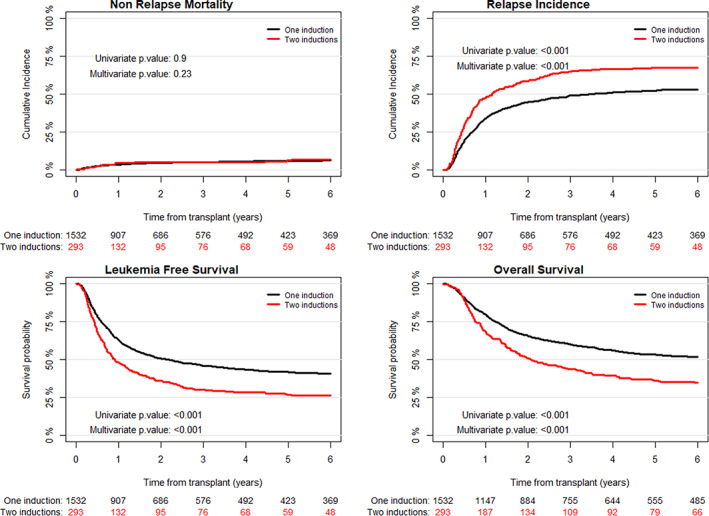
Results: Patients 1532 (84%) with one and 293 (16%) patients with two induction chemotherapies courses (a total of 1825 patients) were included in the study. Follow-up was 7.9 (95% CI: 7.4-8.4) and 7.7 (95% CI: 7.0-8.6) years (p = 0.8). Time from diagnosis to ACT was 4.7 (range, 3.9-5.8) versus 5.7 (range, 4.7-7.1) months (p < 0.001), respectively. Leukemia free survival (LFS) and overall survival (OS) at 5 years were inferior for patients achieving CR1 with 2 versus 1 course of chemotherapy: 26.6% versus 41.7% (HR = 1.42 [95% CI: 1.22-1.66], p < 0.001) and 36.2% versus 53.3%, (HR = 1.48 [95% CI: 1.25-1.75], p < 0.001), and 5-year relapse incidence (RI) was higher: 67.2% versus 52.3%, (HR = 1.46 [95% CI: 1.25-1.72], p < 0.001). Five-year non-relapse mortality (NRM) was 6.2% versus 6.0% for patients with 2 versus 1 chemotherapy courses, and did not differ significantly (HR = 1.31 [95% CI: 0.81-2.10], p = 0.27).
Conclusions: LFS and OS were inferior and relapse rate was higher in AML patients who received two inductions chemotherapy courses to reach CR1 before being autografted. AML patients who required 2 induction courses to achieve remission, may be offered allogeneic transplantation rather than an autologous one in an attempt to reduce their high RI and improve outcomes.
Keywords: acute myeloid leukemia; autologous; complete remission; induction chemotherapy; stem cell transplantation.
© 2022 The Authors. Cancer Medicine published by John Wiley & Sons Ltd.
Conflict of interest statement
The authors declare no competing financial interests.
Figures
References
-
- Gorin NC, Giebel S, Labopin M, Savani B, Mohty M, Nagler A. Autologous stem cell transplantation for adult acute leukemia in 2015: time to rethink? Present Status and Future Prospects. Bone Marrow Transplant. 2015;50(12):1495‐1502. - PubMed
-
- Cornelissen JJ, Versluis J, Passweg JR, et al, Comparative therapeutic value of post‐remission approaches in patients with acute myeloid leukemia aged 40‐60 years. Leukemia 2015, 29(5):1041–50 - PubMed
-
- Choi EJ, Lee JH, Kim H, et al. Autologous hematopoietic cell transplantation following high‐dose cytarabine consolidation for core‐binding factor‐acute myeloid leukemia in first complete remission: a phase 2 prospective trial. Int J Hematol 2021, 113(6):851–860 - PubMed
-
- Rodríguez‐Arbolí E, Martínez‐Cuadrón D, Rodríguez‐Veiga R, et al. Long‐term outcomes after autologous versus allogeneic stem cell transplantation in molecularly‐stratified patients with intermediate cytogenetic risk acute myeloid leukemia: a PETHEMA study. Transplant Cell Ther. 2021; 27(4): 311.e1‐311.e10. - PubMed
-
- Venditti A, Piciocchi A, Candoni A, et al. GIMEMA AML1310 trial of risk‐adapted, MRD‐directed therapy for young adults with newly diagnosed acute myeloid leukemia. Blood 2019; 134(12):935–945 - PubMed
MeSH terms
LinkOut - more resources
Full Text Sources
Medical
