


Different Clinical Presentations of Human Rhinovirus Species Infection in Children and Adults in Mexico
- PMID: 35891697
- PMCID: PMC9308452
- DOI: 10.1093/ofid/ofac303
Different Clinical Presentations of Human Rhinovirus Species Infection in Children and Adults in Mexico
Abstract
Background: Human rhinoviruses (HRVs) are a common cause of influenza-like illness, with the ability to infect the upper and lower respiratory tracts. In this study we aim to describe the clinical and molecular features of HRV infection in Mexican children and adults.
Methods: We performed a hospital-based, 4-year multicenter prospective observational cohort study of patients with influenza-like illness. Participants who tested positive for HRV were included. We described demographic, clinical, and laboratory characteristics and the association between HRV types, illness severity, and clinical outcomes.
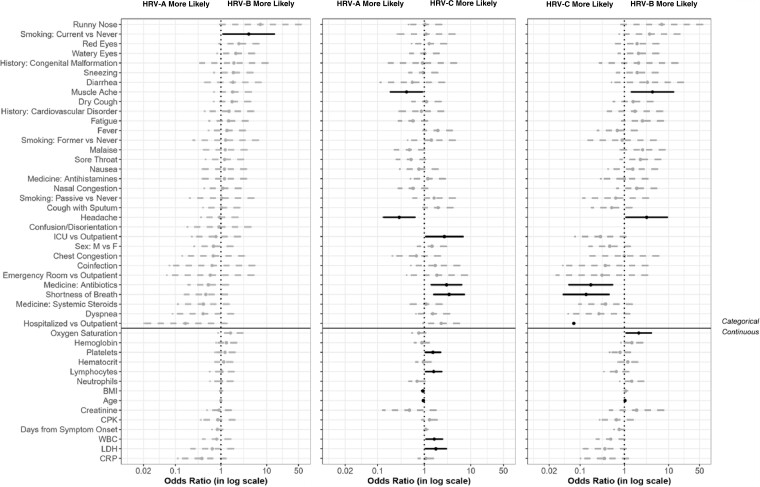
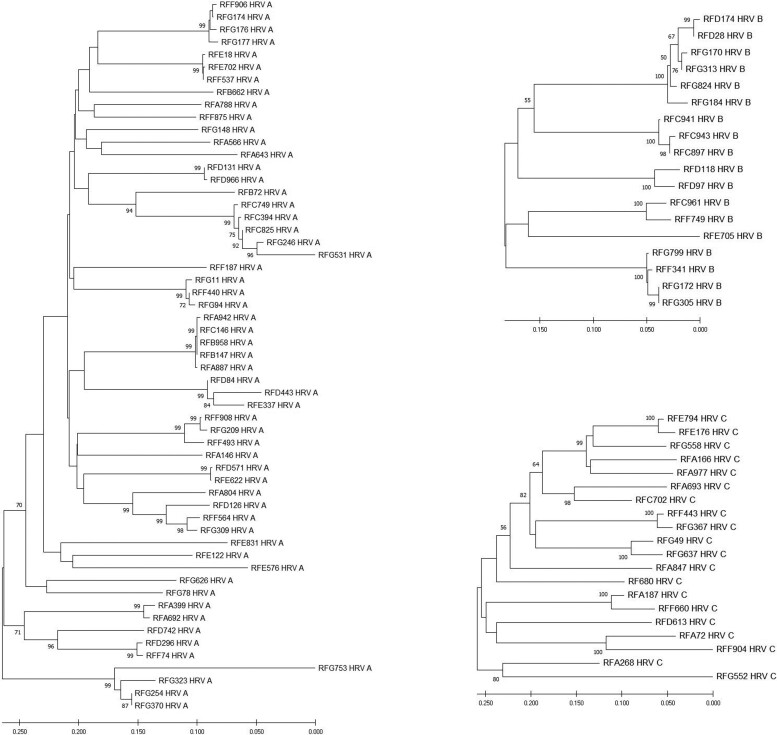
Results: Of the 5662 subjects recruited, 1473 (26%) had HRV; of those, 988 (67.1%) were adults (≥18 years) and 485 (32.9%) were children. One hundred sixty-seven (11.33%) samples were sequenced; 101 (60.5%) were rhinovirus species A (HRV-A), 22 (13.2%) were rhinovirus species B (HRV-B), and 44 (26.3%) were rhinovirus species C (HRV-C). Among children and adults, 30.5% and 23.5%, respectively, were hospitalized (non-intensive care unit [ICU]). The odds of HRV-C are higher than HRV-A for participants in the ICU (compared to outpatient) and when platelets, lymphocytes, white blood cells, and lactate dehydrogenase are increased. The odds of HRV-C are higher than HRV-A and HRV-B with shortness of breath. The odds of HRV-A are higher than HRV-B, and the odds of HRV-B are higher than HRV-C, when mild symptoms like muscle ache and headache occur.
Conclusions: Rhinoviruses are a common cause of influenza-like illness. It is necessary to improve the surveillance, testing, and species identification for these viruses to understand different clinical presentations and risk factors associated with worse outcomes. Clinical Trials Registration. NCT01418287.
Keywords: HRV species; clinical presentation; influenza-like illness; rhinovirus; severity.
© The Author(s) 2022. Published by Oxford University Press on behalf of Infectious Diseases Society of America.
Figures

References
-
- Drysdale SB, Mejias A, Ramilo O. Rhinovirus—not just the common cold. J Infect 2017; 74(Suppl 1):S41–6. - PubMed
Associated data
LinkOut - more resources
Full Text Sources
Medical
