


A Simplified Murine Model to Imitate Flexor Tendon Adhesion Formation without Suture
- PMID: 35892362
- PMCID: PMC9326731
- DOI: 10.3390/biomimetics7030092
A Simplified Murine Model to Imitate Flexor Tendon Adhesion Formation without Suture
Abstract
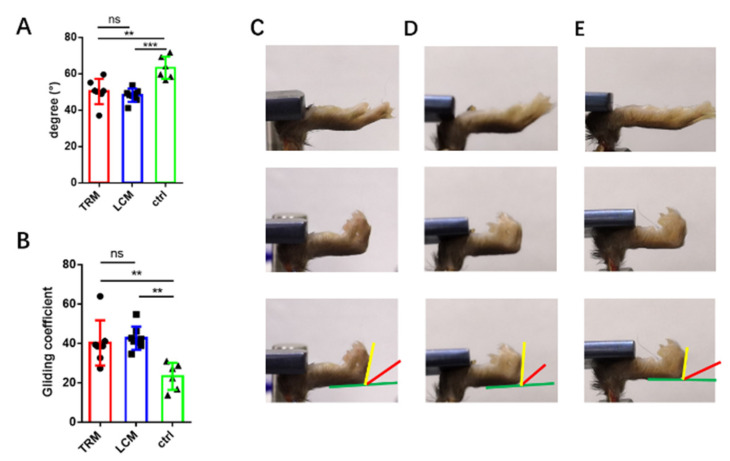
Peritendinous adhesion (PA) around tendons are daunting challenges for hand surgeons. Tenotomy with various sutures are considered classical tendon repair models (TRM) of tendon adhesion as well as tendon healing. However, potential biomimetic therapies such as anti-adhesion barriers and artificial tendon sheaths to avoid recurrence of PA are sometimes tested in these models without considering tendon healing. Thus, our aim is to create a simplified model without sutures in this study by using three 6 mm longitudinal and parallel incisions called the longitudinal incision model (LCM) in the murine flexor tendon. We found that the adhesion score of LCM has no significant difference to that in TRM. The range of motion (ROM) reveals similar adhesion formation in both TRM and LCM groups. Moreover, mRNA expression levels of collagen I and III in LCM shows no significant difference to that in TRM. The breaking force and stiffness of LCM were significantly higher than that of TRM. Therefore, LCM can imitate flexor tendon adhesion formation without sutures compared to TRM, without significant side effects on biomechanics with an easy operation.
Keywords: biomechanics; collagen deposition; flexor tendon; tendon adhesion.
Conflict of interest statement
The authors declare no conflict of interest.
Figures





References
-
- Hasslund S., Jacobson J.A., Dadali T., Basile P., Ulrich-Vinther M., Søballe K., Schwarz E.M., O’Keefe R.J., Mitten D.J., Awad H.A. Adhesions in a murine flexor tendon graft model: Autograft versus allograft reconstruction. J. Orthop. Res. 2008;26:824–833. doi: 10.1002/jor.20531. - DOI - PMC - PubMed
-
- Loiselle A.E., Frisch B.J., Wolenski M., Jacobson J.A., Calvi L.M., Schwarz E.M., Awad H.A., O’Keefe R.J. Bone Marrow-Derived Matrix Metalloproteinase-9 Is Associated with Fibrous Adhesion Formation after Murine Flexor Tendon Injury. PLoS ONE. 2012;7:e40602. doi: 10.1371/journal.pone.0040602. - DOI - PMC - PubMed
Grants and funding
- 82172408/National Natural Science Foundation of China
- 81772314/National Natural Science Foundation of China
- 81922045/National Natural Science Foundation of China
- 22ZR1480300/Original Exploration project
- 21XD1422900/Outstanding Academic Leaders (Youth) project
- No.20191829/Principle Investigator Innovation Team of Both Shanghai Sixth People's Hospital and Shanghai Institute of Nutrition and Health, Shanghai Jiao Tong University Medical College "Two-hundred Talent" Program
- No.SHDC2020CR4032/The Second Three-Year Action Plan for Promoting Clinical Skills and Clinical Innovation in Municipal Hospitals of Shanghai Shenkang
- No.20DZ2254100/Shanghai Excellent Academic Leader Program; and Shanghai Engineering Research Center for Orthopaedic Material Innovation and Tissue Regeneration
- QF 1918/"Qingfeng Scholar" for student Scientific Research Program of Shanghai Medical College, Fudan University
LinkOut - more resources
Full Text Sources
