Review
. 2022 Jul 23;12(8):678.
doi: 10.3390/metabo12080678.

NMR and Metabolomics-A Roadmap for the Future

Affiliations
Review

NMR and Metabolomics-A Roadmap for the Future

David S Wishart et al. Metabolites. .

Abstract

Metabolomics investigates global metabolic alterations associated with chemical, biological, physiological, or pathological processes. These metabolic changes are measured with various analytical platforms including liquid chromatography-mass spectrometry (LC-MS), gas chromatography-mass spectrometry (GC-MS) and nuclear magnetic resonance spectroscopy (NMR). While LC-MS methods are becoming increasingly popular in the field of metabolomics (accounting for more than 70% of published metabolomics studies to date), there are considerable benefits and advantages to NMR-based methods for metabolomic studies. In fact, according to PubMed, more than 926 papers on NMR-based metabolomics were published in 2021-the most ever published in a given year. This suggests that NMR-based metabolomics continues to grow and has plenty to offer to the scientific community. This perspective outlines the growing applications of NMR in metabolomics, highlights several recent advances in NMR technologies for metabolomics, and provides a roadmap for future advancements.

Keywords: NMR spectroscopy; advances; imaging; metabolomics; review.


Conflict of interest statement

The authors declare no conflict of interest. The funders had no role in the design of the study; in the collection, analyses, or interpretation of data; in the writing of the manuscript; or in the decision to publish the results.

Figures
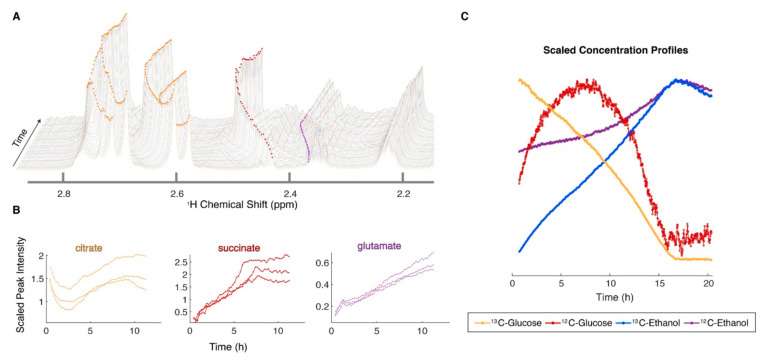
Figure 1
Figure 1
Continuous in vivo metabolism by NMR can be used to monitor the real-time growth of a microorganism under different environmental conditions. The data in (A) are from the filamentous fungus Neurospora crassa, growing in a high-resolution magic angle spinning probe at 600 MHz for about 12 h [10]. Oxygen can be introduced through a hole drilled into the cap of the NMR rotor [77]. The organism is alive at the end of the NMR experiment. The selected ridges shown in (B) were from 3 replicates and can be extracted from the NMR data using a computer vision algorithm [78] and plotted as a function of time. Isotopic substrates can also be used in this experiment (C), which allows for tracing of different pools of metabolites, as described more completely in Judge et al. [10]. Reprinted with permission from Ref. [10]. Copyright 2021 American Chemical Society.
Figure 2
Figure 2
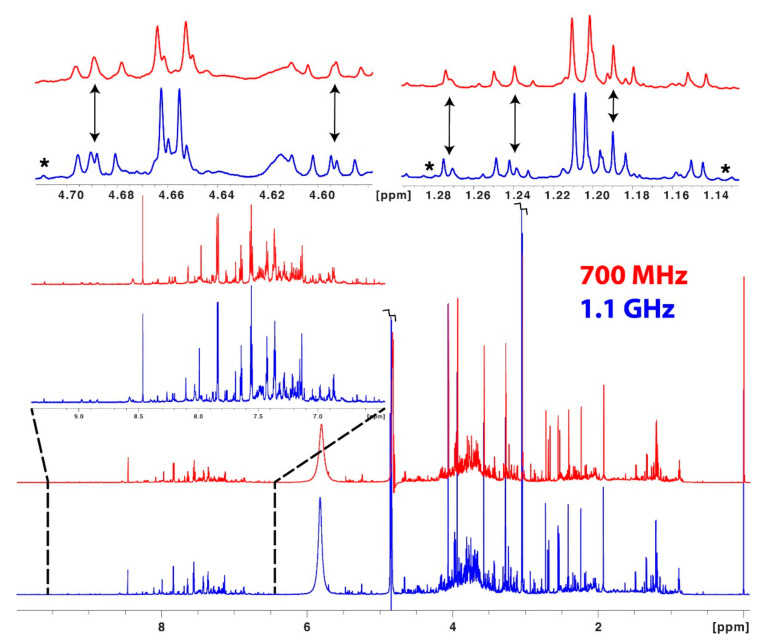
Expansions of experimental NMR data of the same sample of human urine collected in 5 mm tubes at 700 MHz (top red) and 1.1 GHz (bottom blue). For the 700 MHz data, the probe was a 5 mm quadruple resonance inverse CryoProbe (QCI-F). For the 1.1 GHz data, the probe was a 5 mm double resonance carbon-enhanced inverse (DCI) CryoProbe. The water suppression and baseline from the 1.1 GHz data are outstanding. This figure highlights some regions in which the increased chemical shift dispersion has resolved multiplets at 1.1 GHz compared to 700 MHz (indicated by arrows). There are also several small resonances that are difficult or impossible to recognize at 700 MHz that are clear at 1.1 GHz (indicated by *). Because the data were obtained with two types of probes and not fully relaxed, it is impossible to directly compare sensitivity gains across these datasets. Dr. Rainer Kuemmerle of Bruker BioSpin kindly provided the data.
Figure 3
Figure 3
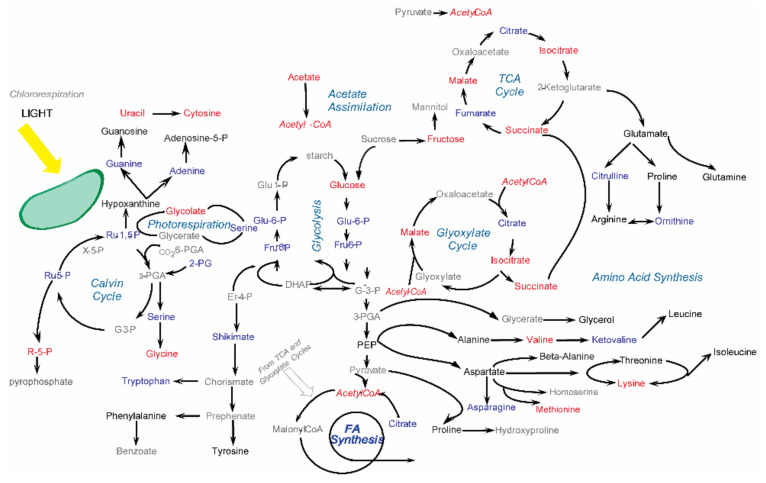
Metabolic pathway summarizing the compound-induced changes in the C. reinhardtii metabolome identified by NMR and GC-MS (metabolites of interest). Metabolites that were only identified by NMR are colored blue. Metabolites that were only identified by GC-MS are colored red. Metabolites identified by both methods are colored black, and metabolites not identified are colored grey. The total numbers of metabolites of interest within these metabolic pathways that were identified by either NMR, GC-MS, or both techniques were 14, 16 and 17 metabolites, respectively. Reprinted with permission from Ref. [134]. Copyright 2018 American Chemical Society.

References

    1. Hoult D.I., Busby S.J.W., Gadian D.G., Radda G.K., Richards R.E., Seeley P.J. Observation of tissue metabolites using phosphorus-31 nuclear magnetic resonance. Nature. 1974;252:285. doi: 10.1038/252285a0. - DOI - PubMed
    1. Shulman R.G., Brown T.R., Ugurbil K., Ogawa S., Cohen S.M., Den Hollander J.A. Cellular applications of phosphorus-31 and carbon-13 nuclear magnetic resonance. Science. 1979;205:160. doi: 10.1126/science.36664. - DOI - PubMed
    1. Gadian D.G., Radda G.K. NMR studies of tissue metabolism. Annu. Rev. Biochem. 1981;50:69–83. doi: 10.1146/annurev.bi.50.070181.000441. - DOI - PubMed
    1. Fiehn O. Metabolomics—The link between genotypes and phenotypes. Plant Mol. Biol. 2002;48:155–171. doi: 10.1023/A:1013713905833. - DOI - PubMed
    1. Yanes O., Tautenhahn R., Patti G.J., Siuzdak G. Expanding Coverage of the Metabolome for Global Metabolite Profiling. Anal. Chem. 2011;83:2152–2161. doi: 10.1021/ac102981k. - DOI - PMC - PubMed

LinkOut - more resources