


Prognostic Implications of the Novel Pulmonary Hypertension Definition in Patients with Aortic Stenosis after Transcatheter Valve Replacement
- PMID: 35893367
- PMCID: PMC9332728
- DOI: 10.3390/jcm11154279
Prognostic Implications of the Novel Pulmonary Hypertension Definition in Patients with Aortic Stenosis after Transcatheter Valve Replacement
Abstract
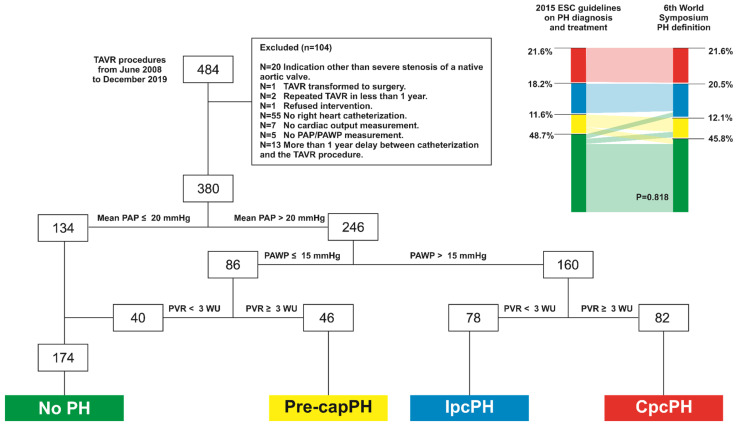
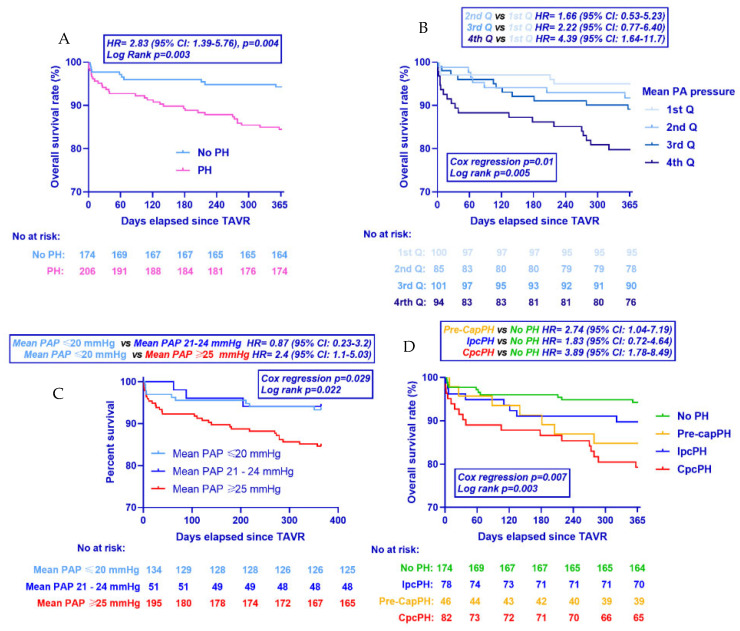
Introduction: Pulmonary hypertension (PH), traditionally defined as a mean pulmonary artery pressure (PAP) ≥ 25 mmHg, is associated with poor outcomes in patients undergoing a transcatheter aortic valve replacement (TAVR) for severe aortic stenosis (AS). Recently, a novel definition for PH has been proposed, placing the cut-off value of mean PAP at 20 mmHg, and introducing pulmonary vascular resistance as an exclusive indicator for the pre-capillary involvement. In light of the novel criteria, whether PH still preserves its prognostic significance remains unknown. Methods: The study population consisted of 380 patients with AS, who underwent a right heart catheterization before TAVR. The cohort was divided according to the presence of PH (n = 174, 45.7%) or not. Patients with PH were further divided into the following groups: (1) Pre-capillary PH ((Pre-capPH), n = 46, 12.1%); (2) Isolated post-capillary PH ((IpcPH), n = 78, 20.5%); (3) Combined pre and post-capillary PH ((CpcPH), n = 82, 21.6%). The primary endpoint was all-cause mortality at 1 year. Results: A total of 246 patients (64.7%) exhibited mean PAP > 20 mmHg. Overall, the presence of PH was associated with higher 1-year mortality rates (hazard ratio (HR) 2.8, 95% CI: 1.4−5.8, p = 0.004). Compared to patients with no PH, Pre-capPH and CpcPH (but not IpcPH) were related to higher 1-year mortality (HR 2.7, 95% CI: 1.0−7.2, p = 0.041 and HR 3.9, 95% CI: 1.8−8.5, p = 0.001, respectively). This remained significant even after the adjustment for baseline comorbidities. Conclusions: Pre-interventional PH according to the novel hemodynamic criteria, is linked with poor outcomes in patients undergoing TAVR for severe AS. However, this is mainly driven by patients with mean PAP ≥ 25 mmHg. Patients with a pre-capillary PH component as defined by increased PVR present an even worse prognosis as compared to patients with isolated post-capillary or no PH who present comparable 1-year mortality rates.
Keywords: aortic stenosis; pulmonary hypertension; transcatheter aortic valve replacement.
Conflict of interest statement
Noble Stephane has financial relations with industry (proctor for Medtronic) and has received institutional grants from Edwards Sapien, Medtronic and Abbott Vascular. The authors declare no conflict of interest.
Figures
References
-
- Alushi B., Beckhoff F., Leistner D., Franz M., Reinthaler M., Stahli B.E., Morguet A., Figulla H.R., Doenst T., Maisano F., et al. Pulmonary Hypertension in Patients with Severe Aortic Stenosis: Prognostic Impact After Transcatheter Aortic Valve Replacement: Pulmonary Hypertension in Patients Undergoing TAVR. JACC Cardiovasc. Imaging. 2019;12:591–601. doi: 10.1016/j.jcmg.2018.02.015. - DOI - PubMed
-
- Lucon A., Oger E., Bedossa M., Boulmier D., Verhoye J.P., Eltchaninoff H., Iung B., Leguerrier A., Laskar M., Leprince P., et al. Prognostic implications of pulmonary hypertension in patients with severe aortic stenosis undergoing transcatheter aortic valve implantation: Study from the FRANCE 2 Registry. Circ. Cardiovasc. Interv. 2014;7:240–247. doi: 10.1161/CIRCINTERVENTIONS.113.000482. - DOI - PubMed
-
- O’Sullivan C.J., Wenaweser P., Ceylan O., Rat-Wirtzler J., Stortecky S., Heg D., Spitzer E., Zanchin T., Praz F., Tuller D., et al. Effect of Pulmonary Hypertension Hemodynamic Presentation on Clinical Outcomes in Patients with Severe Symptomatic Aortic Valve Stenosis Undergoing Transcatheter Aortic Valve Implantation: Insights From the New Proposed Pulmonary Hypertension Classification. Circ. Cardiovasc. Interv. 2015;8:e002358. - PubMed
LinkOut - more resources
Full Text Sources
Research Materials
