Review
. 2022 Jul 26;9(8):383.
doi: 10.3390/vetsci9080383.

Canine Gastric Cancer: Current Treatment Approaches

Affiliations
Review

Canine Gastric Cancer: Current Treatment Approaches

Diana Araújo et al. Vet Sci. .

Abstract

Human gastric cancer (GC) ranks as the fifth most prevalent cancer worldwide, and is the third leading cause of cancer-related death. The incidence of GC is lower in dogs than in humans, accounting for less than 1% of all canine malignancies. In recent years, efforts have been made to understand the pathogenesis of GC and in find an appropriate therapy to maximize curative results, such as adjuvant chemotherapy treatments in addition to surgery. Although surgery is the first-line treatment, it is associated with several complications. In terms of chemotherapeutic intervention, canine gastric cancer has not received much attention, probably due to its late diagnosis, fast progression, low median survival time, and very high mortality rate, along with the lack of publications with concrete scientific results. In this review, we explore canine GC and the pharmacological approach used in the treatment of this often-fatal disease.

Keywords: anticancer drugs; canine gastric cancer; chemotherapy; human gastric cancer; resistance.


Conflict of interest statement

The authors declare no conflict of interest.

Figures
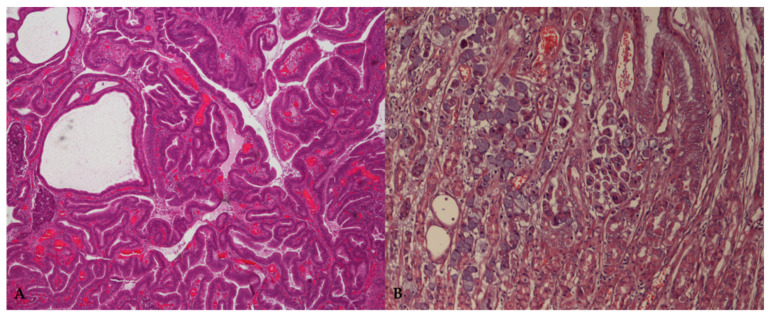
Figure 1
Figure 1
Representative microphotographs of the main histological variants of canine gastric carcinoma. (A) Tubulopapillary or intestinal type, according to the WHO and Lauren classification, respectively. HE = 40×. (B) Signet ring cell carcinoma or diffuse type, according to the WHO and Lauren classification, respectively. HE = 100×.
Figure 2
Figure 2
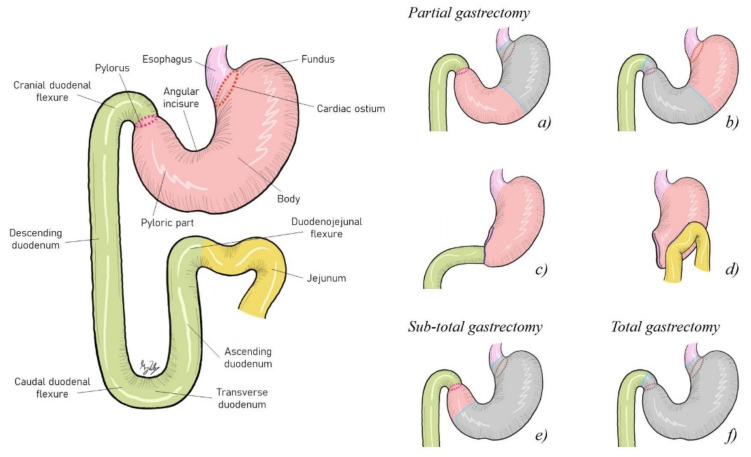
(a,b) Partial gastrectomy (≤70% of the stomach removed). (c) Billroth I (gastroduodenostomy), a reconstruction technique after partial gastrectomy. (d) Billroth II (gastrojejunostomy), a reconstruction technique after partial gastrectomy. (e) Subtotal gastrectomy (>70% but not complete stomach removal). (f): Total gastrectomy (complete stomach removal).
Figure 3
Figure 3
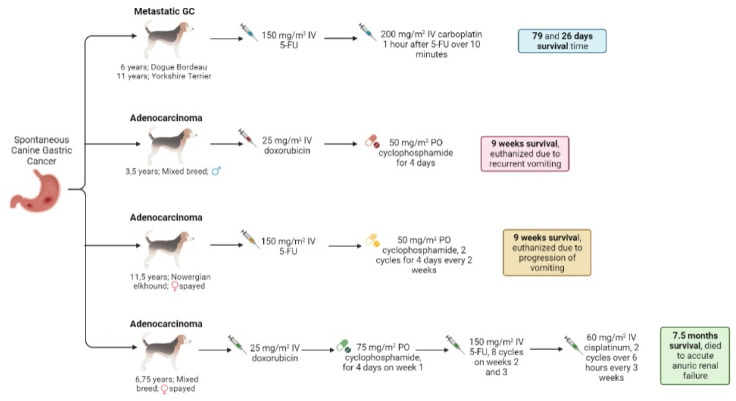
Schematic representation of the most common therapeutical schemes used for canine gastric cancer treatment, based on the available literature [4,37].

References

    1. Hugen S., Thomas R.E., German A.J., Burgener I.A., Mandigers P.J.J. Gastric carcinoma in canines and humans, a review. Vet. Comp. Oncol. 2017;15:692–705. doi: 10.1111/vco.12249. - DOI - PubMed
    1. Patnaik A.K., Hurvitz A.I., Johnson G.F. Canine gastrointestinal neoplasms. Vet. Pathol. 1977;14:547–555. doi: 10.1177/030098587701400602. - DOI - PubMed
    1. Fonda D., Gualtieri M., Scanziani E. Gastric carcinoma in the dog: A clinicopathological—Study of 11 cases. J. Small Anim. Pract. 1989;30:353–360. doi: 10.1111/j.1748-5827.1989.tb01579.x. - DOI
    1. Swann H.M., Holt D.E. Canine Gastric Adenocarcinoma and Leiomyosarcoma: A Retrospective Study of 21 Cases (1986–1999) and Literature Review. J. Am. Anim. Hosp. Assoc. 2002;38:157–164. doi: 10.5326/0380157. - DOI - PubMed
    1. Seim-Wikse T., Jörundsson E., Nødtvedt A., Grotmol T., Bjornvad C.R., Kristensen A.T., Skancke E. Breed predisposition to canine gastric carcinoma—A study based on the Norwegian canine cancer register. Acta Vet. Scand. 2013;55:25. doi: 10.1186/1751-0147-55-25. - DOI - PMC - PubMed

LinkOut - more resources