Quality and Perceived Usefulness of Patient-Submitted Store-and-Forward Teledermatology Images
- PMID: 35895039
- PMCID: PMC9330374
- DOI: 10.1001/jamadermatol.2022.2815
Quality and Perceived Usefulness of Patient-Submitted Store-and-Forward Teledermatology Images
Abstract
Importance: Patient-submitted images vary considerably in quality and usefulness. Studies that characterize patient-submitted images in a real-life setting are lacking.
Objective: To evaluate the quality and perceived usefulness of patient-submitted images as determined by dermatologists and characterize agreement of their responses.
Design, setting, and participants: This survey study included patient images submitted to the Department of Dermatology at Duke University (Durham, North Carolina) between August 1, 2018, and December 31, 2019. From a total pool of 1200 images, 10 dermatologists evaluated 200 or 400 images each, with every image being evaluated by 3 dermatologists. Data analysis occurred during the year leading up to the article being written.
Main outcomes and measures: The primary outcomes were the responses to 2 questions and were analyzed using frequency counts and interrater agreement (Fleiss κ) to assess image quality and perceived usefulness. We performed a random-effects logistic regression model to investigate factors associated with evaluators' decision-making comfort. We hypothesized that most images would be of low quality and perceived usefulness, and that interrater agreement would be poor.
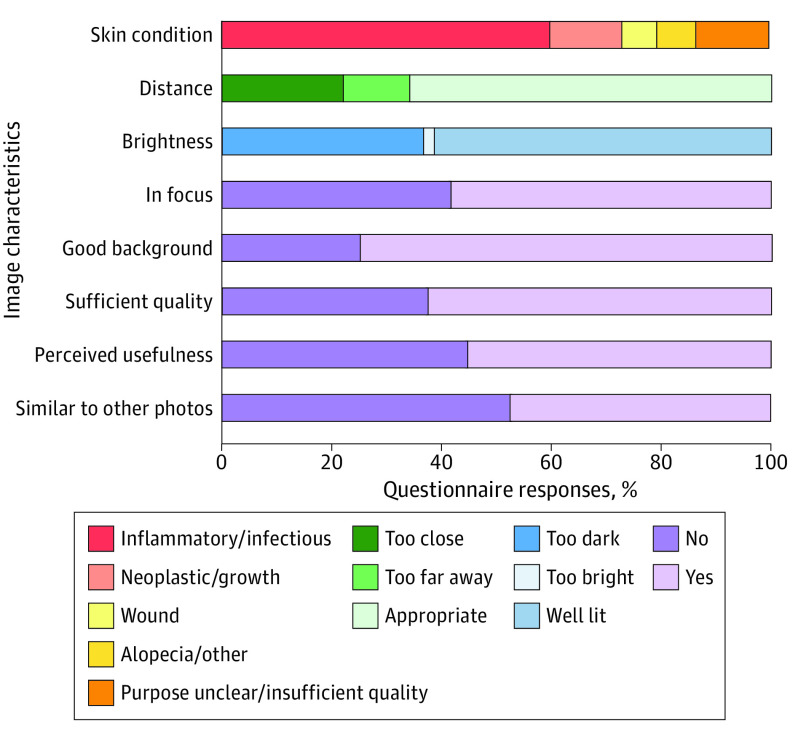
Results: A total of 259 of 2915 patient-submitted images (8.9%) did not depict a skin condition at all. The final analysis comprised 3600 unique image evaluations. Dermatologist evaluators indicated that 1985 images (55.1%) were useful for medical decision-making and 2239 (62.2%) were of sufficient quality. Interrater agreement for a given image's diagnostic categorization was fair to substantial (κ range, 0.36-0.64), while agreement on image quality (κ range, 0.35-0.47) and perceived usefulness (κ range, 0.29-0.38) were fair to moderate. Senior faculty had higher odds of feeling comfortable with medical decision-making than junior faculty (odds ratio [OR], 3.68; 95% CI, 2.9-4.66; P < .001) and residents (OR, 5.55; 95% CI, 4.38-7.04; P < .001). Images depicting wounds (OR, 1.75; 95% CI, 1.18-2.58; P = .01) compared with inflammatory skin conditions and that were in focus (OR, 5.56; 95% CI, 4.63-6.67; P < .001) had higher odds of being considered useful for decision-making.
Conclusions and relevance: In this survey study including 10 dermatologists, a slight majority of patient-submitted images were judged to be of adequate quality and perceived usefulness. Fair agreement between dermatologists was found regarding image quality and perceived usefulness, suggesting that store-and-forward teledermatology initiatives should consider a physician's individual experiences and comfort level. The study results suggest that images are most likely to be useful when they are in focus and reviewed by experienced attending physicians for wound surveillance, but dermatologists may be burdened by irrelevant or unsuitable images.
Conflict of interest statement
Figures
References
-
- Hubiche T, Valério L, Boralevi F, et al. ; Research Group of the French Society of Pediatric Dermatology Groupe de Recherche de la Société Française de Dermatologie Pédiatrique . Visualization of patients’ skin lesions on their smartphones: a new step during dermatology visits. JAMA Dermatol. 2016;152(1):95-97. doi: 10.1001/jamadermatol.2015.2977 - DOI - PubMed
-
- Harris PA, Taylor R, Thielke R, Payne J, Gonzalez N, Conde JG. Research electronic data capture (REDCap)—a metadata-driven methodology and workflow process for providing translational research informatics support. J Biomed Inform. 2009;42(2):377-381. doi: 10.1016/j.jbi.2008.08.010 - DOI - PMC - PubMed
MeSH terms
LinkOut - more resources
Full Text Sources
Medical