. 2022 Dec 1;60(6):2102962.
doi: 10.1183/13993003.02962-2021. Print 2022 Dec.

Reference equations for evaluation of spirometry function tests in South Asia, and among South Asians living in other countries

Affiliations

Reference equations for evaluation of spirometry function tests in South Asia, and among South Asians living in other countries

Wei Yee Leong et al. Eur Respir J. .

Abstract

Background: There are few data to support accurate interpretation of spirometry data in South Asia, a major global region with a high reported burden of chronic respiratory disease.

Method: We measured lung function in 7453 healthy men and women aged ≥18 years, from Bangladesh, North India, South India, Pakistan and Sri Lanka, as part of the South Asia Biobank study. First, we assessed the accuracy of existing equations for predicting normal forced vital capacity (FVC), forced expiratory volume in 1 s (FEV1) and FEV1/FVC ratio. Then, we used our data to derive (n=5589) and internally validate (n=1864) new prediction equations among South Asians, with further external validation among 339 healthy South Asians living in Singapore.

Results: The Global Lung Initiative (GLI) and National Health and Nutrition Examination Survey consistently overestimated expiratory volumes (best fit GLI-African American, mean±sd z-score: FEV1 -0.94±1.05, FVC -0.91±1.10; n=7453). Age, height and weight were strong predictors of lung function in our participants (p<0.001), and sex-specific reference equations using these three variables were highly accurate in both internal validation (z-scores: FEV1 0.03±0.99, FVC 0.04±0.97, FEV1/FVC -0.03±0.99) and external validation (z-scores: FEV1 0.31±0.99, FVC 0.24±0.97, FEV1/FVC 0.16±0.91). Further adjustment for study regions improves the model fit, with highest accuracy for estimation of region-specific lung function in South Asia.

Conclusion: We present improved equations for predicting lung function in South Asians. These offer the opportunity to enhance diagnosis and management of acute and chronic lung diseases in this major global population.


Conflict of interest statement

Conflict of interest: None declared.

Figures
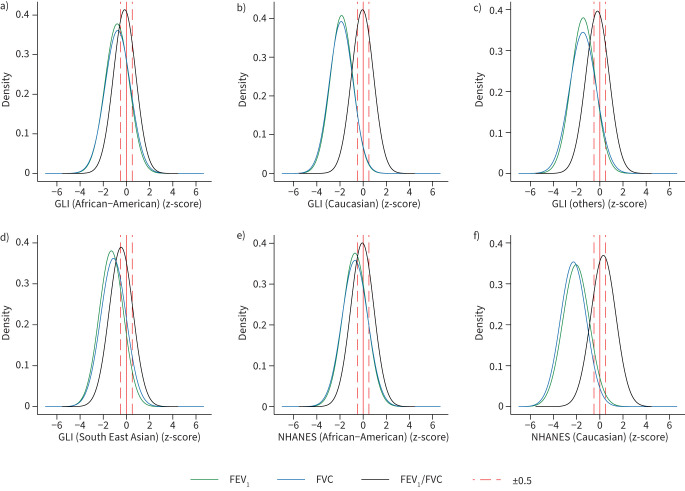
FIGURE 1
FIGURE 1
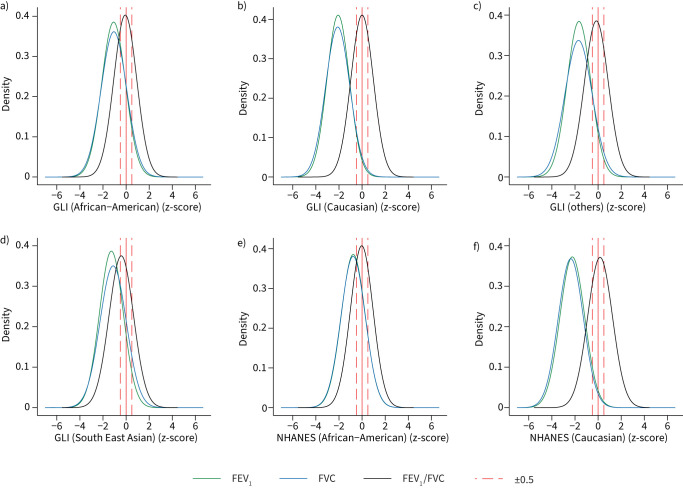
Density plots of z-scores for forced expiratory volume in 1 s (FEV1), forced vital capacity (FVC) and FEV1/FVC in males using a–d) Global Lung Initiative (GLI) 2012 and e, f) National Health and Nutrition Examination Survey (NHANES) III reference values for different ethnic groups (n=7453).
FIGURE 2
FIGURE 2
Density plots of z-scores for forced expiratory volume in 1 s (FEV1), forced vital capacity (FVC) and FEV1/FVC in females using a–d) Global Lung Initiative (GLI) 2012 and e, f) National Health and Nutrition Examination Survey (NHANES) III reference values for different ethnic groups (n=7453).
FIGURE 3
FIGURE 3
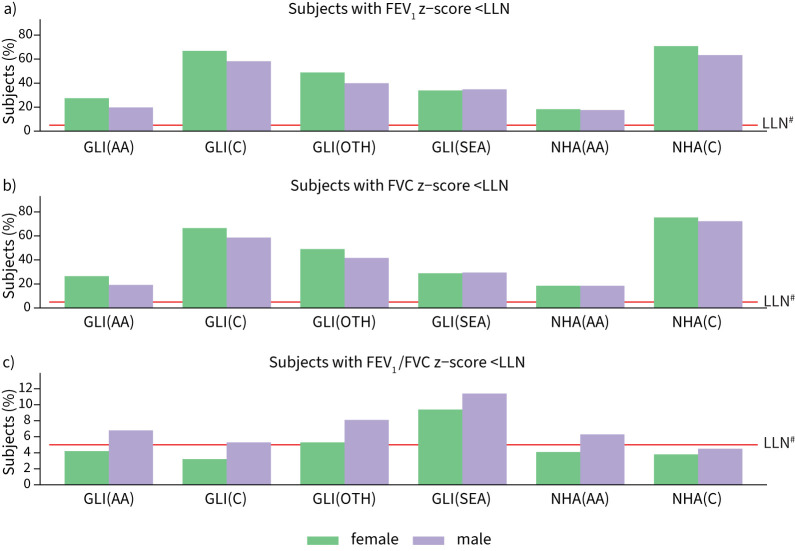
Percentage of healthy subjects categorised as below lower limit of normal (LLN) in a) forced expiratory volume in 1 s (FEV1), b) forced vital capacity (FVC) and c) FEV1/FVC using Global Lung Initiative (GLI) 2012 and National Health and Nutrition Examination Survey (NHANES) III reference values for different ethnic groups, stratified by gender (n=7453). GLI(AA): GLI 2012 (African-American); GLI(C): GLI 2012 (Caucasian); GLI(OTH): GLI 2012 (others); GLI(SEA): GLI 2012 (South-East Asian); NHA(AA): NHANES III (African-American); NHA(C): NHANES III (Caucasian). #: the expected LLN in a healthy population at 5%.
FIGURE 4
FIGURE 4
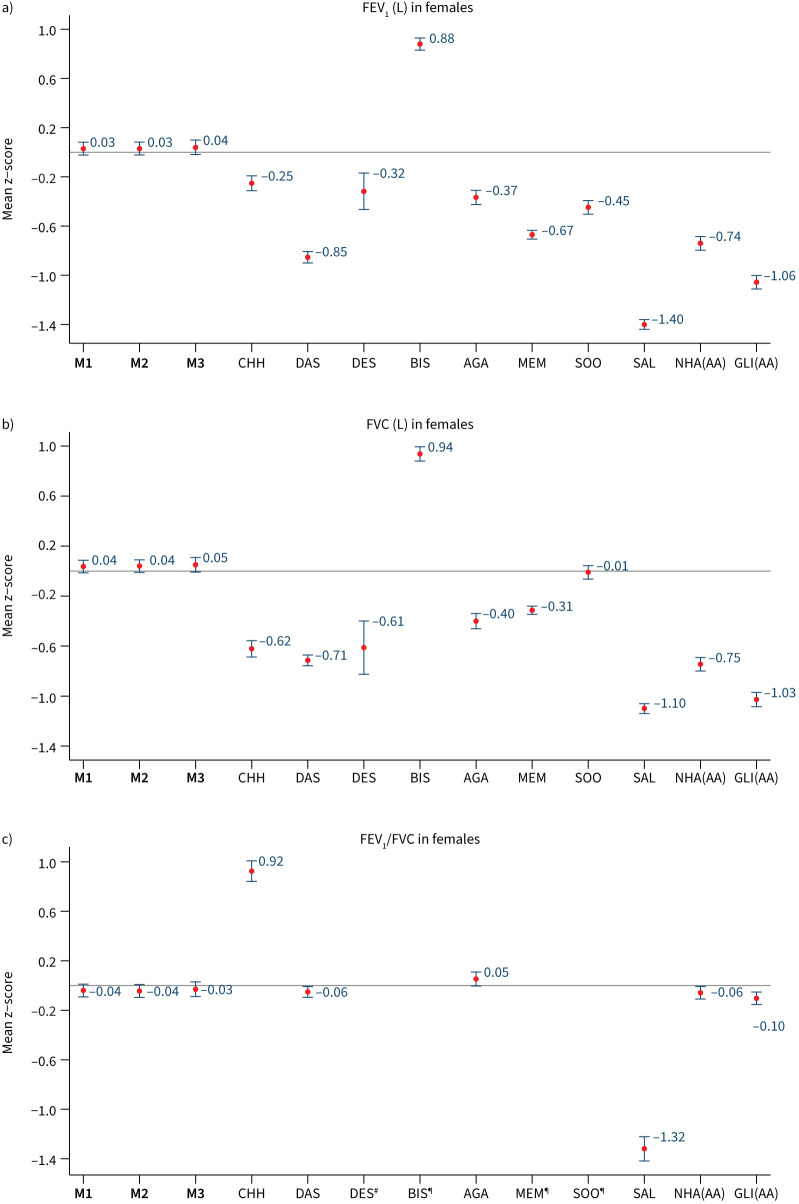
Internal validation (n=1356). Mean (95% confidence interval) of z-scores for a) forced expiratory volume in 1 s (FEV1), b) forced vital capacity (FVC) and c) FEV1/FVC in females, derived from different predictive equations. M1, M2, M3: predictive equations derived from current study; CHH: Chhabra [23]; DAS: Dasgupta [24]; DES: Desai [25]; BIS: Biswas [26]; AGA: Agarwal [27]; MEM: Memon [29]; SOO: Sooriyakanthan [28]; SAL: Saleem [22]; NHA(AA): National Health and Nutrition Examination Survey III (African-American); GLI(AA): Global Lung Initiative 2012 (African-American) #: results not shown because the value is off-scale (mean z-score −5.09, 95% CI −5.17–−5.02); : results for BIS, MEM and SOO are not available.
FIGURE 5
FIGURE 5
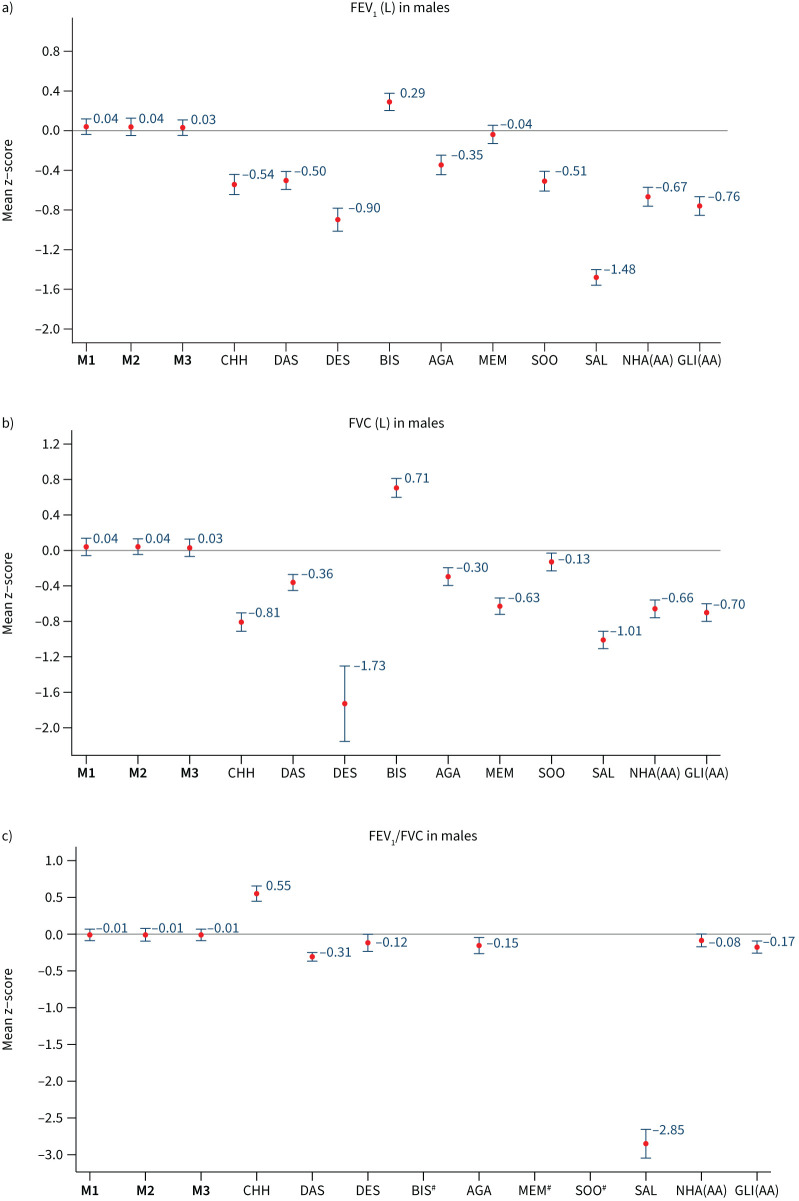
Internal validation (n=508). Mean (95% confidence interval) z-scores for a) forced expiratory volume in 1 s (FEV1), b) forced vital capacity (FVC) and c) FEV1/FVC in males, derived from different predictive equations. M1, M2, M3: predictive equations derived from current study; CHH: Chhabra [23]; DAS: Dasgupta [24]; DES: Desai [25]; BIS: Biswas [26]; AGA: Agarwal [27]; MEM: Memon [29]; SOO: Sooriyakanthan [28]; SAL: Saleem [22]; NHA(AA): National Health and Nutrition Examination Survey III (African-American); GLI(AA): Global Lung Initiative 2012 (African-American) #: results for BIS, MEM and SOO are not available.
FIGURE 6
FIGURE 6
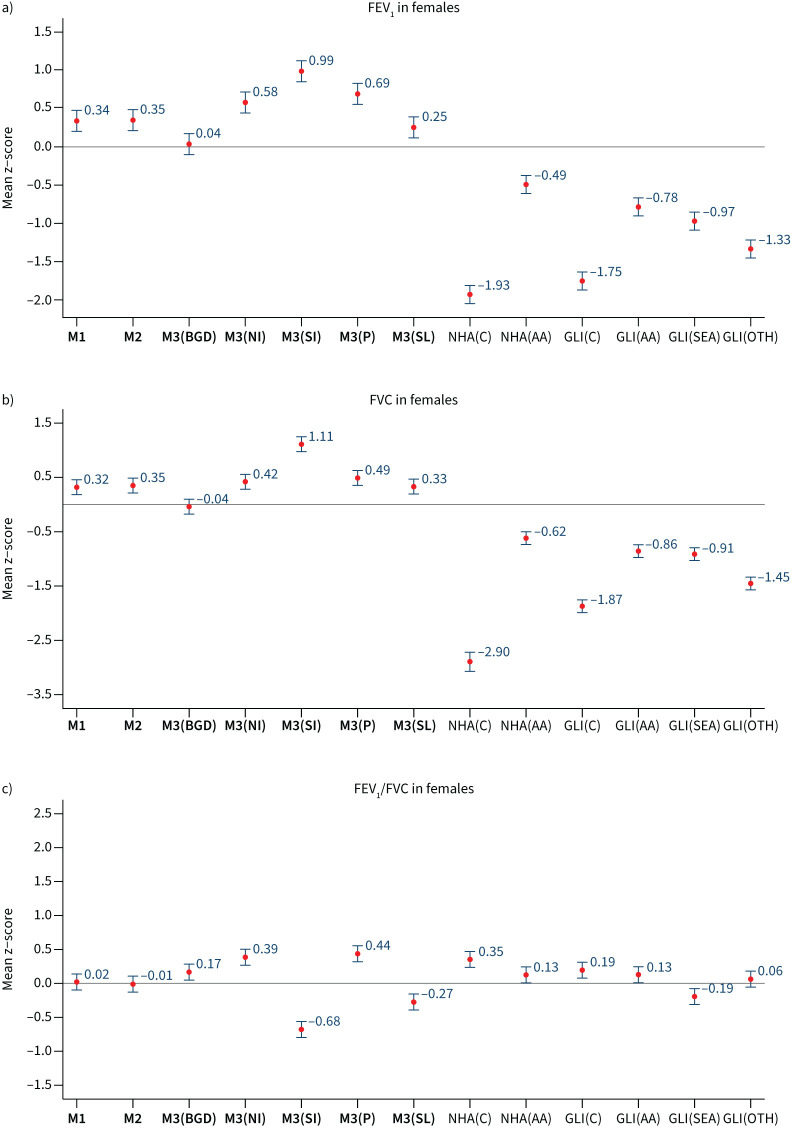
External validation (Health for Life in Singapore (HELIOS) data, n=214). Mean (95% confidence interval) z-scores for a) forced expiratory volume in 1 s (FEV1), b) forced vital capacity (FVC) and c) FEV1/FVC in females, derived from different predictive equations. M3(BGD): Bangladesh; M3(NI): North India; M3(SI): South India; M3(P): Pakistan; M3(SL): Sri Lanka; NHA(C): National Health and Nutrition Examination Survey (NHANES) III (Caucasian). NHANES and Global Lung Initiative (GLI) 2012 reference values: NHA(AA): NHANES(African-American); GLI(C): GLI(Caucasian); GLI(AA): GLI(African-American); GLI(SEA): GLI(South-East Asia); GLI(OTH): GLI(others).
FIGURE 7
FIGURE 7
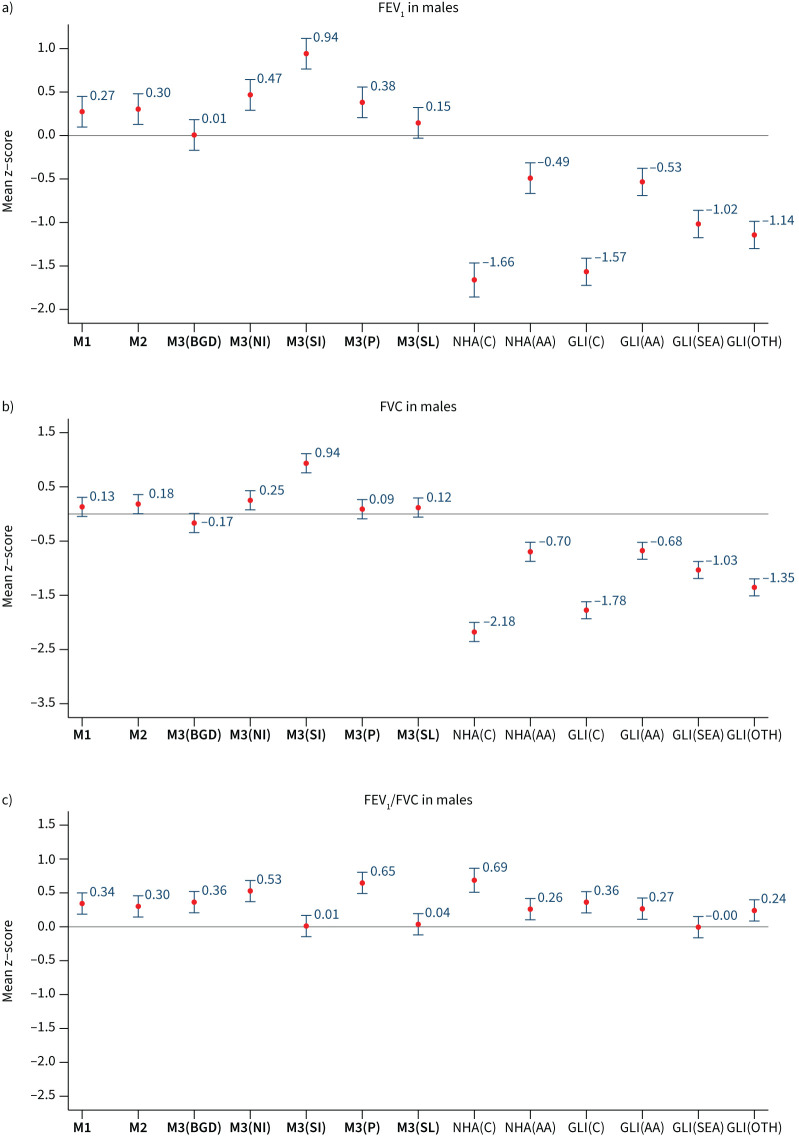
External validation (Health for Life in Singapore (HELIOS) data, n=125). Mean (95% confidence interval) z-scores for a) forced expiratory volume in 1 s (FEV1), b) forced vital capacity (FVC) and c) FEV1/FVC in males, derived from different predictive equations. M3(BGD): Bangladesh; M3(NI): North India; M3(SI): South India; M3(P): Pakistan; M3(SL): Sri Lanka; NHA(C): National Health and Nutrition Examination Survey (NHANES) III (Caucasian). NHANES and Global Lung Initiative (GLI) 2012 reference values: NHA(AA): NHANES(African-American); GLI(C): GLI(Caucasian); GLI(AA): GLI(African-American); GLI(SEA): GLI(South-East Asia); GLI(OTH): GLI(others).

Comment in

References

    1. Menezes AMB, Wehrmeister FC, Hartwig FP, et al. . African ancestry, lung function and the effect of genetics. Eur Respir J 2015; 45: 1582–1589. doi:10.1183/09031936.00112114 - DOI - PMC - PubMed
    1. Braun L. Race, ethnicity and lung function: a brief history. Can J Respir Ther 2015; 51: 99–101. - PMC - PubMed
    1. Hankinson JL, Kinsley KB, Wagner GR. Comparison of spirometric reference values for Caucasian and African American blue-collar workers. J Occup Environ Med 1996; 38: 137–143. doi:10.1097/00043764-199602000-00011 - DOI - PubMed
    1. Hall GL, Cooper BG. Increasing diversity within the Global Lung Function Initiative. Respirology 2018; 23: 1090–1091. doi:10.1111/resp.13373 - DOI - PubMed
    1. Duong ML, Islam S, Rangarajan S, et al. . Global differences in lung function by region (PURE): an international, community-based prospective study. Lancet Respir Med 2013; 1: 599–609. doi:10.1016/S2213-2600(13)70164-4 - DOI - PubMed

Publication types

LinkOut - more resources