Analysis of Pulmonary Function in Thymoma Subjects: A 20-Year Retrospective Cohort Study
- PMID: 35896441
- PMCID: PMC10411097
- DOI: 10.1055/s-0042-1749320
Analysis of Pulmonary Function in Thymoma Subjects: A 20-Year Retrospective Cohort Study
Abstract
Background: Thymoma is the most common tumor of the anterior mediastinum. However, the correlation between thymoma stage and pulmonary function was not assessed. Our objective in this study was to describe the pulmonary function in thymoma subjects stratified with different staging systems.
Methods: A total of 143 subjects with a diagnosis of thymoma who underwent extended thymectomy for thymoma between January 2001 and December 2019 were reviewed retrospectively. All the subjects experienced pulmonary function tests (PFTs) using Master Screen PFT system and total respiratory resistance measurement.
Results: We evaluated 143 subjects with a diagnosis of thymoma; the significant differences were observed in mean values of vital capacity, inspiratory volume (IC), total lung capacity (TLC), ratio of residual volume to total lung capacity (RV/TLC), forced vital capacity, forced expiratory volume in 1 second, ratio of forced expiratory volume in 1 second to forced vital capacity, peak expiratory flow, peak inspiratory flow, maximum ventilation volume, total airway resistance, and diffusing capacity for carbon monoxide (DLCO) across upper airway obstruction classification. PFTs of subjects with varying Masaoka stages are different. RV and RV/TLC of subjects in stages III and IV were higher than those of normal level, while DLCO of subjects in stage IV was lower than the normal level, and the mean level of IC showed significant difference between stage II and stage III.
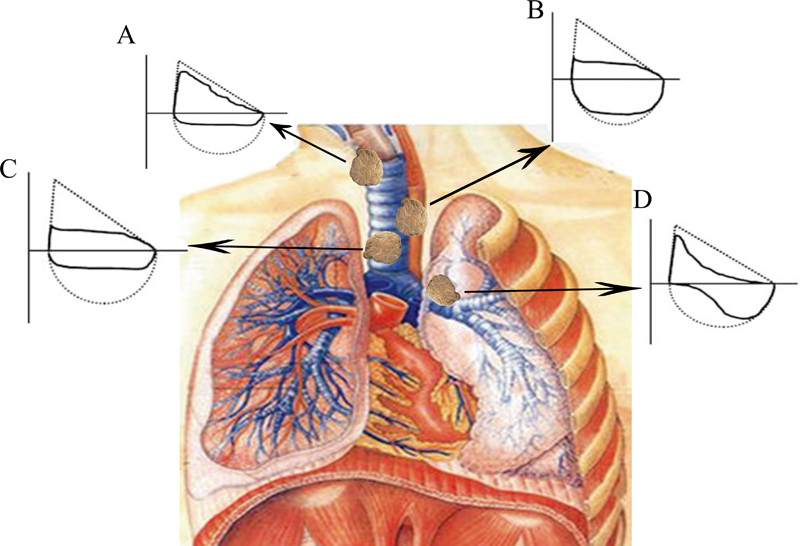
Discussion: The pulmonary function patterns of thymoma subjects significantly correlate with tumor location and size rather than clinical Masaoka stage.
The Author(s). This is an open access article published by Thieme under the terms of the Creative Commons Attribution-NonDerivative-NonCommercial License, permitting copying and reproduction so long as the original work is given appropriate credit. Contents may not be used for commercial purposes, or adapted, remixed, transformed or built upon. (https://creativecommons.org/licenses/by-nc-nd/4.0/).
Conflict of interest statement
None declared.
Figures
References
-
- Lucchi M, Ricciardi R, Melfi Fet al. Association of thymoma and myasthenia gravis: oncological and neurological results of the surgical treatment Eur J Cardiothorac Surg 20093505812–816.discussion 816 - PubMed
-
- Engels E A, Pfeiffer R M. Malignant thymoma in the United States: demographic patterns in incidence and associations with subsequent malignancies. Int J Cancer. 2003;105(04):546–551. - PubMed
-
- Müller-Hermelink H K, Marx A. Thymoma. Curr Opin Oncol. 2000;12(05):426–433. - PubMed
-
- Christopoulos P, Fisch P. Acquired T-cell immunodeficiency in thymoma patients. Crit Rev Immunol. 2016;36(04):315–327. - PubMed