Review
. 2022 Jul 27;8(1):338.
doi: 10.1038/s41420-022-01101-6.

Emerging mechanisms of pyroptosis and its therapeutic strategy in cancer

Affiliations
Review

Emerging mechanisms of pyroptosis and its therapeutic strategy in cancer

Liqing Lu et al. Cell Death Discov. .

Abstract

Pyroptosis, a type of inflammatory programmed cell death, is triggered by caspase cleavage of gasdermin family proteins. Based on accumulating evidence, pyroptosis is closely associated with tumour development, but the molecular mechanism underlying pyroptosis activation and the signalling pathways regulated by pyroptosis remain unclear. In this review, we first briefly introduce the definition, morphological characteristics, and activation pathways of pyroptosis and the effect of pyroptosis on anticancer immunity. Then we review recent progress concerning the complex role of pyroptosis in various tumours. Importantly, we summarise various FDA-approved chemotherapy drugs or natural compounds that exerted antitumor properties by inducing pyroptosis of cancer cells. Moreover, we also focus on the current application of nanotechnology-induced pyroptosis in tumour therapy. In addition, some unsolved problems and potential future research directions are also raised.


Conflict of interest statement

The authors declare no competing interests.

Figures
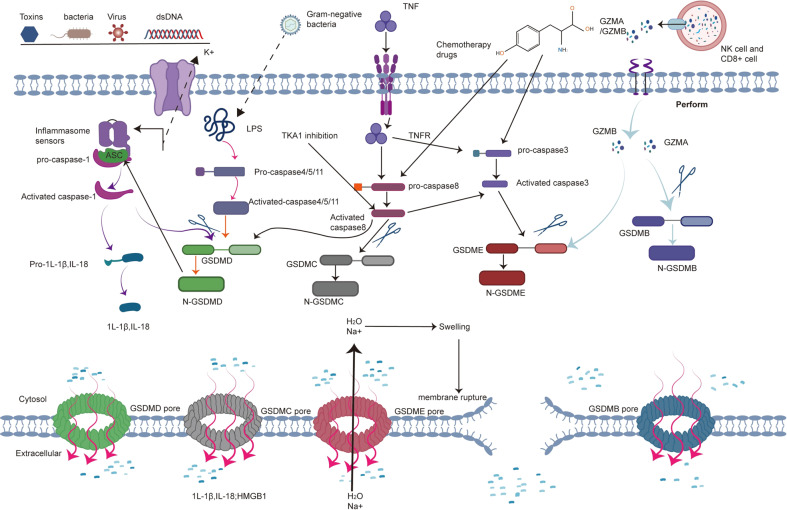
Fig. 1
Fig. 1. Molecular mechanism of pyroptosis.
The canonical inflammasome is assembled from intracellular sensor proteins in response to PAMPs and DAMPs. Active caspase-1 cleaves pro-IL-1β and pro-IL-18 and results in the maturation of IL-1β and IL-18 that are subsequently released from the N-GSDMD pore. Active caspase-1 also cleaves GSDMD, releasing N-GSDMD to form nonselective pores on the plasma membrane, which allows the release of mature IL-1β and IL-18. In the noncanonical pathway, LPS directly binds to pro-caspase-4/5/11, resulting in activation of caspase-4/5/11, which cleaves GSDMD to trigger pyroptosis. In apoptotic caspase-induced pyroptosis, TNF activates caspase-8, which cleaves GSDMC and then induces pyroptosis in cancer cells. In addition, chemotherapeutic drugs trigger pyroptosis through the caspase-3/GSDME, caspase 1/GSDMD or caspase-8/GSDMC cascades. In the granzyme-A/B-dependent pyroptosis pathway, GzmA and GzmB from NK cells and CD8 + T cells enter cancer cells via perforin and recognise GSDMB and GSDME, respectively, to induce pyroptosis.
Fig. 2
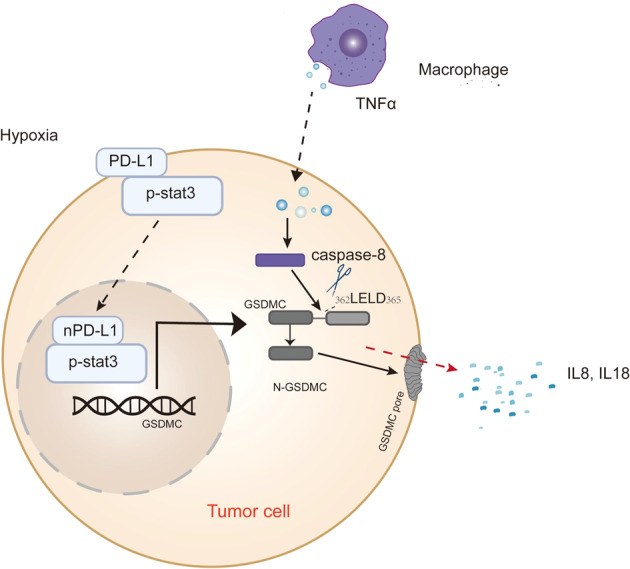
Fig. 2. The mechanism of PD-L1 in pyroptosis.
PD-L1 interacts with p-stat3 and then translocate into the nucleus to transcriptionally increase the expression of GSDMC, resulting in pyroptosis in response to hypoxic stress. TNFα in macrophages activates caspase-8, which cleaves GSDMC at the 362LELD365 site, releasing N-GSDMC to induce the switch of apoptosis to pyroptosis in cancer cells.
Fig. 3
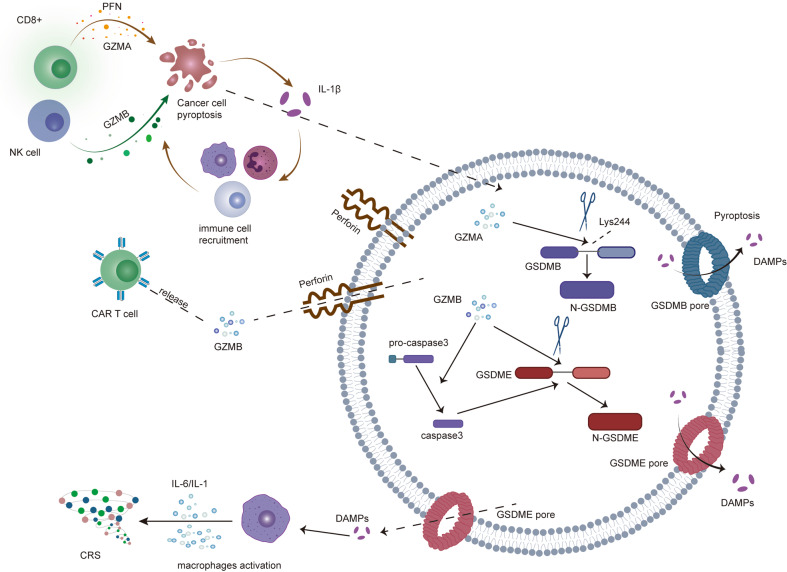
Fig. 3. Positive feedback loops involved in pyroptosis and immune response.
Pyroptotic cancer cells release a number of inflammatory factors, which in turn recruit immune cells and enhance the systemic immune response to kill cancer cells. CD4 + T cells, CD8 + T cells and CAR T cells secrete proteins of the granzyme family and perforin. Perforin forms membrane pores in tumour cells, through which granzymes translocate into tumour cells to trigger pyroptosis. Moreover, DAMPs released from the pyroptosis of cancer cells activate macrophages, which release large amounts of IL-6 and IL-1, inducing CRS. The positive feedback loop indicates that only a few cancer cells undergoing pyroptosis activate the immune system, alter the tumour microenvironment, and further trigger cell death.

References

    1. Torre LA, Siegel RL, Ward EM, Jemal A. Global cancer incidence and mortality rates and trends-an update. Cancer Epidemiol, Biomark Prev. 2016;25:16–27. doi: 10.1158/1055-9965.EPI-15-0578. - DOI - PubMed
    1. Galluzzi L, Vitale I, Aaronson SA, Abrams JM, Adam D, Agostinis P, et al. Molecular mechanisms of cell death: recommendations of the nomenclature committee on cell death 2018. Cell death Differ. 2018;25:486–541. doi: 10.1038/s41418-017-0012-4. - DOI - PMC - PubMed
    1. Radi ZA, Stewart ZS, O’Neil SP. Accidental and programmed cell death in investigative and toxicologic pathology. Curr Protoc Toxicol. 2018;76:e51. doi: 10.1002/cptx.51. - DOI - PubMed
    1. Carneiro BA, El-Deiry WS. Targeting apoptosis in cancer therapy. Nat Rev Clin Oncol. 2020;17:395–417. doi: 10.1038/s41571-020-0341-y. - DOI - PMC - PubMed
    1. Shi J, Gao W, Shao F. Pyroptosis: gasdermin-mediated programmed necrotic cell death. Trends Biochemical Sci. 2017;42:245–54. doi: 10.1016/j.tibs.2016.10.004. - DOI - PubMed