. 2022 Jul 27;13(1):4347.
doi: 10.1038/s41467-022-31743-0.

Decoherence of V B spin defects in monoisotopic hexagonal boron nitride

Affiliations

Decoherence of V B spin defects in monoisotopic hexagonal boron nitride

A Haykal et al. Nat Commun. .

Abstract

Spin defects in hexagonal boron nitride (hBN) are promising quantum systems for the design of flexible two-dimensional quantum sensing platforms. Here we rely on hBN crystals isotopically enriched with either 10B or 11B to investigate the isotope-dependent properties of a spin defect featuring a broadband photoluminescence signal in the near infrared. By analyzing the hyperfine structure of the spin defect while changing the boron isotope, we first confirm that it corresponds to the negatively charged boron-vacancy center ( V B ). We then show that its spin coherence properties are slightly improved in 10B-enriched samples. This is supported by numerical simulations employing cluster correlation expansion methods, which reveal the importance of the hyperfine Fermi contact term for calculating the coherence time of point defects in hBN. Using cross-relaxation spectroscopy, we finally identify dark electron spin impurities as an additional source of decoherence. This work provides new insights into the properties of V B spin defects, which are valuable for the future development of hBN-based quantum sensing foils.


Conflict of interest statement

The authors declare no competing interests.

Figures
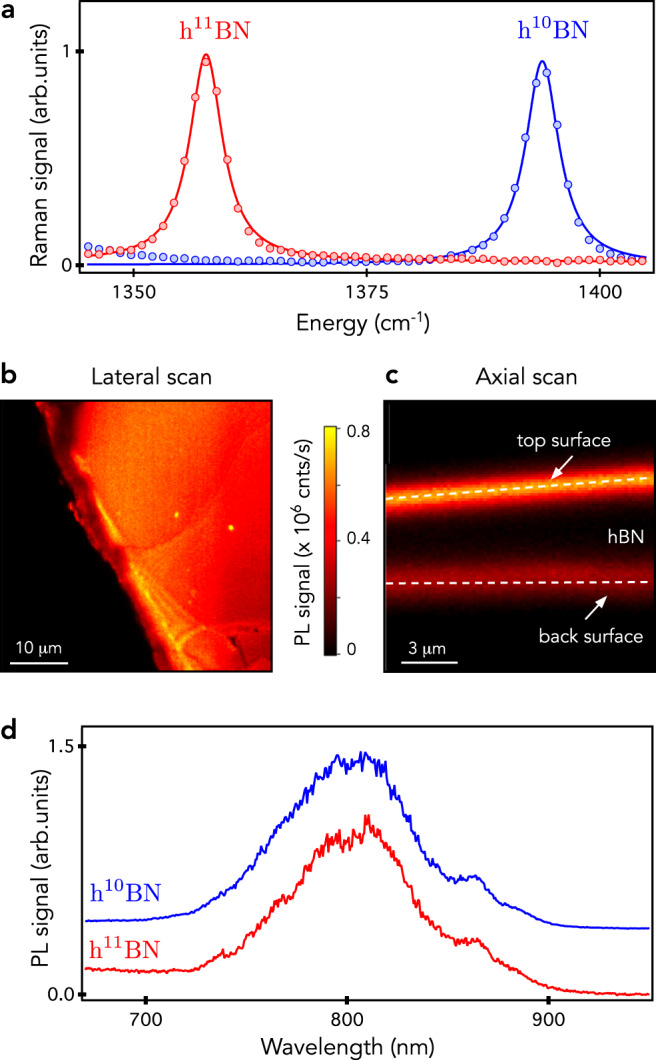
Fig. 1
Fig. 1. Optical properties of neutron-irradiated monoisotopic hBN crystals.
a Raman scattering spectra recorded at room temperature on the h11BN (red dots) and h10BN crystals (blue dots) after neutron irradiation. The solid lines are data fitting with Lorentzian functions. b Typical lateral PL raster scan of the h10BN crystals under green laser illumination with a power of 1 mW. c Axial confocal scan showing a high PL signal localized at the crystal surfaces. d PL spectra recorded from the h11BN (red) and h10BN crystals (blue). The data have been normalized and vertically shifted for the sake of clarity.
Fig. 2
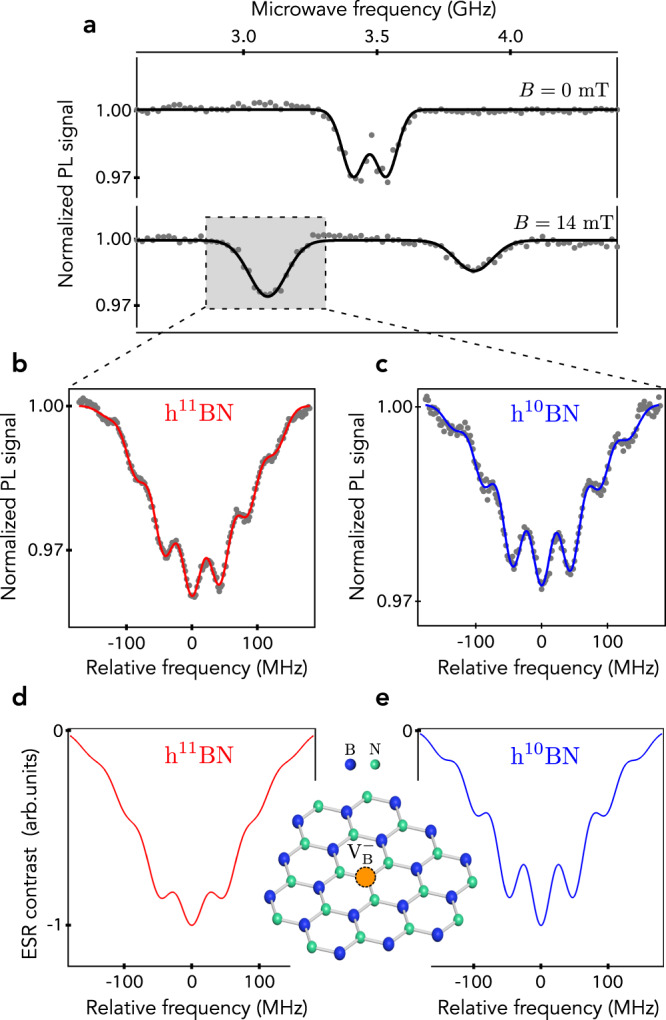
Fig. 2. Analysis of the hyperfine structure.
a Optically detected ESR spectra recorded on the h10BN crystal at zero field (top panel) and for a magnetic field B = 14 mT applied along the c axis, i.e., perpendicular to the sample surface. b, c Hyperfine structure of the ESR line measured in b h11BN and c h10BN crystals. The solid lines are data fitting with a sum of seven Gaussian functions. d, e Simulated hyperfine spectra of the VB defect in hBN obtained via the procedure described in the main text while using Δs = 30 MHz. The inset shows the atomic structure of the VB center in hBN.
Fig. 3
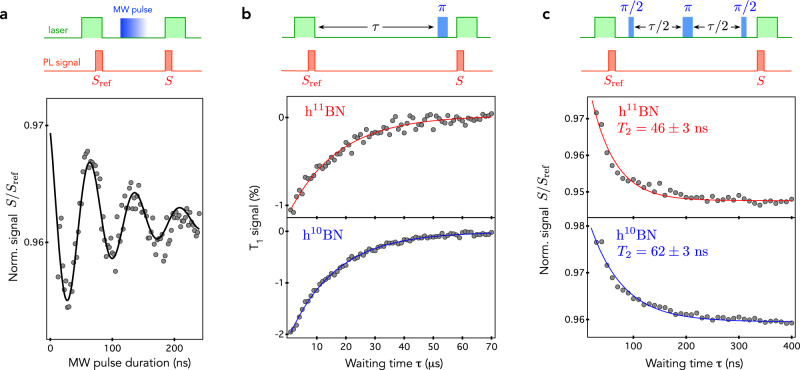
Fig. 3. Spin coherence properties.
a Optically detected Rabi oscillations of an ensemble of VB spin defects recorded by applying the experimental sequence shown in the top panel. The spin-dependent PL signal S is integrated at the beginning of the readout laser pulse and normalized by a reference signal Sref, which corresponds to the steady-state PL signal measured at the end of the initialization laser pulse. b T1 measurements in the two monoisotopic crystals. Here we plot the difference of the normalized PL signal S/Sref measured with and without applying the resonant microwave π-pulse (see top panel). Solid lines are data fitting with an exponential decay, leading to T1 ~ 16 μs in both samples. c Measurement of the spin coherence time T2 using a spin echo pulse sequence. Solid lines are data fitting with an exponential decay. All experiments are performed with a static magnetic field B ~ 15 mT applied along the c axis. The duration of the laser pulses is 8 μs with a power of 1 mW and the integration time window of S and Sref is fixed to 300 ns. The duration of the microwave π/2 pulse is set to 15 ns.
Fig. 4
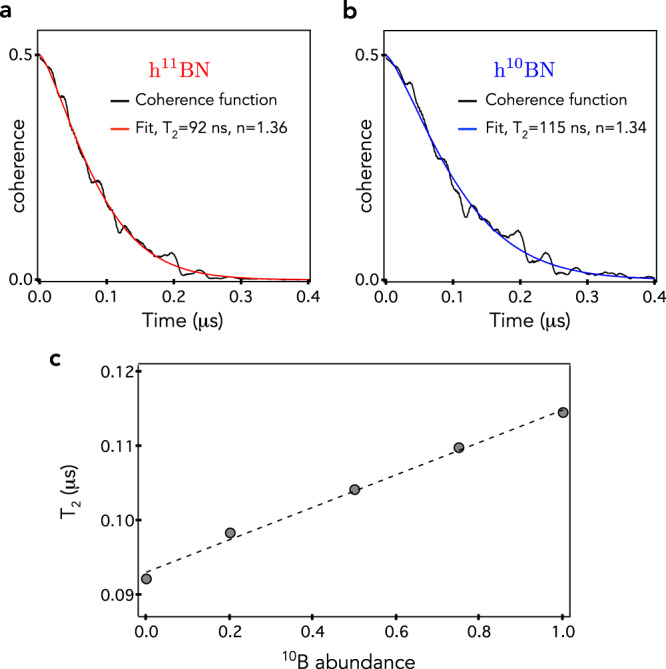
Fig. 4. Nuclear spin bath induced decoherence.
a, b Simulated spin echo decay curve and corresponding stretched exponential fit for the VB defect in a h11BN and b h10BN. c Calculated spin coherence time T2 as a function of the abundance of 10B isotope. The T2 time is enhanced by the reduced hyperfine and nuclear spin-nuclear spin interaction strengths in 10B-enriched samples. The black dashed line is a linear fit.
Fig. 5
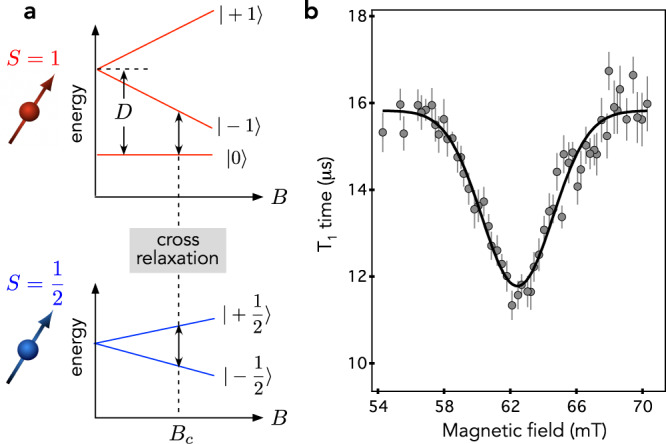
Fig. 5. Cross-relaxation spectroscopy.
a Energy levels of the VB spin triplet ground state (top panel) and of a paramagnetic impurity with S = 1/2 (bottom panel) as a function of a static magnetic field B. The two spin systems are brought in resonance for B = Bc ~ 62 mT. b T1 time of the VB spin defect in the h10BN crystal as a function of a magnetic field applied along the c-axis. The field amplitude is inferred by recording the Zeeman shift of the ESR frequency of the VB defect. The solid line is data fitting with a Gaussian function. The error bars correspond to the uncertainty of fitting the T1 decay curve with an exponential function.

References

    1. Awschalom DD, Hanson R, Wrachtrup J, Zhou BB. Quantum technologies with optically interfaced solid-state spins. Nat. Phot. 2018;12:516–527. doi: 10.1038/s41566-018-0232-2. - DOI
    1. Waldherr G, et al. Quantum error correction in a solid-state hybrid spin register. Nature. 2014;506:204–207. doi: 10.1038/nature12919. - DOI - PubMed
    1. Hensen B, et al. Loophole-free bell inequality violation using electron spins separated by 1.3 kilometres. Nature. 2015;526:682. doi: 10.1038/nature15759. - DOI - PubMed
    1. Pompili M, et al. Realization of a multinode quantum network of remote solid-state qubits. Science. 2021;372:259–264. doi: 10.1126/science.abg1919. - DOI - PubMed
    1. Degen CL, Reinhard F, Cappellaro P. Quantum sensing. Rev. Mod. Phys. 2017;89:035002. doi: 10.1103/RevModPhys.89.035002. - DOI