


Enhancing exposure therapy for posttraumatic stress disorder (PTSD): a randomized clinical trial of virtual reality and imaginal exposure with a cognitive enhancer
- PMID: 35896533
- PMCID: PMC9329292
- DOI: 10.1038/s41398-022-02066-x
Enhancing exposure therapy for posttraumatic stress disorder (PTSD): a randomized clinical trial of virtual reality and imaginal exposure with a cognitive enhancer
Abstract
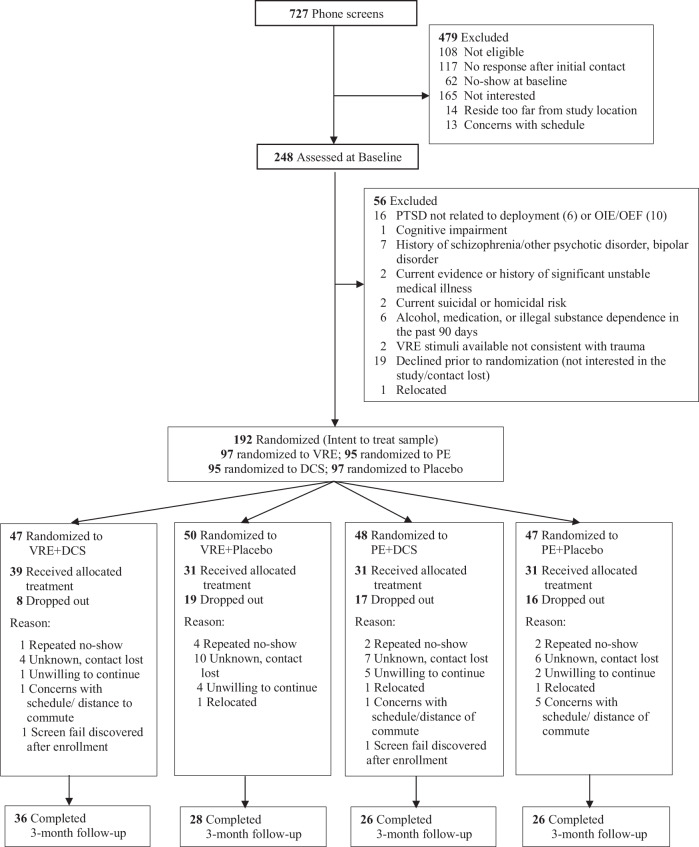
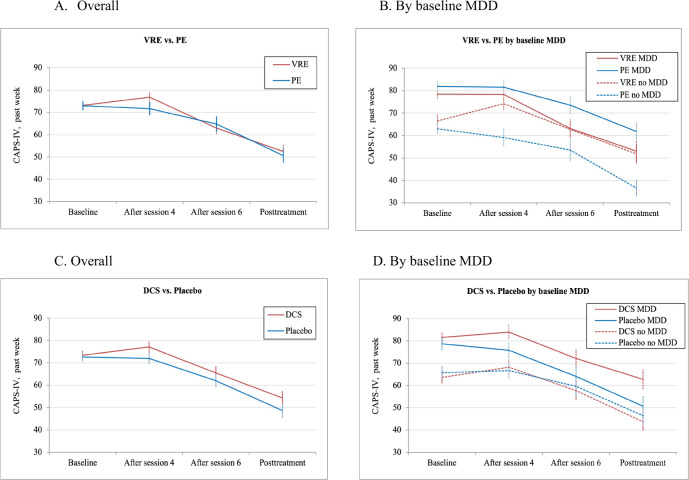
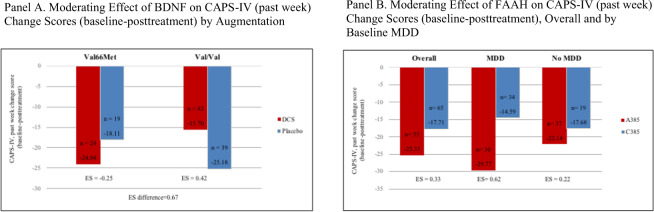
Posttraumatic stress disorder (PTSD) is a significant public health issue. Yet, there are limited treatment options and no data to suggest which treatment will work for whom. We tested the efficacy of virtual reality exposure (VRE) or prolonged imaginal exposure (PE), augmented with D-cycloserine (DCS) for combat-related PTSD. As an exploratory aim, we examined whether brain-derived neurotrophic factor (BDNF) and fatty acid amide hydrolase (FAAH) moderated treatment response. Military personnel with PTSD (n = 192) were recruited into a multisite double-blind randomized controlled trial to receive nine weeks of VRE or PE, with DCS or placebo. Primary outcome was the improvement in symptom severity. Randomization was stratified by comorbid depression (MDD) and site. Participants in both VRE and PE showed similar meaningful clinical improvement with no difference between the treatment groups. A significant interaction (p = 0.45) suggested VRE was more effective for depressed participants (CAPS difference M = 3.51 [95% CI 1.17-5.86], p = 0.004, ES = 0.14) while PE was more effective for nondepressed participants (M = -8.87 [95% CI -11.33 to -6.40], p < 0.001, ES = -0.44). The main effect of DCS vs. placebo was not significant. Augmentation by MDD interaction (p = 0.073) suggested that depressed participants improved more on placebo (M = -8.43 [95% CI -10.98 to -5.88], p < 0.001, ES = -0.42); DCS and placebo were equally effective for nondepressed participants. There was an apparent moderating effect of BDNF Val66Met polymorphism on DCS augmentation (ES = 0.67). Met66 allele carriers improved more on DCS (ES = -0.25). FAAH 385 A carriers improved more than non-carriers (ES = 0.33), particularly those with MDD (ES = 0.62). This study provides a step toward precision therapeutics for PTSD by demonstrating that comorbid MDD and genetic markers may help guide treatment selection.ClinicalTrials.gov Identifier: NCT01352637.
© 2022. The Author(s).
Conflict of interest statement
The authors, with the exception of JD, BOR, AAR, JC and TJ, declare no conflicts of interest. JD has funding from Department of Defense Clinical Trial Grants (No. W81XWH-15-1-0645 and No. W81XWH-18-1-0262) and Weill Cornell Medical College. JD serves as a member of the advisory board at Pear Therapeutics, Inc. BOR has funding from Wounded Warrior Project, Department of Defense Clinical Trial Grant No.W81XWH-10-1-1045, National Institute of Mental Health Grant No. 1R01MH094757-01, and McCormick Foundation. BOR receives royalties from Oxford University Press, Guilford, APPI, and Emory University and received advisory board payments from Genentech, Jazz Pharmaceuticals, Nobilis Therapeutics, Neuronetics, and Aptinyx. BOR owns equity in Virtually Better, Inc. that creates virtual reality products. The terms of this arrangement have been reviewed and approved by Emory University in accordance with its conflict of interest policies. However, The Virtual Iraq software used in this study was created by AAR and his team at ICT, not Virtually Better. AAR serves as a member of the advisory board at Pear Therapeutics, Inc. JC serves as a consultant to Virtually Better, Inc. TJ has support from the National Institutes of Health (R01MH111682, R01MH110364). The authors declare no competing interests.
Figures
References
-
- Kessler RC. Posttraumatic stress disorder: the burden to the individual and to society. J Clin Psychiatry. 2000;61:4–12. - PubMed
Publication types
MeSH terms
Substances
Associated data
Grants and funding
LinkOut - more resources
Full Text Sources
Medical
Research Materials
Miscellaneous
