


Comment
doi: 10.1038/d41586-022-01948-w.
A short burst of reward curbs the addictiveness of ketamine
- PMID: 35896660
- PMCID: PMC10342185
- DOI: 10.1038/d41586-022-01948-w
Item in Clipboard
Comment
A short burst of reward curbs the addictiveness of ketamine
Nature.
2022 Aug.
Abstract
An analysis of ketamine and cocaine use in mice reveals that the drugs trigger release of the neurotransmitter dopamine through different mechanisms, and indicates that the risk of addiction to ketamine is low.
Keywords: Depression; Neuroscience.
Figures
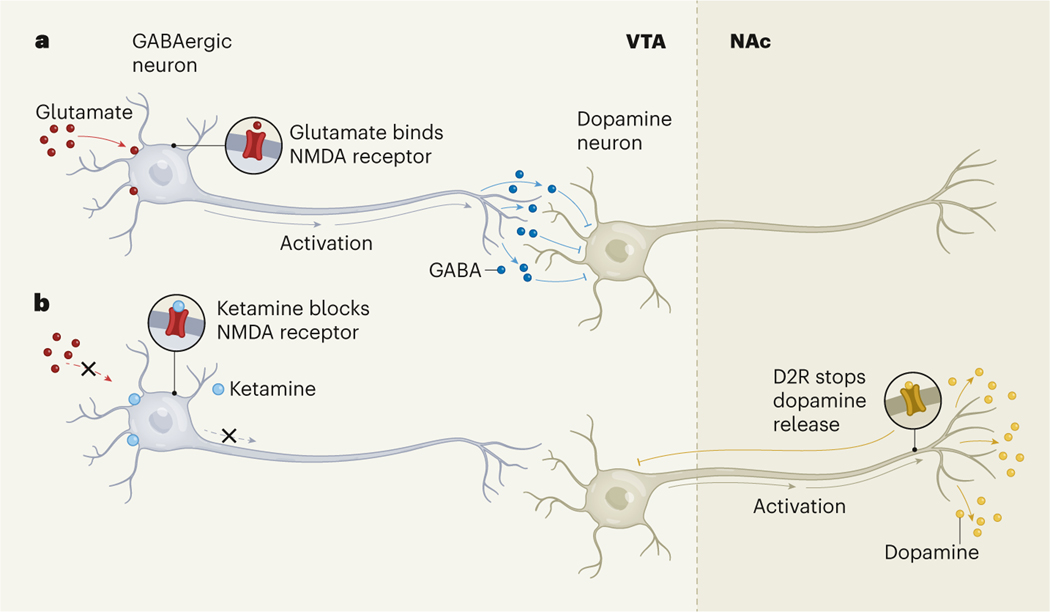
a, GABAergic neurons in the brain’s ventral
tegmental area (VTA) are stimulated by binding of the neurotransmitter glutamate
to NMDA receptor proteins. These neurons release the neurotransmitter GABA,
which inhibits the activity of dopamine neurons that project to a reward centre
called the nucleus accumbens (NAc). b, Ketamine binds to NMDA
receptors to inhibit their activation. Simmler et al. show that this leads to
activation of the dopamine neurons, triggering a short burst of dopamine release
in the NAc. The release is rapidly quashed when dopamine binds to the D2-type
receptor (D2R) protein on the dopamine neurons, inhibiting their activity. This
mechanism of action differs from the pathways through which cocaine triggers
sustained dopamine release (not shown), which might explain why ketamine is not
highly addictive.
Comment on
-
Dual action of ketamine confines addiction liability.Nature. 2022 Aug;608(7922):368-373. doi: 10.1038/s41586-022-04993-7. Epub 2022 Jul 27. Nature. 2022. PMID: 35896744
References
Publication types
MeSH terms
Substances
Grants and funding
LinkOut - more resources
Full Text Sources
