


Competing paradigms of obesity pathogenesis: energy balance versus carbohydrate-insulin models
- PMID: 35896818
- PMCID: PMC9436778
- DOI: 10.1038/s41430-022-01179-2
Competing paradigms of obesity pathogenesis: energy balance versus carbohydrate-insulin models
Abstract
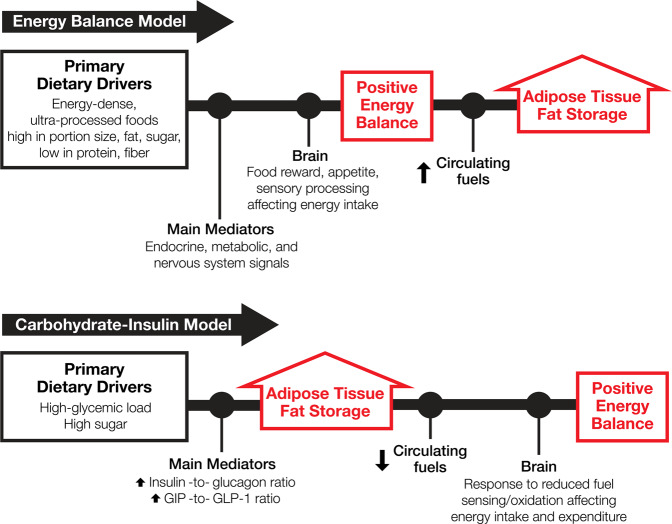
The obesity pandemic continues unabated despite a persistent public health campaign to decrease energy intake ("eat less") and increase energy expenditure ("move more"). One explanation for this failure is that the current approach, based on the notion of energy balance, has not been adequately embraced by the public. Another possibility is that this approach rests on an erroneous paradigm. A new formulation of the energy balance model (EBM), like prior versions, considers overeating (energy intake > expenditure) the primary cause of obesity, incorporating an emphasis on "complex endocrine, metabolic, and nervous system signals" that control food intake below conscious level. This model attributes rising obesity prevalence to inexpensive, convenient, energy-dense, "ultra-processed" foods high in fat and sugar. An alternative view, the carbohydrate-insulin model (CIM), proposes that hormonal responses to highly processed carbohydrates shift energy partitioning toward deposition in adipose tissue, leaving fewer calories available for the body's metabolic needs. Thus, increasing adiposity causes overeating to compensate for the sequestered calories. Here, we highlight robust contrasts in how the EBM and CIM view obesity pathophysiology and consider deficiencies in the EBM that impede paradigm testing and refinement. Rectifying these deficiencies should assume priority, as a constructive paradigm clash is needed to resolve long-standing scientific controversies and inform the design of new models to guide prevention and treatment. Nevertheless, public health action need not await resolution of this debate, as both models target processed carbohydrates as major drivers of obesity.
© 2022. The Author(s).
Conflict of interest statement
DSL received grants to study the carbohydrate-insulin model from the National Institutes of Health (USA) and philanthropies unaffiliated with the food industry, and royalties for books that recommend a carbohydrate-modified diet; his spouse owns a nutrition education and consulting business. CMA has, in the previous 12 months, participated on advisory boards for Altimmune, Inc., Cowen and Company, LLC, Gelesis, Srl., L-Nutra, Inc., NeuroBo Pharmaceuticals, Inc., Novo Nordisk, Inc., Pain Script Corporation, Riverview School, Rhythm Pharmaceuticals, and Xeno Biosciences; and received research funding from the National Institutes of Health (USA), PCORI and GI Dynamics, Inc. LJA received consulting fees from and serves on advisory boards for ERX, Jamieson Wellness, Pfizer, Novo Nordisk, Sanofi, Janssen, UnitedHealth Group Ventures and Gelesis; received research funding from Lilly, Janssen, Allurion, and Novo Nordisk; has an equity interest in Intellihealth, ERX, Zafgen, Gelesis, MYOS, and Jamieson Wellness; and serves on the board of directors for Intellihealth and Jamieson Wellness. AA is a member of Scientific Advisory Board for WW (USA), RNPC (France), Gelesis (USA), and Novo Nordisk A/S; and is currently employed by the Novo Nordisk Foundation to establish the National Centre for Healthy Weight in Denmark with the aim to prevent childhood obesity. LCC is founder of Faeth Therapeutics, a company that generates diets to enhance responses to cancer drugs. CBE received grants to study the carbohydrate-insulin model from the National Institutes of Health (USA) and philanthropies unaffiliated with the food industry. SBH is a member of the Scientific Advisory Board for Medifast. JDJ received research grants to study the role of hyperinsulinemia in metabolism from the Canadian Institute for Health Research; and is co-founder and Board Chair of the Institute for Personalized Therapeutic Nutrition, a registered charity in Canada in which he has no financial interest. RMK is a member of the Scientific Advisory Boards of Virta Health, Day Two, and Seraphina Therapeutics; and received payments from JumpStartMD. GT received royalties for books that discuss the history, science and therapeutic applications of carbohydrate-restricted eating. JSV received royalties for books on low-carbohydrate diets; is founder and has equity in Virta Health; and serves on the advisory board of Simply Good Foods. WSY consults for dietdoctor.com by providing scientific review of website content. Other authors declared no conflicts of interest.
Figures
References
-
- Kuhn TS. The structure of scientific revolutions. 2nd ed. Chicago: The University of Chicago Press; 1970.
-
- American College of Cardiology/American Heart Association Task Force on Practice Guidelines, Obesity Expert Panel, 2013. Expert Panel Report: Guidelines (2013) for the management of overweight and obesity in adults. Obesity. 2014;22:S41–410. - PubMed
