


Material Security Scale as a Measurement of Poverty among Key Populations At-Risk for HIV/AIDS in Malaysia: An Implication for People Who Use Drugs and Transgender People during the COVID-19 Pandemic
- PMID: 35897368
- PMCID: PMC9331958
- DOI: 10.3390/ijerph19158997
Material Security Scale as a Measurement of Poverty among Key Populations At-Risk for HIV/AIDS in Malaysia: An Implication for People Who Use Drugs and Transgender People during the COVID-19 Pandemic
Abstract
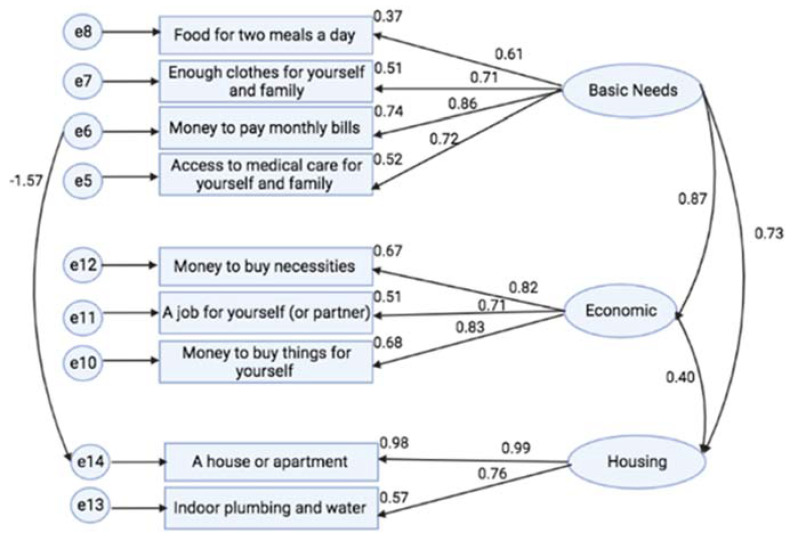
The HIV epidemic is fueled by poverty; yet, methods to measure poverty remain scarce among populations at risk for HIV infection and disease progression to AIDS in Malaysia. Between August and November 2020, using data from a cross-sectional study of people who use drugs, (PWUD), transgender people, sex workers and men who have sex with men, this study examined the reliability and validity of a material security scale as a measurement of poverty. Additionally, we assessed factors associated with material security scores. We performed confirmatory factor analysis (CFA) for 268 study participants included in the analysis. A revised nine-item three-factor structure of the material security scale demonstrated an excellent fit in CFA. The revised material security score displayed good reliability, with Cronbach's alpha of 0.843, 0.826 and 0.818 for housing, economic resources and basic needs factors, respectively. In a subsequent analysis, PWUD and transgender people were less likely to present good material security scores during the pandemic, compared to their counterparts. The revised nine-item scale is a useful tool to assess poverty among key populations at-risk for HIV/AIDS with the potential to be extrapolated in similar income settings.
Keywords: HIV; poverty; reliability; social determinants of health; validity.
Conflict of interest statement
The authors declare no conflict of interest. The funders had no role in the design of the study; in the collection, analyses, or interpretation of data; in the writing of the manuscript, or in the decision to publish the results.
Figures
References
-
- Richardson L.A., Kerr T.H., Dobrer S., Puskas C.M., Guillemi S.A., Montaner J.S., Wood E., Milloy M.J. Socio-economic marginalization and plasma HIV-1 RNA non-detectability among individuals who use illicit drugs in a Canadian setting. AIDS. 2015;29:2487. doi: 10.1097/QAD.0000000000000853. - DOI - PMC - PubMed
-
- Rueda S., Mitra S., Chen S., Gogolishvili D., Globerman J., Chambers L., Wilson M., Logie C.H., Shi Q., Morassaei S. Examining the associations between HIV-related stigma and health outcomes in people living with HIV/AIDS: A series of meta-analyses. BMJ Open. 2016;6:e011453. doi: 10.1136/bmjopen-2016-011453. - DOI - PMC - PubMed
-
- Besharov D.J., Couch K. European measures of income, poverty, and social exclusion: Recent developments and lessons for US poverty measurement. J. Policy Anal. Manag. 2009;28:713–715. doi: 10.1002/pam.20467. - DOI
-
- Dorling D. Who’s afraid of income inequality? Environ. Plan. A. 1999;31:571–574. doi: 10.1068/a310571. - DOI
Publication types
MeSH terms
LinkOut - more resources
Full Text Sources
Medical
