


Do Parents Perceive Practitioners to Have a Specific Role in Change? A Longitudinal Study Following Participation in an Evidence-Based Program
- PMID: 35897464
- PMCID: PMC9368381
- DOI: 10.3390/ijerph19159100
Do Parents Perceive Practitioners to Have a Specific Role in Change? A Longitudinal Study Following Participation in an Evidence-Based Program
Abstract
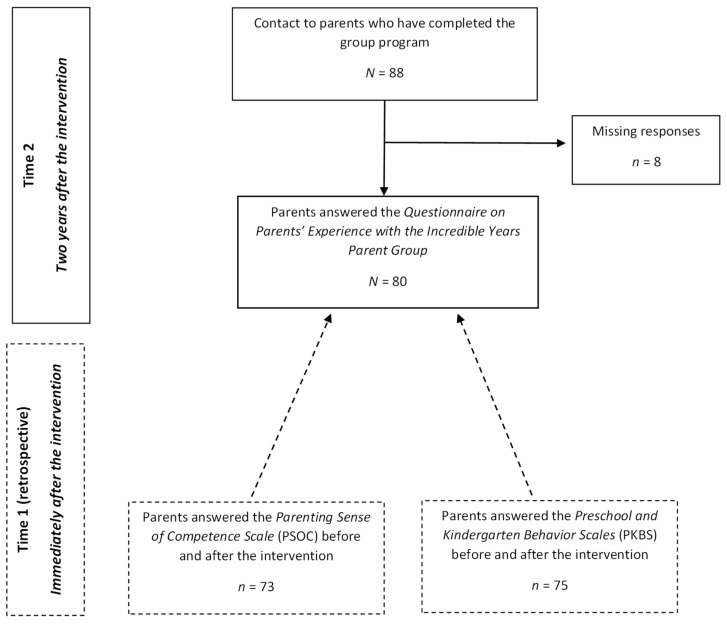
Little attention has been given to the role of practitioners in evidence-based parenting programs and to the evaluation that parents make of their importance in the process of change. This study aims to explore the role that parents assign to the facilitators of the Incredible Years (IY) program in enabling long-term life changes, as well as the association between parents' evaluation of the practitioners' skills and specific changes perceived after the intervention. In this longitudinal study, we applied 1 survey to 80 community parents who had participated in an IY group 2 years before, and we retrieved archival data to assess changes in parents' ratings of sense of competence and in children's behaviors immediately after the end of the intervention. Two years after the intervention, parents perceived significant improvements, especially in their parenting and their children's behaviors, and they recognized that their IY practitioners had played a significant role in these life changes. Parents who attributed a greater role to the practitioners' skills reported a greater number of improvements in parental sense of competence and in children's behaviors. The practitioners' skills relating more broadly to these specific changes are the practitioners' sensitivity and flexibility towards parents' needs and the practitioners' ability to clearly share knowledge with parents. The practitioner's assigned role when implementing an evidence-based parenting program seems to go far beyond the mere conveyance of the program's specific contents and methods and deserves to be researched further.
Keywords: change; evidence-based; parenting; practitioner; skills.
Conflict of interest statement
The authors declare no conflict of interest. The funders had no role in the design of the study; in the collection, analyses, or interpretation of data; in the writing of the manuscript, or in the decision to publish the results.
Figures
References
-
- Carr A. Family therapy and systemic interventions for child-focused problems: The current evidence base. J. Fam. Ther. 2019;41:153–213. doi: 10.1111/1467-6427.12226. - DOI
-
- National Institute for Health and Clinical Excellence . Antisocial Behaviour and Conduct Disorders in Children and Young People: Recognition, Intervention and Management (National Clinical Guideline 158) British Psychological Society; Leicester, UK: 2013. [(accessed on 22 April 2022)]. Available online: http://www.nice.org.uk/guidance/CG158. - PubMed
-
- Weber L., Kamp-Becker I., Christiansen H., Mingebach T. Treatment of child externalizing behavior problems: A comprehensive review and meta-meta-analysis on effects of parent-based interventions on parental characteristics. Eur. Child Adolesc. Psychiatry. 2018;28:1025–1036. doi: 10.1007/s00787-018-1175-3. - DOI - PubMed
Publication types
MeSH terms
LinkOut - more resources
Full Text Sources
Medical
