. 2022 Jul 23;22(15):5511.
doi: 10.3390/s22155511.

Virtual Reality for Shoulder Rehabilitation: Accuracy Evaluation of Oculus Quest 2

Affiliations

Virtual Reality for Shoulder Rehabilitation: Accuracy Evaluation of Oculus Quest 2

Arianna Carnevale et al. Sensors (Basel). .

Abstract

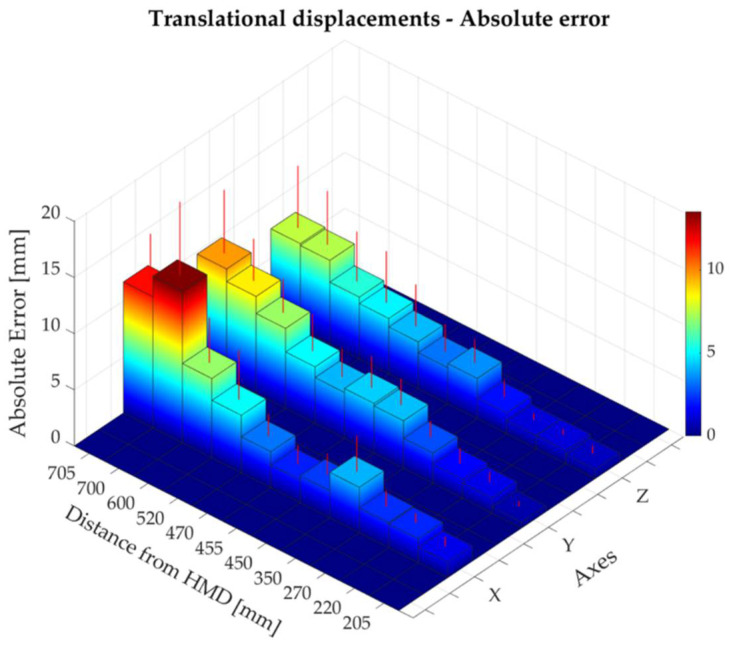
Virtual reality (VR) systems are becoming increasingly attractive as joint kinematics monitoring systems during rehabilitation. This study aimed to evaluate the accuracy of the Oculus Quest 2 in measuring translational and rotational displacements. As the Oculus Quest 2 was chosen for future applications in shoulder rehabilitation, the translation range (minimum: ~200 mm, maximum: ~700 mm) corresponded to the forearm length of the 5th percentile female and the upper limb length of the 95th percentile male. The controller was moved on two structures designed to allow different translational displacements and rotations in the range 0-180°, to cover the range of motion of the upper limb. The controller measures were compared with those of a Qualisys optical capture system. The results showed a mean absolute error of 13.52 ± 6.57 mm at a distance of 500 mm from the head-mounted display along the x-direction. The maximum mean absolute error for rotational displacements was found to be 1.11 ± 0.37° for a rotation of 40° around the z-axis. Oculus Quest 2 is a promising VR tool for monitoring shoulder kinematics during rehabilitation. The inside-out movement tracking makes Oculus Quest 2 a viable alternative to traditional motion analysis systems.

Keywords: Oculus Quest 2; rehabilitation; shoulder; upper limb; virtual reality.


Conflict of interest statement

The authors declare no conflict of interest.

Figures
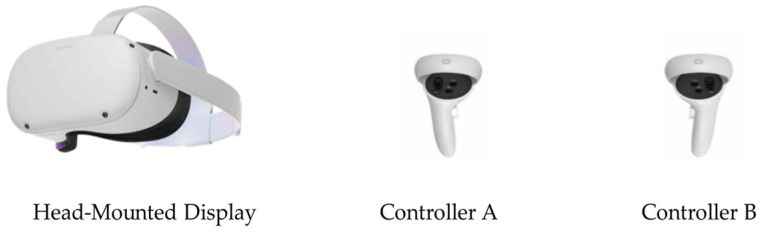
Figure 1
Figure 1
Oculus Quest 2. From the left, the head-mounted display, the left controller (Controller A), and right controller (Controller B).
Figure 2
Figure 2
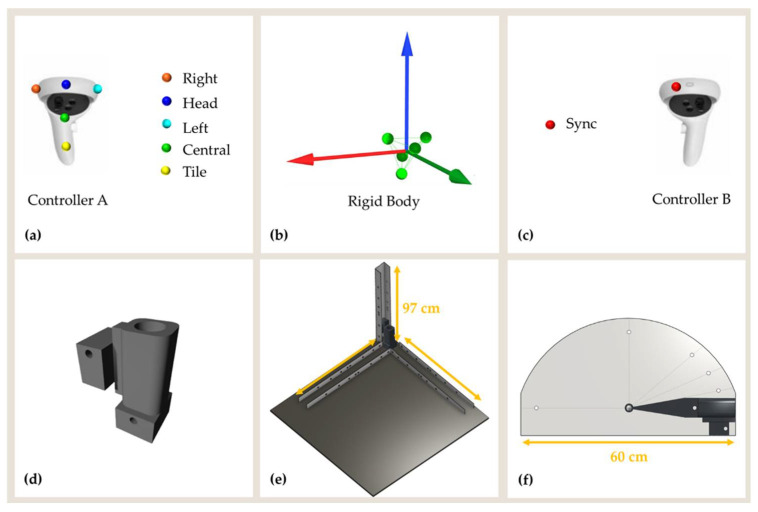
(a) Controller A and markers configuration used to define the (b) rigid body. (c) Controller B and position of the synchronization marker. Controller A was allocated in a (d) custom-made support designed to be easily moved on the structures for (e) translational and (f) rotational movements.
Figure 3
Figure 3
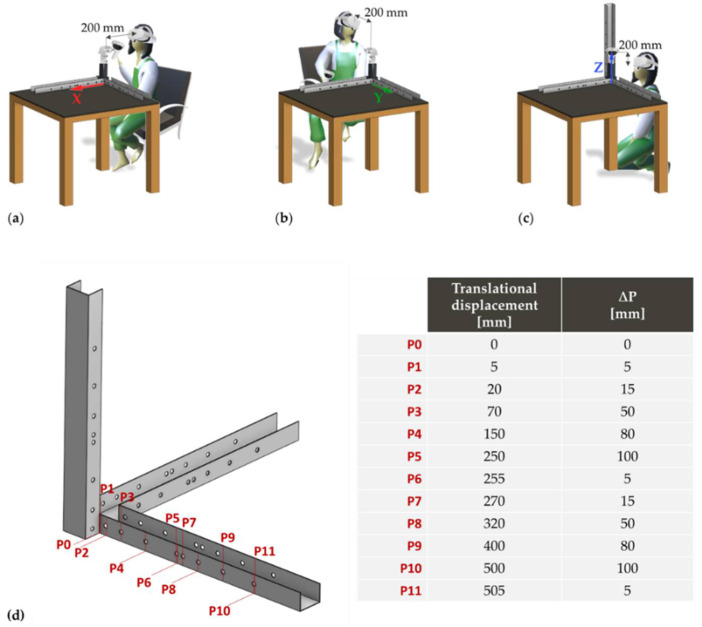
Acquisition configuration of translational displacements along the (a) x-axis, (b) y-axis, and (c) z-axis, starting at a distance of about 200 mm from the reference position P0; (d) representation of translational displacements Pi (i = 1, …,11) and variations (ΔP, i.e., differences between translational displacements ith and ith1.
Figure 4
Figure 4
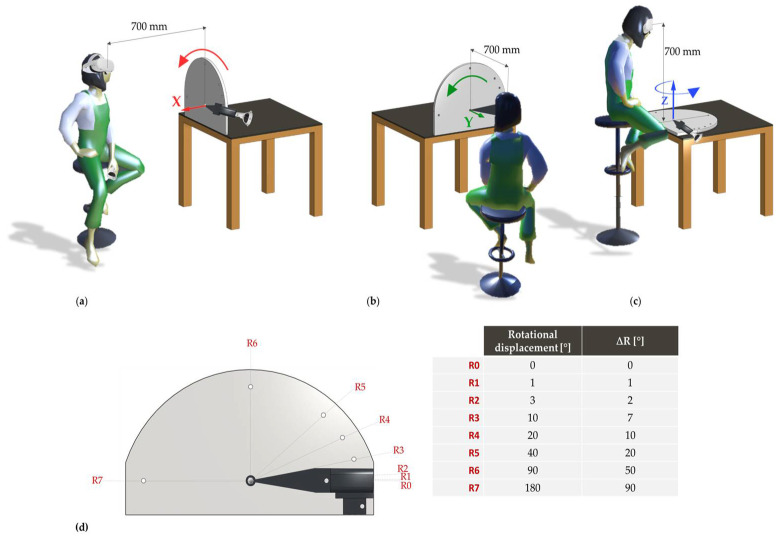
Acquisition configuration of rotational displacements around the (a) x-axis, (b) y-axis, and (c) z-axis, starting at a distance of about 700 mm from the reference position R0; (d) representation of rotational displacements Ri (i = 1,…,11) and variations (ΔR, i.e., differences between rotational displacements ith and ith1.
Figure 5
Figure 5
Absolute error along the x-, y-, and z-axes at different distances from the head-mounted display (HMD).
Figure 6
Figure 6
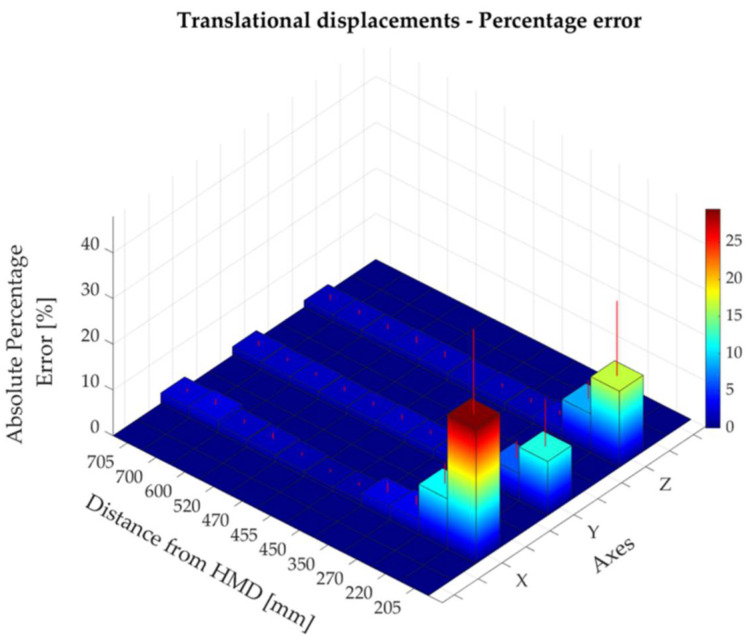
The percentage error along the x-, y-, and z-axes at different distances from the head-mounted display (HMD).
Figure 7
Figure 7
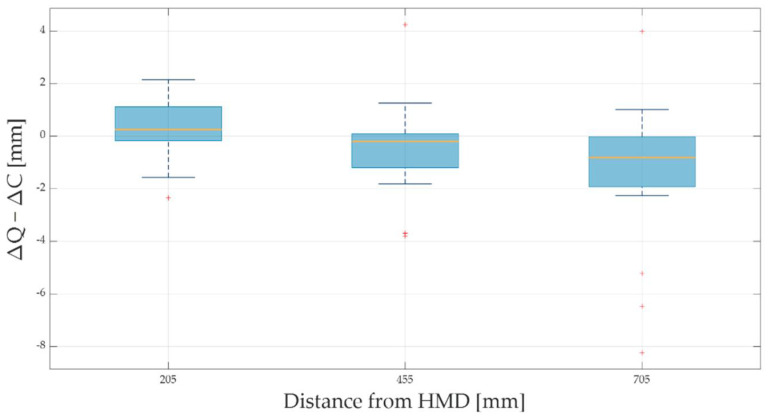
Error corresponding to the increment of 5 mm at the distances of 205 mm, 455 mm, and 705 mm from the head-mounted display (HMD).
Figure 8
Figure 8
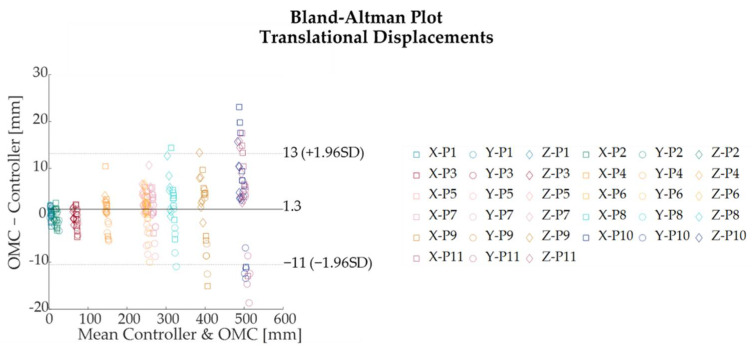
Bland–Altman plots comparing the translational displacements measured by the Qualisys Optical Motion Capture (OMC) system and by the Controller A of the Oculus Quest 2.
Figure 9
Figure 9
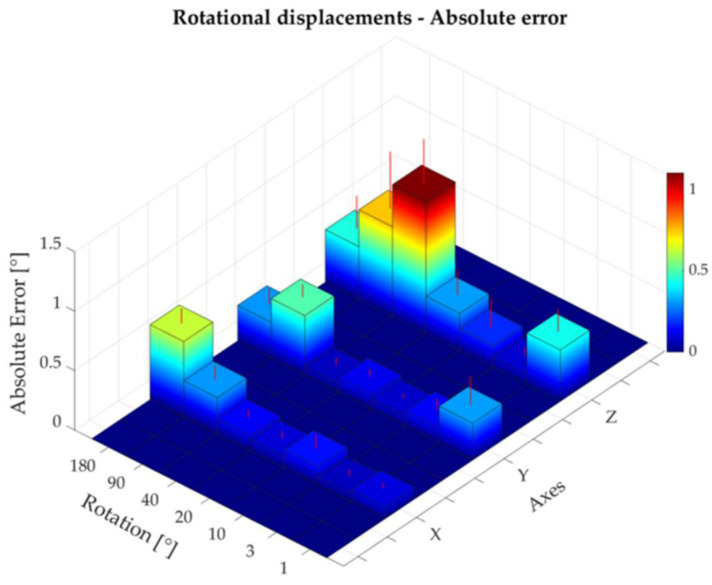
Absolute error corresponding to rotational displacements around the x-, y-, and z-axes.
Figure 10
Figure 10
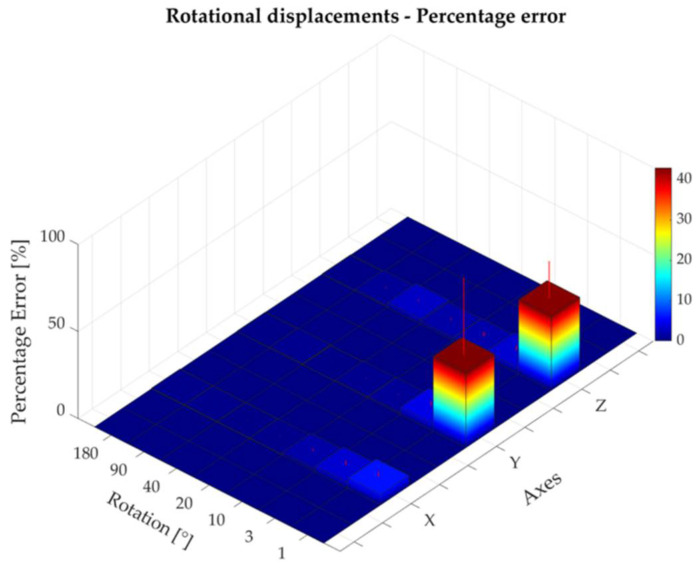
The percentage error corresponding to rotational displacements around the x-, y-, and z-axes.
Figure 11
Figure 11
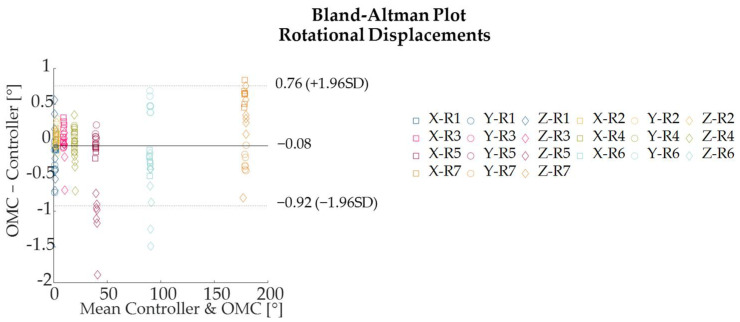
Bland–Altman plots comparing the rotational displacements measured by the Qualisys Optical Motion Capture (OMC) system and by the Controller A of the Oculus Quest 2.

References

    1. do Nascimento L.M.S., Bonfati L.V., Freitas M.L.B., Mendes Junior J.J.A., Siqueira H.V., Stevan S.L. Sensors and systems for physical rehabilitation and health monitoring—A review. Sensors. 2020;20:4063. doi: 10.3390/s20154063. - DOI - PMC - PubMed
    1. Zhou H., Hu H. Human motion tracking for rehabilitation—A survey. Biomed. Signal Process. Control. 2008;3:1–18. doi: 10.1016/j.bspc.2007.09.001. - DOI
    1. Almasi S., Ahmadi H., Asadi F., Shahmoradi L., Arji G., Alizadeh M., Kolivand H. Kinect-based rehabilitation systems for stroke patients: A scoping review. BioMed Res. Int. 2022;2022:4339054. doi: 10.1155/2022/4339054. - DOI - PMC - PubMed
    1. Milosevic B., Leardini A., Farella E. Kinect and wearable inertial sensors for motor rehabilitation programs at home: State of the art and an experimental comparison. Biomed. Eng. Online. 2020;19:25. doi: 10.1186/s12938-020-00762-7. - DOI - PMC - PubMed
    1. Saposnik G., Teasell R., Mamdani M., Hall J., McIlroy W., Cheung D., Thorpe K.E., Cohen L.G., Bayley M. Effectiveness of virtual reality using Wii gaming technology in stroke rehabilitation: A pilot randomized clinical trial and proof of principle. Stroke. 2010;41:1477–1484. doi: 10.1161/STROKEAHA.110.584979. - DOI - PMC - PubMed