This is a preprint.
A simple SEIR-V model to estimate COVID-19 prevalence and predict SARS-CoV-2 transmission using wastewater-based surveillance data
- PMID: 35898336
- PMCID: PMC9327624
- DOI: 10.1101/2022.07.17.22277721
A simple SEIR-V model to estimate COVID-19 prevalence and predict SARS-CoV-2 transmission using wastewater-based surveillance data
Update in
-
A simple SEIR-V model to estimate COVID-19 prevalence and predict SARS-CoV-2 transmission using wastewater-based surveillance data.Sci Total Environ. 2023 Jan 20;857(Pt 1):159326. doi: 10.1016/j.scitotenv.2022.159326. Epub 2022 Oct 8. Sci Total Environ. 2023. PMID: 36220466 Free PMC article.
Abstract
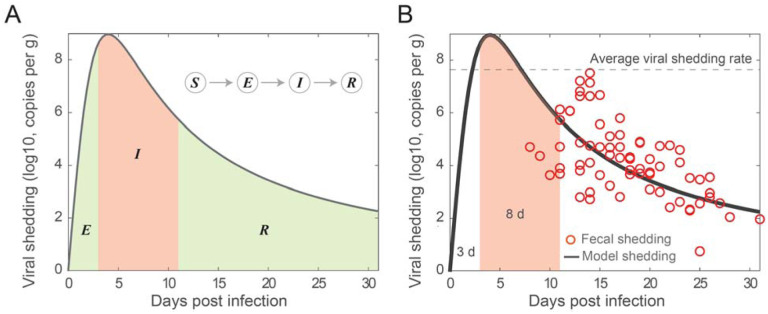
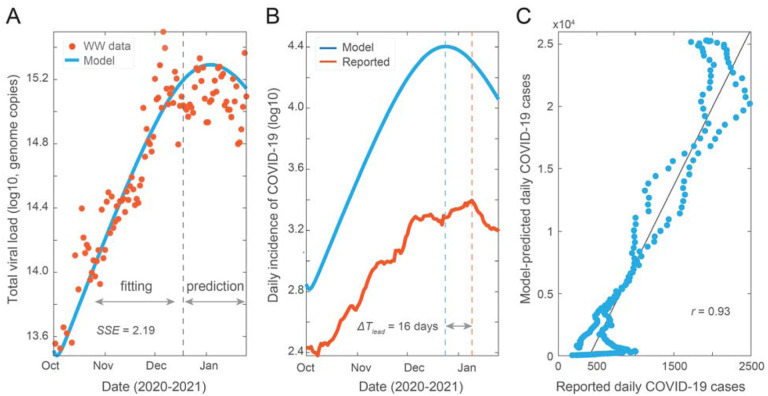
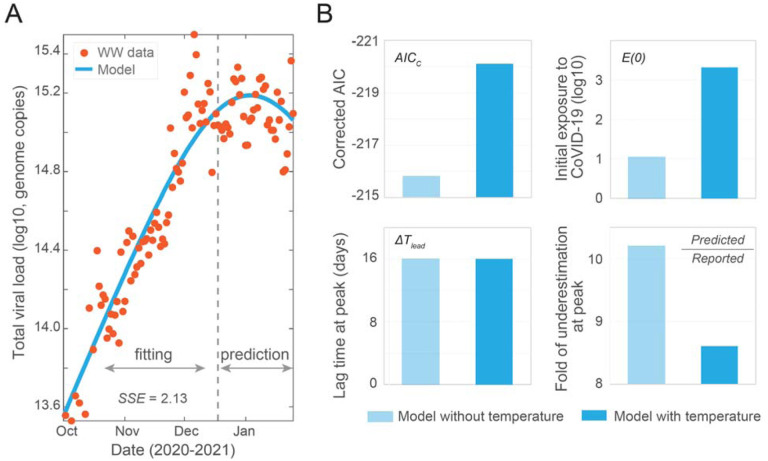
Wastewater-based surveillance (WBS) has been widely used as a public health tool to monitor SARS-CoV-2 transmission. However, epidemiological inference from WBS data remains understudied and limits its application. In this study, we have established a quantitative framework to estimate COVID-19 prevalence and predict SARS-CoV-2 transmission through integrating WBS data into an SEIR-V model. We conceptually divide the individual-level viral shedding course into exposed, infectious, and recovery phases as an analogy to the compartments in population-level SEIR model. We demonstrated that the temperature effect on viral losses in the sewer can be straightforwardly incorporated in our framework. Using WBS data from the second wave of the pandemic (Oct 02, 2020 â€" Jan 25, 2021) in the Great Boston area, we showed that the SEIR-V model successfully recapitulates the temporal dynamics of viral load in wastewater and predicts the true number of cases peaked earlier and higher than the number of reported cases by 16 days and 8.6 folds ( R = 0.93), respectively. This work showcases a simple, yet effective method to bridge WBS and quantitative epidemiological modeling to estimate the prevalence and transmission of SARS-CoV-2 in the sewershed, which could facilitate the application of wastewater surveillance of infectious diseases for epidemiological inference and inform public health actions.
Conflict of interest statement
Declaration of Competing Interest
The authors declare no competing interest.
Figures
References
-
- Běhrádek J (1930). “Temperature coefficients in biology”. Biological Reviews 5(1), pp. 30–58.
Publication types
Grants and funding
LinkOut - more resources
Full Text Sources
Miscellaneous