


Use of GLP-1 Receptor Agonists and Occurrence of Thyroid Disorders: a Meta-Analysis of Randomized Controlled Trials
- PMID: 35898463
- PMCID: PMC9309474
- DOI: 10.3389/fendo.2022.927859
Use of GLP-1 Receptor Agonists and Occurrence of Thyroid Disorders: a Meta-Analysis of Randomized Controlled Trials
Abstract
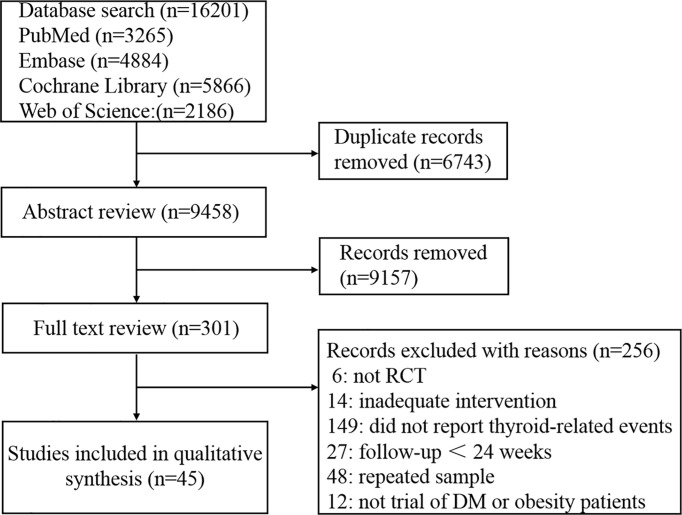
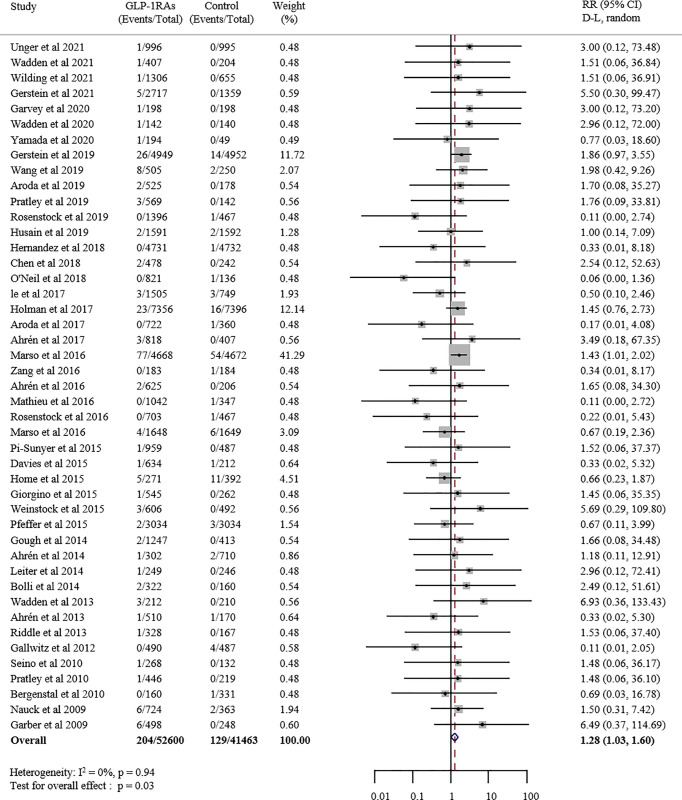
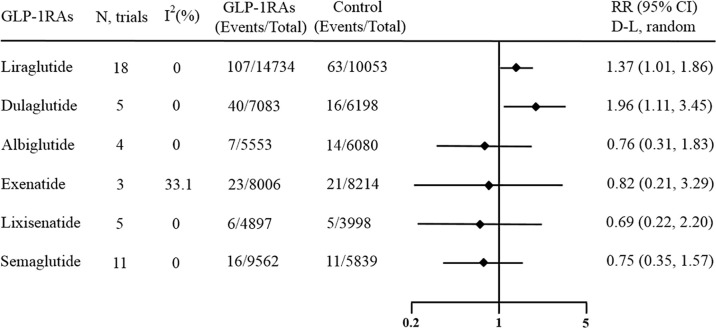
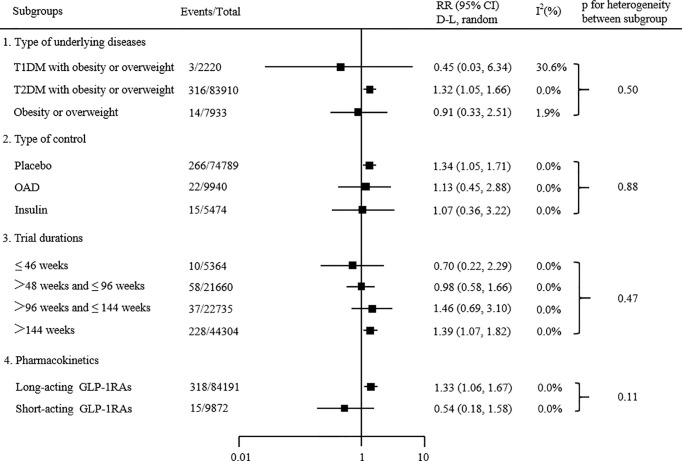
The association between glucagon-like peptide-1 (GLP-1) receptor agonists and the risk of various kinds of thyroid disorders remains uncertain. We aimed to evaluate the relationship between the use of GLP-1 receptor agonists and the occurrence of 6 kinds of thyroid disorders. We searched PubMed (MEDLINE), EMBASE, the Cochrane Central Register of Controlled Trials (CENTRAL) and Web of Science from database inception to 31 October 2021 to identify eligible randomized controlled trials (RCTs). We performed meta-analysis using a random-effects model to calculate risk ratios (RRs) and 95% confidence intervals (CIs). A total of 45 trials were included in the meta-analysis. Compared with placebo or other interventions, GLP-1 receptor agonists' use showed an association with an increased risk of overall thyroid disorders (RR 1.28, 95% CI 1.03-1.60). However, GLP-1 receptor agonists had no significant effects on the occurrence of thyroid cancer (RR 1.30, 95% CI 0.86-1.97), hyperthyroidism (RR 1.19, 95% CI 0.61-2.35), hypothyroidism (RR 1.22, 95% CI 0.80-1.87), thyroiditis (RR 1.83, 95% CI 0.51-6.57), thyroid mass (RR 1.17, 95% CI 0.43-3.20), and goiter (RR 1.17, 95% CI 0.74-1.86). Subgroup analyses and meta-regression analyses showed that underlying diseases, type of control, and trial durations were not related to the effect of GLP-1 receptor agonists on overall thyroid disorders (all P subgroup > 0.05). In conclusion, GLP-1 receptor agonists did not increase or decrease the risk of thyroid cancer, hyperthyroidism, hypothyroidism, thyroiditis, thyroid mass and goiter. However, due to the low incidence of these diseases, these findings need to be examined further.
Systematic review registration: PROSPERO https://www.crd.york.ac.uk/prospero/, identifier: CRD42021289121.
Keywords: GLP-1 receptor agonists; meta-analysis; randomized controlled trials; thyroid cancer; thyroid disorders.
Copyright © 2022 Hu, Song, Cheng, Liu, Guo, Tang, Zhang, Zhao, Li and Liu.
Conflict of interest statement
The authors declare that the research was conducted in the absence of any commercial or financial relationships that could be construed as a potential conflict of interest.
Figures
References
Publication types
MeSH terms
Substances
LinkOut - more resources
Full Text Sources
Medical
