Exploring the Limits of Polyhydroxyalkanoate Production by Municipal Activated Sludge
- PMID: 35900322
- PMCID: PMC9387092
- DOI: 10.1021/acs.est.2c03043
Exploring the Limits of Polyhydroxyalkanoate Production by Municipal Activated Sludge
Abstract
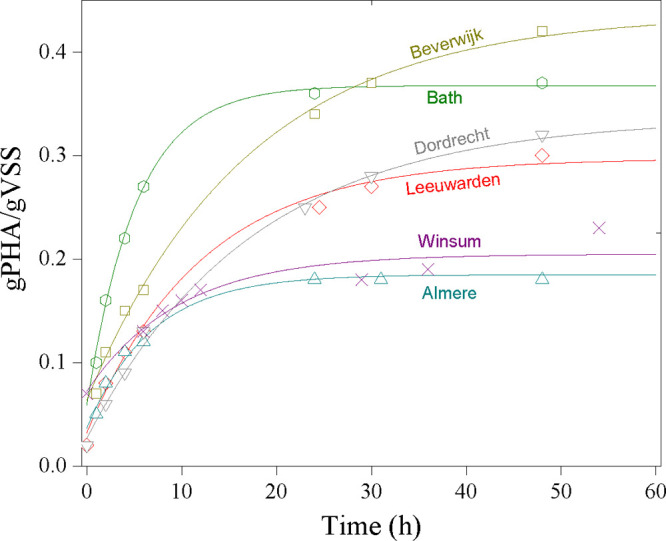
Municipal activated sludge can be used for polyhydroxyalkanoate (PHA) production, when supplied with volatile fatty acids. In this work, standardized PHA accumulation assays were performed with different activated sludge to determine (1) the maximum biomass PHA content, (2) the degree of enrichment (or volume-to-volume ratio of PHA-accumulating bacteria with respect to the total biomass), and (3) the average PHA content in the PHA-storing biomass fraction. The maximum attained biomass PHA content with different activated sludge ranged from 0.18 to 0.42 gPHA/gVSS, and the degree of enrichment ranged from 0.16 to 0.51 volume/volume. The average PHA content within the PHA-accumulating biomass fraction was relatively constant and independent of activated sludge source, with an average value of 0.58 ± 0.07 gPHA/gVSS. The degree of enrichment for PHA-accumulating bacteria was identified as the key factor to maximize PHA content when municipal activated sludge is directly used for PHA accumulation. Future optimization should focus on obtaining a higher degree of enrichment of PHA-accumulating biomass, either through selection during wastewater treatment or by selective growth during PHA accumulation. A PHA content in the order of 0.6 g PHA/g VSS is a realistic target to be achieved when using municipal activated sludge for PHA production.
Keywords: activated sludge; biopolymers; municipal wastewater treatment; polyhydroxyalkanoate (PHA); resource recovery.
Conflict of interest statement
The authors declare no competing financial interest.
Figures


References
-
- Kehrein P.; Van Loosdrecht M.; Osseweijer P.; Garfí M.; Dewulf J.; Posada J. A critical review of resource recovery from municipal wastewater treatment plants-market supply potentials, technologies and bottlenecks. Environmental Science: Water Research and Technology 2020, 6 (4), 877–910. 10.1039/c9ew00905a. - DOI
-
- Orhon D. Evolution of the activated sludge process: The first 50 years. J. Chem. Technol. Biotechnol. 2015, 90 (4), 608–640. 10.1002/jctb.4565. - DOI
Publication types
MeSH terms
Substances
LinkOut - more resources
Full Text Sources