


High HIV prevalence and associated factors in Lesotho: Results from a population-based survey
- PMID: 35901094
- PMCID: PMC9333200
- DOI: 10.1371/journal.pone.0271431
High HIV prevalence and associated factors in Lesotho: Results from a population-based survey
Abstract
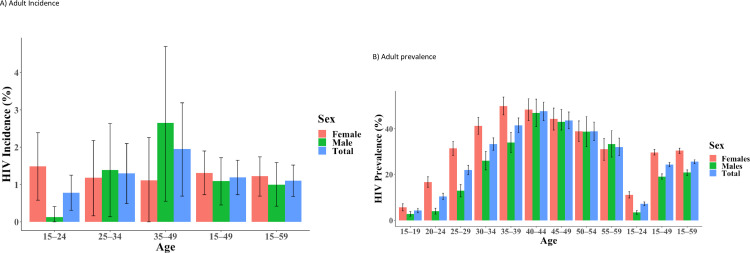
Despite extensive global efforts, sub-Saharan Africa remains disproportionately affected by the HIV epidemic. This generalized epidemic can be seen in Lesotho which in 2014 the HIV prevalence rate of those aged 15-49 years was 24.6%, with and incidence of 1.9 new infections per 100-person-year exposures. To better understand the impact of Lesotho's national HIV response and significant predictors associated with HIV infection, the Lesotho Population-based HIV Impact Assessment was conducted. This survey provided a nationally representative sample of individuals aged 15-59 years old in which participants were tested for HIV and given an individual questionnaire that included socio-demographic and behavioral risk questions. The association of factors between survey questions and HIV incident was assessed using logistic regression. Multivariate logistic regression models for men and women were constructed for each outcome using variables known to be or plausibly associated with recent or chronic infection. Overall annualized incidence among people aged 15-49 was 1.19% (95% CI 0.73-1.65) per year. The overall prevalence of HIV was 25.6% with women having significantly higher prevalence. Multiple variables, including decreased wealth status, lower education levels, marital status, condom use at first sex, and circumcision (men only) were identified as being significantly associated with HIV infection for both men and women. In combination with improving the awareness of HIV status, an increased focus is needed on AGYW and men 35-49 years old to prevent new infections. HIV education and prevention programs should focus heavily on younger age groups prior to and soon after sexual debut to prevent HIV transmission. The findings of the survey showed significant room for improvement in increasing awareness of HIV status and reinforcing the need for continued HIV prevention and treatment efforts in Lesotho to prevent new infections.
Conflict of interest statement
The authors have declared that no competing interests exist.
Figures
References
-
- Stockdale AJ, Saunders MJ, Boyd MA, Bonnett LJ, Johnston V, Wandeler G, et al. Effectiveness of protease inhibitor/nucleos(t)ide reverse transcriptase inhibitor–based second-line antiretroviral therapy for the treatment of human immunodeficiency virus type 1 infection in sub-Saharan Africa: a systematic review and meta-analysis. Clinical Infectious Diseases 2018; 66 (12):1846–1857. doi: 10.1093/cid/cix1108 - DOI - PMC - PubMed
-
- Takarinda KC, Madyira LK, Mhangara M, Makaza V, Maphosa-Mutsaka M, Rusakaniko S, et al. Factors associated with ever being HIV-tested in Zimbabwe: an extended analysis of the Zimbabwe Demographic and Health Survey (2010–2011). PLoS One 2016; 11(1); e0147828. doi: 10.1371/journal.pone.0147828 - DOI - PMC - PubMed
-
- Treves-Kaga S, El Ayadi AM, Pettifor A, MacPhail C, Twine R, Maman S, et al. Gender, HIV testing and stigma: the association of HIV testing behaviors and community-level and individual-level stigma in rural South Africa differ for men and women. AIDS and Behavior 2017; 21:2579–2588. doi: 10.1007/s10461-016-1671-8 - DOI - PMC - PubMed
Publication types
MeSH terms
Grants and funding
LinkOut - more resources
Full Text Sources
Medical
