


Biopsychosocial impact on caregivers of head and neck cancer patients undergoing radiotherapy at a tertiary care hospital
- PMID: 35903207
- PMCID: PMC9319181
- DOI: 10.5114/wo.2022.116275
Biopsychosocial impact on caregivers of head and neck cancer patients undergoing radiotherapy at a tertiary care hospital
Abstract
Introduction: Patients diagnosed with head and neck cancer are often subjected to an array of unprecedented challenges, which have seldom been scrutinized in other cancers, such as prolonged restrictions in their capaci-ty to breathe, speak, and swallow, considerable deformity, and an alleviated risk of death. These predicaments have consequential repercussions on the psychological well-being of patients, and they debilitate the mental, social, and financial facet of not only the patient's but also of the caregiver's lives, placing them in a state of constant uncertainty while also deteriorating their physical and mental health. Aim of the study was to assess the burden on the caregiver and their quality of life (QOL) using the Caregiver Quality of Life Index-Cancer (CQOLC) scale by comparing the sali-vary cortisol levels of caregivers at different intervals of the radiotherapy session.
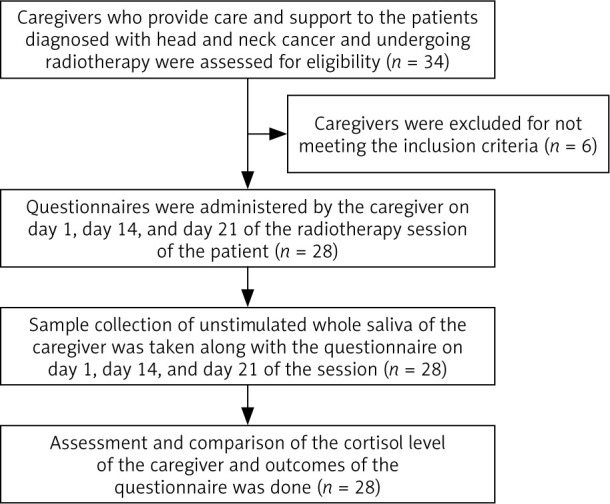
Materials and methods: The current study was a prospective cohort study conducted on 28 caregivers of patients undergoing radiotherapy, aged 15 years and more. The entire collection of saliva samples of each of the caregivers was collected on day 1, day 14, and day 21 of the radiotherapy session while simultaneously handing out the CQOLC for them to fill out. The samples were later analysed using an ELISA kit to measure the cortisol levels.
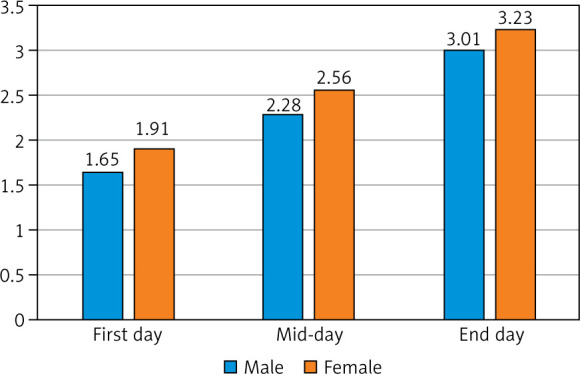
Results: On day 1 the QOL score was 1.97 ±0.28, on day 14 the QOL score was 2.53 ±0.31, and on day 21 the QOL score was 3.15 ±0.26, with a p-value of 0.0001 over the entire session. There was no statistically significant change in the salivary cortisol level. P < 0.05 is considered statistically significant.
Conclusions: The assessed quality of life portrayed a progressive decline over the calculated period, concluding that the radiotherapy sessions of the patients subjected the caregivers to distress. It was also found that the males had a noteworthy diminution in QOL compared to the females; however, there was no signifi-cant change in the cortisol level over the calculated period.
Keywords: caregivers; head and neck cancer; psychological distress; quality of life; radiotherapy; salivary cortisol.
Copyright © 2022 Termedia.
Conflict of interest statement
The authors declare no conflict of interest.
Figures
References
-
- World Health Organization . World Health Statistics 2019: Monitoring Health for the SDGs. Geneva, Switzerland, 2018.
-
- National Cancer Institute . Radiation Therapy to Treat Cancer. USA, 2019.
-
- Zeller JL. High suicide risk found for patients with head and neck cancer. JAMA 2006; 296: 1716-1717. - PubMed
-
- Babin E, Sigston E, Hitier M, Dehesdin D, Marie JP, Choussy O. Quality of life in head and neck cancers patients: predictive factors, functional and psychosocial outcome. Eur Arch Otorhinolaryngol 2008; 265: 265-270. - PubMed
LinkOut - more resources
Full Text Sources
