


The perceived credibility of repeated-event witnesses depends upon their veracity
- PMID: 35903504
- PMCID: PMC9318215
- DOI: 10.1080/13218719.2021.1956382
The perceived credibility of repeated-event witnesses depends upon their veracity
Abstract
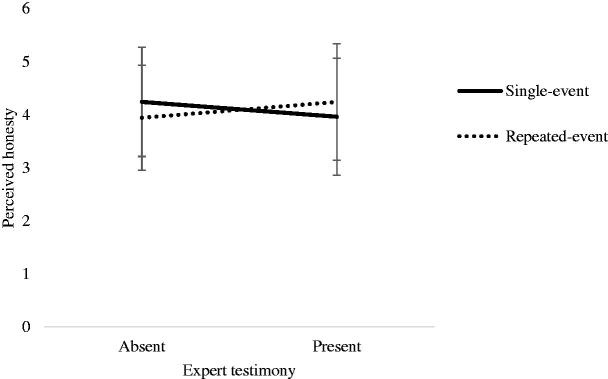
For repeated crimes like domestic violence and workplace bullying, the primary evidence is often the alleged victim's testimony. Consequently, the perceived credibility of repeated event speakers can be pivotal to legal proceedings. In order to investigate perceptions of truthful and deceptive repeated-event speakers, undergraduate students observed interviews of speakers describing a single occurrence of an event that was either experienced or fabricated either once or multiple times. Some participants additionally read an expert statement on repeated-event memory. The effect of repetition on perceived credibility depended on the speaker's veracity, enhancing the credibility of fabricators but diminishing the credibility of truth-tellers. The expert testimony was found to raise the perceived honesty and cognitive competence of the repeated-event speakers and thus could be a promising mechanism for enhancing perceived credibility in legal proceedings.
Keywords: credibility; credibility assessment; deception detection; decision making; eyewitness testimony; memory; repeated events.
© 2021 The Australian and New Zealand Association of Psychiatry, Psychology and Law.
Figures

References
-
- Alonso-Quecuty, M. (1992). Deception detection and reality monitoring: A new answer to an old question. In Losel F., Bender D., & Bliesener T. (Eds.), Psychology and law: International perspectives (pp. 328–332). Walter de Gruyter.
-
- Benton, T. R., Ross, D. F., Bradshaw, E., Thomas, W. N., & Bradshaw, G. S. (2006). Eyewitness memory is still not common sense: Comparing jurors, judges and law enforcement to eyewitness experts. Applied Cognitive Psychology, 20(1), 115–129. 10.1002/acp.1171 - DOI
-
- Cullen, H. J., & Monds, L. A. (2020). Jury simulation studies: To exclude or not to exclude participants based on a lack of comprehension of the case? Applied Cognitive Psychology, 34(5), 1224–1233. 10.1002/acp.3695 - DOI
LinkOut - more resources
Full Text Sources