


Balsam fir (Abies balsamea) needles and their essential oil kill overwintering ticks (Ixodes scapularis) at cold temperatures
- PMID: 35906288
- PMCID: PMC9338056
- DOI: 10.1038/s41598-022-15164-z
Balsam fir (Abies balsamea) needles and their essential oil kill overwintering ticks (Ixodes scapularis) at cold temperatures
Abstract
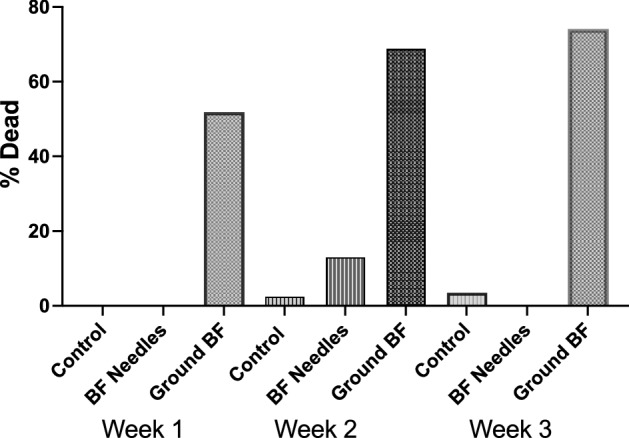
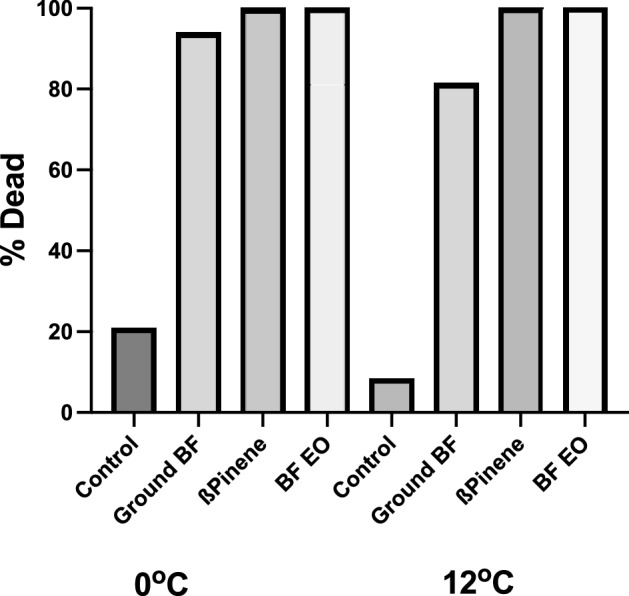
The blacklegged tick, Ixodes scapularis, vectors Borrelia burgdorferi, a bacterium that causes Lyme Disease. Although synthetic pesticides can reduce tick numbers, there are concerns about their potential effects on beneficial insects, such as pollinators. Plant-based pest control agents such as essential oils could provide an alternative because they have low environmental persistency; however, these products struggle to provide effective control. We found a new natural acaricide, balsam fir (Abies balsamea) needles, that kill overwintering I. scapularis ticks. We extracted the essential oil from the needles, analyzed its chemical composition, and tested it for acaricidal activity. We placed ticks in tubes with substrate and positioned the tubes either in the field or in incubators simulating winter temperatures. We added balsam fir essential oil, or one of the main components of balsam fir essential oil (i.e., ß-pinene), to each tube. We found that both the oil and ß-pinene kill overwintering ticks. Whole balsam fir needles require several weeks to kill overwintering ticks, while the essential oil is lethal within days at low temperatures (≤ 4 °C). Further, low temperatures increased the efficacy of this volatile essential oil. Higher temperatures (i.e., 20 °C) reduce the acaricidal effectiveness of the essential oil by 50% at 0.1% v/v. Low temperatures may promote the effectiveness of other natural control products. Winter is an overlooked season for tick control and should be explored as a possible time for the application of low toxicity products for successful tick management.
© 2022. The Author(s).
Conflict of interest statement
The authors declare no competing interests.
Figures

References
-
- Adenubi OT, et al. Pesticidal plants as a possible alternative to synthetic acaricides in tick control: A systematic review and meta-analysis. Ind. Crop. Prod. 2018;123:779–806. doi: 10.1016/j.indcrop.2018.06.075. - DOI
Publication types
MeSH terms
Substances
LinkOut - more resources
Full Text Sources
Medical
