. 2022 Jul 29;12(1):12994.
doi: 10.1038/s41598-022-16305-0.

ICAM-1-binding Plasmodium falciparum erythrocyte membrane protein 1 variants elicits opsonic-phagocytosis IgG responses in Beninese children

Affiliations

ICAM-1-binding Plasmodium falciparum erythrocyte membrane protein 1 variants elicits opsonic-phagocytosis IgG responses in Beninese children

Jennifer Suurbaar et al. Sci Rep. .

Abstract

Members of the highly polymorphic Plasmodium falciparum erythrocyte membrane protein 1 (PfEMP1) family expressed on the surface of infected erythrocytes (IEs) are important virulence factors, which mediate vascular adhesion of IEs via endothelial host receptors and are targets of naturally acquired immunity. The PfEMP1 family can be divided into clinically relevant subgroups, of which some bind intercellular adhesion molecule 1 (ICAM-1). While the acquisition of IgG specific for ICAM-1-binding DBLβ domains is known to differ between PfEMP1 groups, its ability to induce antibody-dependent cellular phagocytosis (ADCP) is unclear. We therefore measured plasma levels of DBLβ-specific IgG, the ability of such IgG to inhibit PfEMP1-binding to ICAM-1, and its ability to opsonize IEs for ADCP, using plasma from Beninese children with severe (SM) or uncomplicated malaria (UM). IgG specific for DBLβ from group A and B ICAM-1-binding PfEMP1 were dominated by IgG1 and IgG3, and were similar in SM and UM. However, levels of plasma IgG inhibiting ICAM-1-binding of group A DBLβ of PFD1235w was significantly higher in children with UM than SM, and acute UM plasma induced a higher ADCP response than acute SM plasma.


Conflict of interest statement

The authors declare no competing interests.

Figures
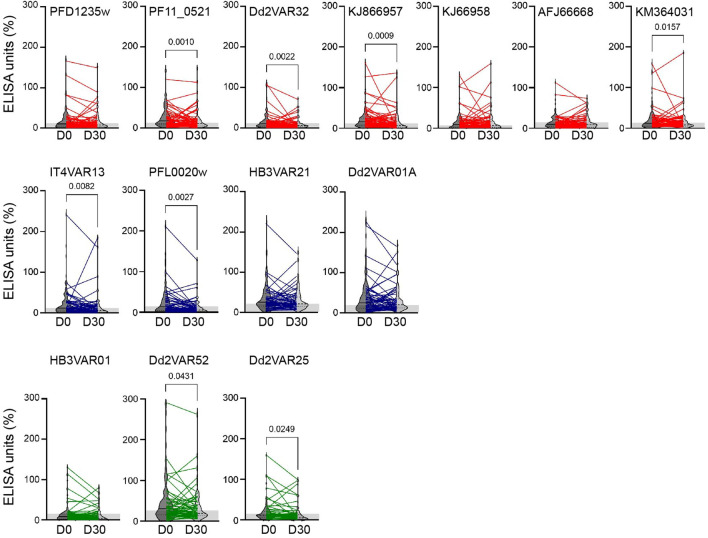
Figure 1
Figure 1
Plasma levels of IgG with specificity for P. falciparum DBLβ domains. Samples were obtained from 137 Beninese children at hospitalization (day 0) and at convalescence (day 30) following discharge from the hospital. Antibody levels (ELISA units; EU) in plasma from individual children against the ICAM-1-binding DBLβ of group A (top panel) PFD1235w, PF11_0521; Dd2VAR32, KJ866957, KJ866958, AFJ66668, KM364031, ICAM-1-binding group B (middle panel) IT4VAR13, PFL0020w, HB3VAR21, Dd2VAR01A, and non-ICAM-1-binding group A (bottom panel) DBLβ domains of HB3VAR01, Dd2VAR52, and Dd2VAR25. The violin plots show the median and interquartile range of all-day 0 and day 30 samples, lines show day 0 and day 30 values of paired samples i.e., same individual. Statistical significance comparing day 0 and day 30 was determined using Wilcoxon matched pairs signed rank test and significant P-values shown along the top of the panels. Thirty (30) non-exposed Danish individuals were included as negative controls (DK); the grey shaded area indicates sample reactivity below the cut-off (DK mean + 2SD).
Figure 2
Figure 2
Plasma IgG levels against DBLβ in children in matched children´s samples and clinical categories. The anti-DBLβ antibody reactivity (ELISA units; EU) of the individual children shown in Fig. 1 were grouped according to clinical disease category, i.e., severe malaria (SM including CM and nCSM; n = 28), and uncomplicated malaria (UM, n = 27) at the day 0 (hospitalization) and day 30 (convalescent) samples. The reactivity was measured against the same DBLβ domains as in Fig. 1. Statistical significance comparing the different groups was determined using Wilcoxon matched pairs signed rank test, no significant differences found.
Figure 3
Figure 3
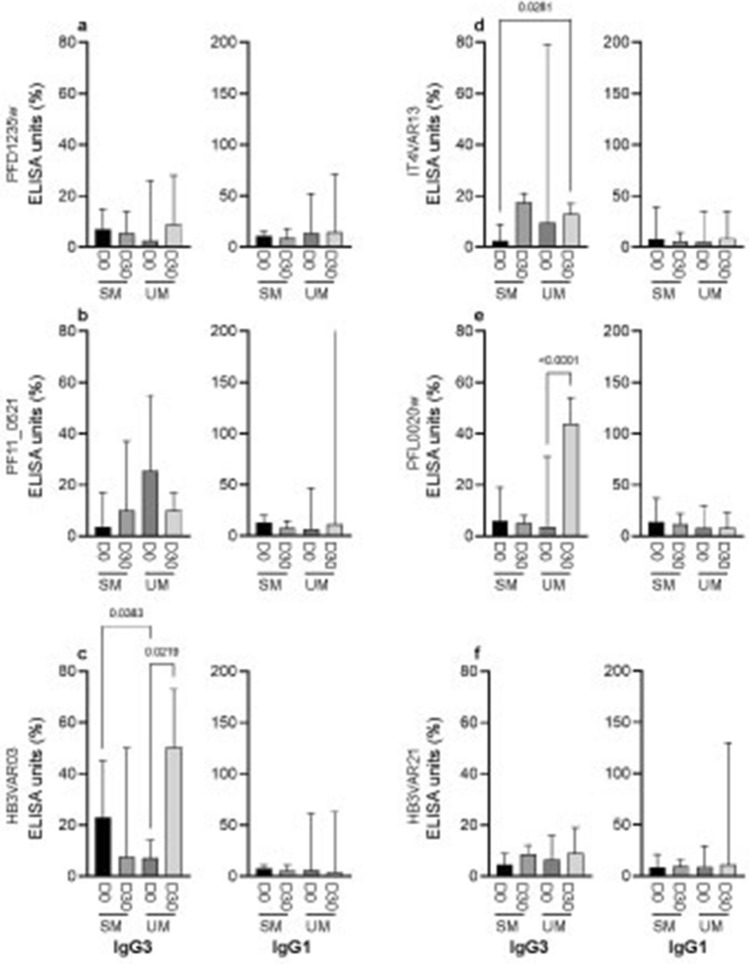
IgG subclass reactivity to group A and B ICAM-1-binding DBLβ domains. IgG1-4 antibody levels (ELISA units; EU) were measured in day 0 plasma samples from 84 of 137 Beninese children against DBLβ of group A (a) PFD1235w, (b) PF11_0521, (c) HB3VAR03, and group B (d) IT4VAR13, (e) PFL0020w, and (f) HB3VAR21. The anti-DBLβ antibody reactivity (ELISA units; EU) of the individual children were grouped according to clinical disease category, i.e., severe malaria (SM including CM and nCSM), and uncomplicated malaria (UM). The IgG2 and IgG4 median EU levels against any of the proteins were ≤ 9 EU (data not shown). Bars indicate the median and interquartile range. Statistical significance was determined using Wilcoxon matched pairs signed rank test and significant P-values shown along the top of the panel.
Figure 4
Figure 4
Plasma IgG inhibition of PfEMP1 DBLβ domain binding to ICAM-1. The percentage (%) binding inhibition of individual plasma samples from Beninese children collected at hospitalization (day 0) and at convalescence (day 30) and for different clinical categories (CM, nCSM, UM) at hospitalization. (a) The percentage (%) binding inhibition of individual plasma samples were calculated compared to ICAM-1-binding of DBLβ in the absence of plasma. The inhibition was measured for group A (a1) PFD1235w [(day 0, n = 50; day 30, n = 16), (CM, n = 13; nCSM, n = 19; UM, n = 19)] and (a2) A HB3VAR03 [(day 0, n = 53; day 30, n = 14), (CM, n = 16; nCSM, n = 17; UM, n = 20)], group B (a3) HB3VAR21 [(day 0, n = 50; day 30, n = 15), (CM, n = 13; nCSM, n = 14; UM, n = 23)] and (a4) IT4VAR13 [(day 0, n = 60; day 30, n = 13) (CM, n = 16; nCSM, n = 20; UM, n = 24)]. Statistical significance was determined using determined using Wilcoxon matched pairs signed rank test and significant P-values shown along the top of each panel. Black lines indicate the median and interquartile range. (b) The percentage inhibition of individual samples was correlated to the antibody reactivity (EU %) of each individual sample (day 0) using Spearman correlation test. Spearman´s correlation coefficient (rs) and P-value are shown in each panel, (c) The percentage ICAM-1-binding inhibition of plasma antibodies shown for each of the three clinical categories uncomplicated (UM), severe (SM), and cerebral malaria (CM) at day 0. Lines indicate the median and interquartile range. Red dots represent SM and/or CM samples.
Figure 5
Figure 5
Plasma IgG-mediated phagocytosis of DBLβ coated-beads. (a) The percentage (%) phagocytosis by individual plasma samples from Beninese children collected at hospitalization (day 0, n = 84) and at follow-up (day 30, n = 45) were calculated as the percentage of THP-1 cells that internalized coupled beads. Beads were coupled with either (a1) PFD1235w, (a2) HB3VAR03, (a3) HB3VAR21, or (a4) IT4VAR13. (a) Statistical significance was determined using unpaired Mann–Whitney test to compare D0 and D30 samples, Black lines indicate the median and interquartile range. (b) Statistical significance was determined using Wilcoxon matched pairs signed rank test and significant P-values shown along the top of the panels. Black lines indicate the median and interquartile range. (c) The percentage phagocytosis of individual samples was correlated to the antibody reactivity (EU %) of each individual sample (day 0) using Spearman correlation test. Spearman´s correlation coefficient (rs) and P-value are shown in each panel. Red dots (a, c) and red lines (b) represent SM samples (CM and nCSM). (d) The percentage of phagocytosis shown for each of the two clinical categories uncomplicated malaria (UM) and severe malaria (CM and nCSM) at day 0 and day 30. Box blot with 5 to 95% percentile. The multiple comparisons were performed by using a mixed-effect model (REML) in GraphPad Prism 9. Statistical significance is shown along the top of the panels.

References

    1. WHO, W. H. O. World malaria report 2021. (2021).
    1. Gumulira A. Malaria vaccine approval: A step change for global health. N. Engl. J. Med. 2021;385:1005–1017. doi: 10.1056/NEJMoa2026330. - DOI - PubMed
    1. Kurtovic L, Reiling L, Opi DH, Beeson JG. Recent clinical trials inform the future for malaria vaccines. Commun. Med. 2021;1:26. doi: 10.1038/s43856-021-00030-2. - DOI - PMC - PubMed
    1. Wahlgren M, Goel S, Akhouri RR. Variant surface antigens of Plasmodium falciparum and their roles in severe malaria. Nat. Rev. Microbiol. 2017;15:479–491. doi: 10.1038/nrmicro.2017.47. - DOI - PubMed
    1. Bull PC, et al. Parasite antigens on the infected red cell surface are targets for naturally acquired immunity to malaria. Nat. Med. 1998;4:358–360. doi: 10.1038/nm0398-358. - DOI - PMC - PubMed

Publication types

Substances