. 2022 Jul 29;22(1):826.
doi: 10.1186/s12885-022-09923-4.

Burden, trends, and risk factors for breast cancer in China from 1990 to 2019 and its predictions until 2034: an up-to-date overview and comparison with those in Japan and South Korea

Affiliations

Burden, trends, and risk factors for breast cancer in China from 1990 to 2019 and its predictions until 2034: an up-to-date overview and comparison with those in Japan and South Korea

Na Liu et al. BMC Cancer. .

Abstract

Background: The difference in epidemiological characteristics of breast cancer (BC) across countries is valuable for BC management and prevention. The study evaluated the up-to-date burden, trends, and risk factors of BC in China, Japan and South Korea during 1990-2019 and predicted the BC burden until 2034.

Methods: Data on incident cases, deaths, disability-adjusted life-years (DALYs) and age-standardized rate (ASR) of BC were extracted from the Global Burden of Disease Study 2019. Trend analysis and prediction until 2034 were conducted by estimated annual percentage change and a Bayesian age-period-cohort model, respectively. Besides, the attributable burden to BC risk factors was also estimated.

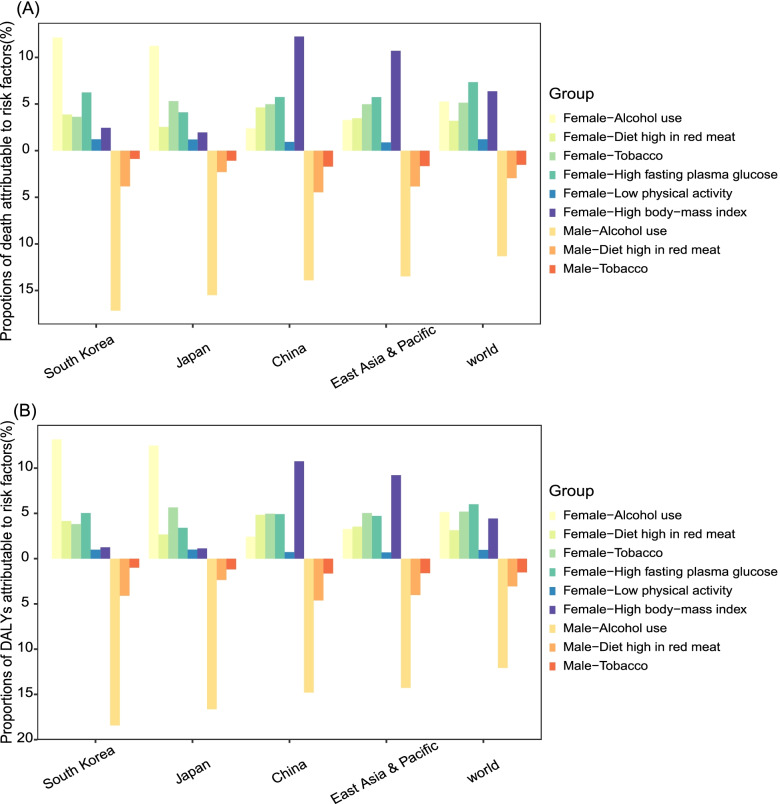
Results: In 2019, the number of BC incident cases, deaths and DALYs in China were 375,484, 96,306 and 2,957,453, respectively. The ASR of incidence increased, while that of death and DALYs decreased for Chinese females and Japanese and South Korean males during 1990-2019. High body-mass-index (BMI) was the largest contributor to Chinese female BC deaths and DALYs, while alcohol use was the greatest risk factor for Japanese and South Korean as well as Chinese males. The incident cases and deaths were expected to continue increase during 2020-2034 (except for Japanese female incident cases).

Conclusions: China had the greatest burden of BC among the three countries. Incident cases and deaths of BC were projected to increase over the next 15 years in China, particularly among Chinese males. Effective prevention and management strategies are urgently necessary for BC control in China.

Keywords: Breast cancer; Prediction; Risk factor; Trend.


Conflict of interest statement

No potential conflicts of interest are disclosed.

Figures
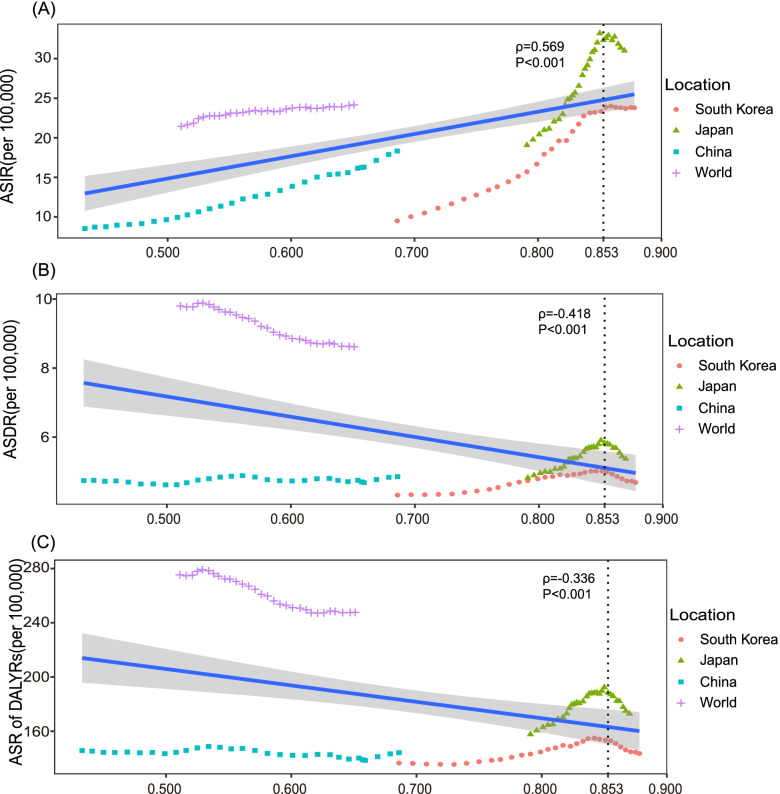
Fig. 1
Fig. 1
The trends in ASIR A, ASDR B and ASR of DALYs C of breast cancer in China, Japan, South Korea and the world by socio-demographic index for both sexes combined, 1990 to 2019. Expected values are shown as the blue line. ASIR, age-standardized incidence rate; ASDR, age-standardized death rate; ASR, age-standardized rate; DALYs, disability-adjusted life-years. The ρ was the Pearson correlation coefficient. The P values were derived from the Pearson correlation test
Fig. 2
Fig. 2
Proportions of Deaths A and DALYs B attributable to risk factors for female and male breast cancer in China, Japan, South Korea, East Asia and Pacific and the world in 2019. DALYs, disability-adjusted life-years
Fig. 3
Fig. 3
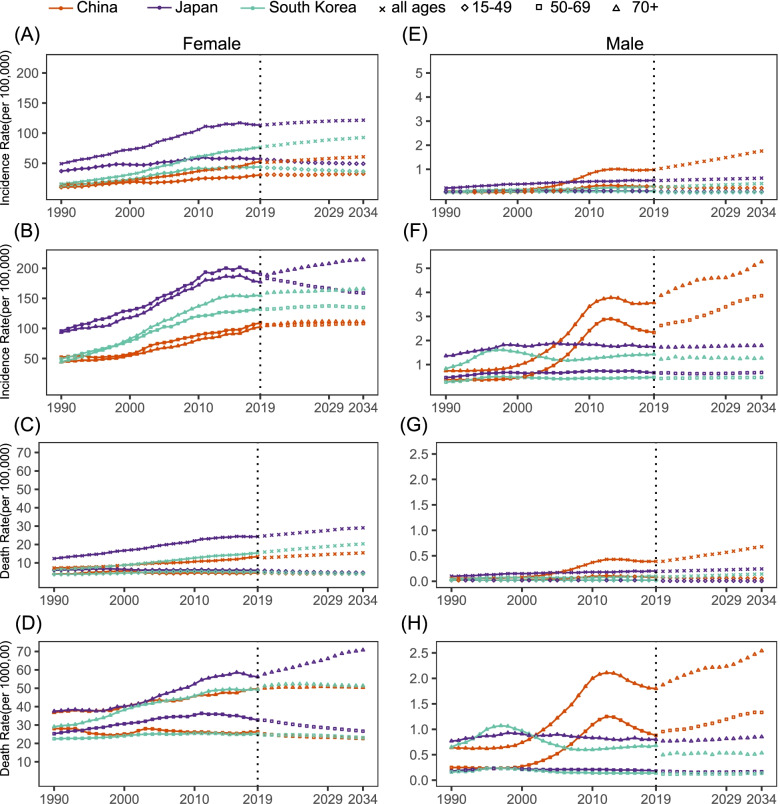
Trends in age-specific incidence and death rates during 1990–2019 and predictions from 2020 to 2034 in China, Japan and South Korea. A-B Female incidence; C-D Female death; EF Male incidence; H-I Male death. The solid lines represent the observed value and the dots represent the estimated and predicted value calculated by Bayesian age-period-cohort modeling and prediction (BAMP) model; The vertical dashed grey line indicates year of 2019
Fig. 4
Fig. 4
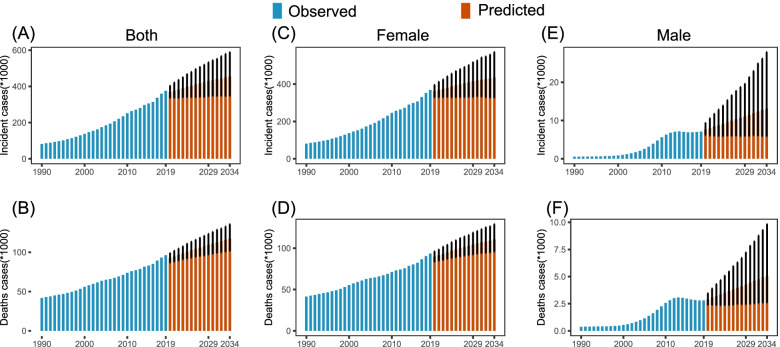
The number of incident cases and deaths during 1990–2019 and projected from 2020 to 2034 in China. A-B Both sexes; C-D Female; EF Male. The error bar indicates 95% confidence interval (CI) of the number

References

    1. Sung H, Ferlay J, Siegel RL, Laversanne M, Soerjomataram I, Jemal A, et al. Global Cancer Statistics 2020: GLOBOCAN Estimates of Incidence and Mortality Worldwide for 36 Cancers in 185 Countries. CA Cancer J Clin. 2021;71(3):209–249. doi: 10.3322/caac.21660. - DOI - PubMed
    1. Konduri S, Singh M, Bobustuc G, Rovin R, Kassam A. Epidemiology of male breast cancer. Breast. 2020;54:8–14. doi: 10.1016/j.breast.2020.08.010. - DOI - PMC - PubMed
    1. Abdelwahab Yousef AJ. Male Breast Cancer: Epidemiology and Risk Factors. Semin Oncol. 2017;44(4):267–272. doi: 10.1053/j.seminoncol.2017.11.002. - DOI - PubMed
    1. Britt KL, Cuzick J, Phillips KA. Key steps for effective breast cancer prevention. Nat Rev Cancer. 2020;20(8):417–436. doi: 10.1038/s41568-020-0266-x. - DOI - PubMed
    1. Guan Z, Raut JR, Weigl K, Schottker B, Holleczek B, Zhang Y, et al. Individual and joint performance of DNA methylation profiles, genetic risk score and environmental risk scores for predicting breast cancer risk. Mol Oncol. 2020;14(1):42–53. doi: 10.1002/1878-0261.12594. - DOI - PMC - PubMed