Review
. 2022 Jul 29;23(1):725.
doi: 10.1186/s12891-022-05677-z.

Management of arthrofibrosis in neuromuscular disorders: a review

Affiliations
Review

Management of arthrofibrosis in neuromuscular disorders: a review

Edith Martinez-Lozano et al. BMC Musculoskelet Disord. .

Abstract

Arthrofibrosis, or rigid contracture of major articular joints, is a significant morbidity of many neurodegenerative disorders. The pathogenesis depends on the mechanism and severity of the precipitating neuromuscular disorder. Most neuromuscular disorders, whether spastic or hypotonic, culminate in decreased joint range of motion. Limited range of motion precipitates a cascade of pathophysiological changes in the muscle-tendon unit, the joint capsule, and the articular cartilage. Resulting joint contractures limit functional mobility, posing both physical and psychosocial burdens to patients, economic burdens on the healthcare system, and lost productivity to society. This article reviews the pathophysiology of arthrofibrosis in the setting of neuromuscular disorders. We describe current non-surgical and surgical interventions for treating arthrofibrosis of commonly affected joints. In addition, we preview several promising modalities under development to ameliorate arthrofibrosis non-surgically and discuss limitations in the field of arthrofibrosis secondary to neuromuscular disorders.

Keywords: Contractures; Neuromuscular; Range of motion; Surgery; Therapy.


Conflict of interest statement

The corresponding author (Edward K Rodriguez) is an associate editor of BMC Musculoskeletal Disorder. EKR, AN, and MWG are co-inventors on a patent application submitted to the USPTO on the use of human relaxin-2 as a treatment for arthrofibrosis. The patent application is available for licensing.

Figures

Fig. 1
Fig. 1
Motor Corticospinal Tract. Representation of the motor neuron pathway illustrating the anatomic site of lesion corresponding to each neuromuscular disorder [1, 4]
Fig. 2
Fig. 2
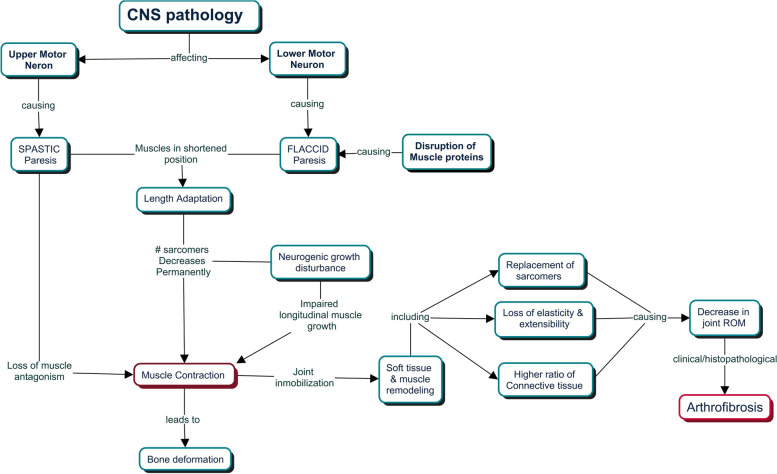
Pathophysiology of arthrofibrosis secondary to neuromuscular disorders. Central nervous system (CNS) disruptions can damage the Upper or Lower motor neuron. UMN lesions lack cortical inhibitory signaling but increase excitability in the gamma and alpha motor neurons (distally at the spinal cord), causing spastic paresis. Overactivated spastic muscles lose balance with their corresponding antagonist muscles and suffer from “pulling” the entire limb into a deformed posture. With time, the contracted (shortened) muscle undergoes length adaptation decreasing the number of sarcomeres continuously until it becomes a fixed muscle contraction. On the other hand, lesions in the spinal cord or peripheral axons represent LMN lesions. These lesions cause denervation, atrophy, and flaccid paralysis, leading to muscle contractures. Both UMN/LMN lesions may present neurogenic growth disturbances if the contractured muscle grows at a different rate than the bone (aggravating the contraction and leading to bone deformities). As the muscle shortens in patients with NMD, the joint becomes immobilized in an abnormal position. With time, pathophysiological changes in the muscle-tendon unit and the periarticular soft tissue occur, including 1) replacement of sarcomeres with fibrofatty connective tissue that will reach the joint space, 2) loss of elasticity and extensibility as the connective tissue forms more cross-bridges with collagen and 3) a higher ratio of connective to contractile tissue (as the connective tissue loss is less rapidly). All this together will ultimately cause arthrofibrosis with a decrease in ROM both histologically and clinically. [References] [, , –12]
Fig. 3
Fig. 3
Representation of knee arthrofibrosis and available treatment therapies. *Intra-articular injections include corticosteroids and antifibrotic treatments such as novel relaxin-2 and collagenase

References

    1. Johnson ER, Fowler WM, Lieberman JS. Contractures in neuromuscular disease. Arch Phys Med Rehabil. 1992. 10.5555/uri:pii:000399939290149Q. - PubMed
    1. Skalsky AJ, McDonald CM. Prevention and management of limb contractures in neuromuscular diseases. Phys Med Rehabil Clin N Am. 2012;23:675–687. - PMC - PubMed
    1. Larkindale J, Yang W, Hogan PF, Simon CJ, Zhang Y, Jain A, et al. Cost of illness for neuromuscular diseases in the United States. Muscle Nerve. 2014. 10.1002/mus.23942. - PubMed
    1. Ragagnin AMG, Shadfar S, Vidal M, Jamali MS, Atkin JD. Motor neuron susceptibility in ALS/FTD. Front Neurosci. 2019;13:532. - PMC - PubMed
    1. Purves D, Augustine G, Fitzpatrick D, Katz L, LaMantia A-S, McNamara J, et al. Neuroscience. 2nd ed. Sunderland (MA): Sinauer Associates; 2001.