


What fragile factors hinder the pace of China's alleviation efforts of the poverty-stricken population? A study from the perspective of impoverishment caused by medical expenses
- PMID: 35906603
- PMCID: PMC9336080
- DOI: 10.1186/s12913-022-08237-2
What fragile factors hinder the pace of China's alleviation efforts of the poverty-stricken population? A study from the perspective of impoverishment caused by medical expenses
Abstract
Objective: China has made remarkable achievements in poverty alleviation. However, with the change in economic development and age structure, the population stricken by poverty due to medical expenses and disability accounted for 42.3 and 14.4% of the total poverty-stricken population, respectively. Accordingly, it is crucial to accurately pinpoint the characteristics of people who are about to become poor due to illness. In this study, we analyzed the incidence of impoverishment by medical expense at the provincial, family, and different medical insurance scheme levels to identify the precise groups that are vulnerable to medical-related poverty.
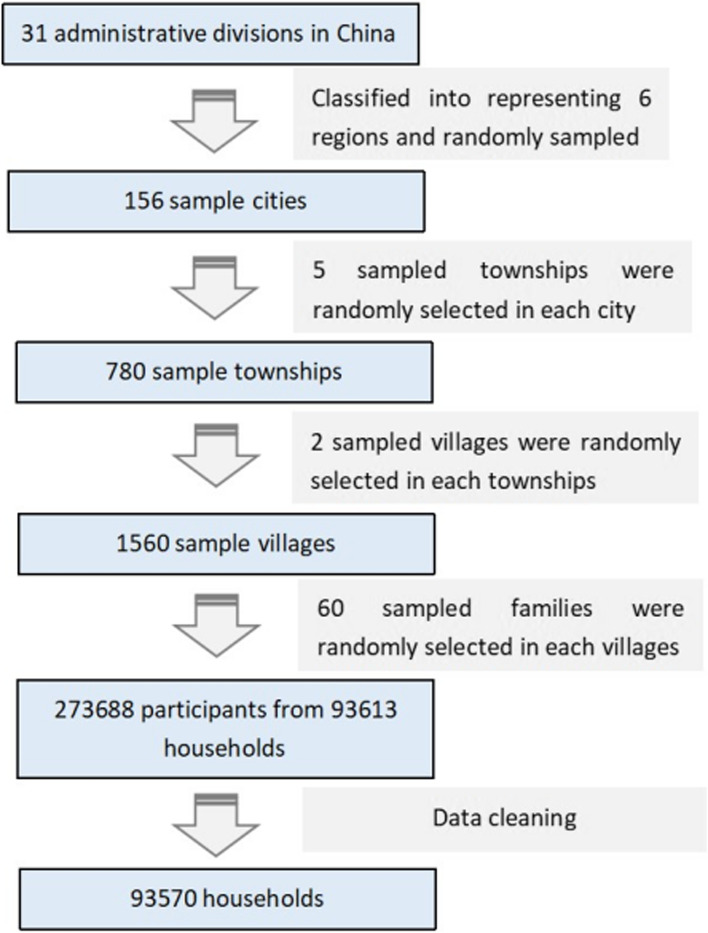
Method: Data were extracted from the Fifth National Health Service Survey in China in 2013 through a multi-stage, stratified, and random sampling method, leaving 93,570 households (273,626 people) for the final sample. The method recommended by World Health Organization (WHO) was adopted to calculate impoverishment by medical expense, and logistic regression was adopted to evaluate its determinants.
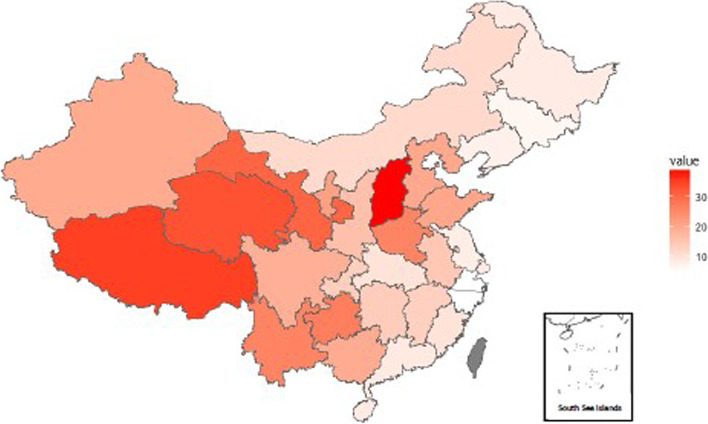
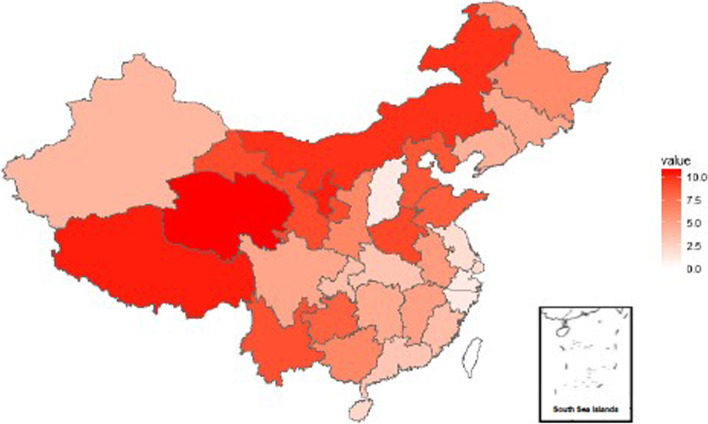
Results: The poverty and impoverishment rate in China were 16.2 and 6.3% respectively. The poverty rate in western region was much higher than that of central and eastern regions. The rate of impoverishment by medical expense (IME) was higher in the western region (7.2%) than that in the central (6.5%) and eastern (5.1%) regions. The New Cooperative Medical Scheme (NCMS) was associated with the highest rate (9.1%) of IME cases. The top three diseases associated with IME were malignant tumor, congenital heart disease, and mental disease. Households with non-communicable disease members or hospitalized members had a higher risk on IME. NCMS-enrolled, poorer households were more likely to suffer from IME.
Conclusion: The joint roles of economic development, health service utilization, and welfare policies result in medical impoverishment for different regions. Poverty and health service utilization are indicative of households with high incidence of medical impoverishment. Chronic diseases lead to medical impoverishment. The inequity existing in different medical insurance schemes leads to different degrees of risk of IME. A combined strategy to precise target multiple vulnerabilities of poor population would be more effective.
Keywords: China; Financial protection; Medical impoverishment; Poverty alleviation.
© 2022. The Author(s).
Conflict of interest statement
The authors declare that they have no competing interests.
Figures
Similar articles
-
Does the medical insurance system really achieved the effect of poverty alleviation for the middle-aged and elderly people in China? Characteristics of vulnerable groups and failure links.BMC Public Health. 2020 Apr 3;20(1):435. doi: 10.1186/s12889-020-08554-3. BMC Public Health. 2020. PMID: 32245435 Free PMC article.
-
Targeting vulnerable groups of health poverty alleviation in rural China- what is the role of the New Rural Cooperative Medical Scheme for the middle age and elderly population?Int J Equity Health. 2020 Sep 14;19(1):161. doi: 10.1186/s12939-020-01236-x. Int J Equity Health. 2020. PMID: 32928229 Free PMC article.
-
Health poverty reduction effect of medical insurance in China's middle-aged and elderly populations: a cross-sectional study.BMJ Open. 2025 Apr 27;15(4):e085226. doi: 10.1136/bmjopen-2024-085226. BMJ Open. 2025. PMID: 40288789 Free PMC article.
-
Can the reform of integrating health insurance reduce inequity in catastrophic health expenditure? Evidence from China.Int J Equity Health. 2020 Apr 3;19(1):49. doi: 10.1186/s12939-020-1145-5. Int J Equity Health. 2020. PMID: 32245473 Free PMC article.
-
Health Poverty Reduction Policies and Effectiveness Evaluation in China Since 2015: A Narrative Review.Inquiry. 2025 Jan-Dec;62:469580251337232. doi: 10.1177/00469580251337232. Epub 2025 May 16. Inquiry. 2025. PMID: 40376926 Free PMC article. Review.
Cited by
-
Knowledge, attitude, and practice (KAP) towards pulmonary nodules among Chinese adults: a mediation analysis.Sci Rep. 2024 Nov 22;14(1):28950. doi: 10.1038/s41598-024-79657-9. Sci Rep. 2024. PMID: 39578539 Free PMC article.
-
Estimating weight for multidimensional health poverty using Delphi method and analytic hierarchy process: a case of China.BMC Public Health. 2024 Oct 21;24(1):2908. doi: 10.1186/s12889-024-20406-y. BMC Public Health. 2024. PMID: 39434048 Free PMC article.
-
Ottawa ankle and foot rules in China: applicability in a defensive environment.Eur J Med Res. 2025 Jul 30;30(1):687. doi: 10.1186/s40001-025-02961-1. Eur J Med Res. 2025. PMID: 40739246 Free PMC article.
-
The impact of national comprehensive medical reform on residents' medical expenses: Evidence from China.Front Public Health. 2023 Jan 5;10:1038543. doi: 10.3389/fpubh.2022.1038543. eCollection 2022. Front Public Health. 2023. PMID: 36684899 Free PMC article.
-
Perspectives and evaluation on the effect of financial burden relief of medical insurance for people with catastrophic diseases and its influencing factors.Front Public Health. 2023 Apr 6;11:1123023. doi: 10.3389/fpubh.2023.1123023. eCollection 2023. Front Public Health. 2023. PMID: 37089514 Free PMC article.
References
-
- Xinhua News. (Authorized to publish) Xi Jinping: Speech at the Symposium on Decisive Victory of Poverty Alleviation. 2020. http://www.xinhuanet.com/politics/leaders/2020-03/06/c_1125674682.htm (Accessed 11 Apr 2021).
-
- Saunders P: Towards a credible poverty framework: from income poverty to deprivation. uncategorised 2004.
-
- Townsend P. Measuring poverty. Br J Sociol. 1954;5(2):130–137. doi: 10.2307/587651. - DOI
-
- Gu X. International exploration of poverty measurement and definition of China's poverty line. Tianjin Sociol Sci. 2011;(01):56–62+65.
-
- Zhang Q. Relative poverty standard and the ratio of relative poverty population. Stat Decision. 2012;06:87–88.
MeSH terms
LinkOut - more resources
Full Text Sources
