Review
. 2022 Aug;24(4):661-670.
doi: 10.1007/s10126-022-10144-w. Epub 2022 Jul 30.

Molecular Regulation of Biosynthesis of Long Chain Polyunsaturated Fatty Acids in Atlantic Salmon

Affiliations
Review

Molecular Regulation of Biosynthesis of Long Chain Polyunsaturated Fatty Acids in Atlantic Salmon

Alex K Datsomor et al. Mar Biotechnol (NY). 2022 Aug.

Abstract

Salmon is a rich source of health-promoting omega-3 long chain polyunsaturated fatty acids (n-3 LC-PUFA), such as eicosapentaenoic acid (EPA, 20:5n-3) and docosahexaenoic acid (DHA, 22:6n-3). The LC-PUFA biosynthetic pathway in Atlantic salmon is one of the most studied compared to other teleosts. This has largely been due to the massive replacement of LC-PUFA-rich ingredients in aquafeeds with terrestrial plant oils devoid of these essential fatty acids (EFA) which ultimately pushed dietary content towards the minimal requirement of EFA. The practice would also reduce tissue content of n-3 LC-PUFA compromising the nutritional value of salmon to the human consumer. These necessitated detailed studies of endogenous biosynthetic capability as a contributor to these EFA. This review seeks to provide a comprehensive and concise overview of the current knowledge about the molecular genetics of PUFA biosynthesis in Atlantic salmon, highlighting the enzymology and nutritional regulation as well as transcriptional control networks. Furthermore, we discuss the impact of genome duplication on the complexity of salmon LC-PUFA pathway and highlight probable implications on endogenous biosynthetic capabilities. Finally, we have also compiled and made available a large RNAseq dataset from 316 salmon liver samples together with an R-script visualization resource to aid in explorative and hypothesis-driven research into salmon lipid metabolism.

Keywords: Atlantic salmon; Enzymology; Genome duplication; Nutritional regulation; Polyunsaturated fatty acids; Transcriptional control.


Conflict of interest statement

The authors declare no competing interests.

Figures
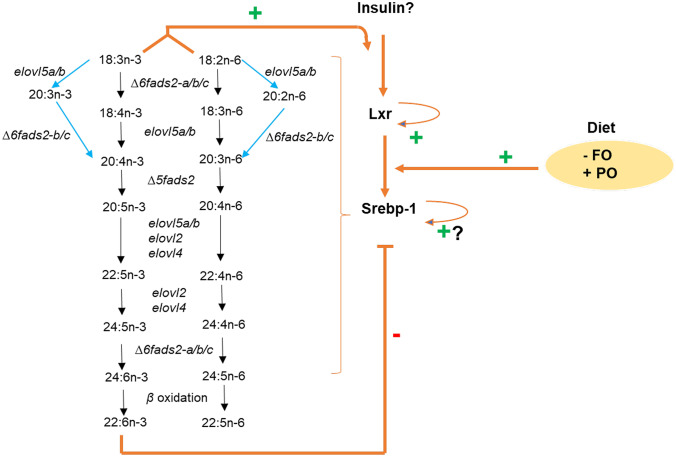
Fig. 1
Fig. 1
Transcriptional control of Atlantic salmon LC-PUFA biosynthetic pathway: interplay between PUFAs and the Lxr-Srebp-1 transcription regulatory pathway. Activities of enzymes in salmon LC-PUFA biosynthetic pathway have previously been assayed in vitro via heterologous expressional studies in Saccharomyces cerevisiae and to some extent in vivo for ∆6fads2-a (Datsomor et al. ; Zheng et al. 2005), ∆6fads2-b and ∆6fads2-c (Monroig et al. 2010), and ∆5fads2 (Hastings et al. 2004), and for the elongases elovl5 (elovl5a and elovl5b) (Hastings et al. ; Morais et al. 2009) and elovl2 (Datsomor et al. ; Morais et al. 2009). Heterologous expression studies have demonstrated that salmon ∆6 Fads2-b and ∆6 Fads2-c possess ∆8-desaturation activities (Monroig et al. 2011a, b), and similar results were obtained from in vivo CRISPR/Cas9 functional studies (Datsomor et al. 2019a). The ∆8-pathway is marked with blue arrows. Results so far suggest possible existence of the liver-x receptor (Lxr)-sterol regulatory element binding protein-1 (Srebp-1) pathway that controls salmon LC-PUFA biosynthetic pathway (Carmona-Antoñanzas et al. ; Minghetti et al. 2011). High dietary composition of the PUFA precursors, 18:3n-3 and 18:2n-6 (typical of plant oil–based diets), has been shown to induce the LC-PUFA pathway by increasing desaturation/elongation of PUFAs (Tocher et al. 2003) (denoted as a green plus sign), while high dietary levels of 20:5n-3 and especially 22:6n-3 (typical of fish oil–based diets) inhibit the LC-PUFA biosynthetic pathway (Minghetti et al. 2011) possibly via the Lxr-Srebp-1-dependent fashion (Carmona-Antoñanzas et al. ; Datsomor et al. ; Jin et al. , ; Minghetti et al. 2011); this is depicted as a red minus sign. Treatment of Atlantic salmon SHK-1 cells with GW3965, a potent and selective Lxr agonist induced lxrα expression suggesting possible autoregulation (Carmona-Antoñanzas et al. 2014). Furthermore, an analysis of putative transcription factor binding sites within salmon srebp-1 promoter revealed the presence of sterol regulatory element binding protein site (Grønvold et al. ; Samy et al. 2017), also suggesting probable self-regulation
Fig. 2
Fig. 2
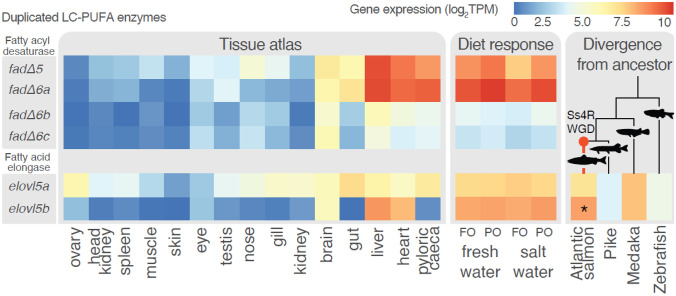
Comparing expression profiles of duplicated LC-PUFA enzymes; delta (Δ) 5 and 6 fatty acyl desaturases (fads); and the fatty acid elongases elovl5a and elovl5b genes. Heatmap shows gene expression levels measured in Transcripts Per Million (TPM) on a log2 scale, with the lowest values in blue and the highest in red. A common scale is used across genes and samples. Samples are from three experiments: first, tissue atlas data from Lien et al. (Lien et al. 2016) shows expression across 15 tissue types, where kidney indicated in the figure excludes the head kidney. Second, data from Gillard et al. (Gillard et al. 2018) shows liver expression response to two diets, fish oil (FO)– or plant oil (PO)–based diet, at two life stages, in freshwater or saltwater (mean of the day 20 samples). Lastly, data from Gillard et al. (Gillard et al. 2021) shows liver expression of elovl in Atlantic salmon compared to species without the salmonid-specific whole genome duplication (Ss4R WGD). Salmon elovl5b was found to have significantly (*p < 0.05) diverged from the ancestral state, with higher expression in salmonid livers

References

    1. Bell JG, McEvoy J, Tocher DR, McGhee F, Campbell PJ, Sargent JR. Replacement of fish oil with rapeseed oil in diets of Atlantic salmon (Salmo salar) affects tissue lipid compositions and hepatocyte fatty acid metabolism. J Nutr. 2001;131:1535–1543. doi: 10.1093/jn/131.5.1535. - DOI - PubMed
    1. Betancor MB, Olsen RE, Solstorm D, Skulstad OF, Tocher DR. Assessment of a land-locked Atlantic salmon (Salmo salar L.) population as a potential genetic resource with a focus on long-chain polyunsaturated fatty acid biosynthesis. Biochim Biophys Acta. 2016;1861:227–238. doi: 10.1016/j.bbalip.2015.12.015. - DOI - PubMed
    1. Bicskei B, Bron JE, Glover KA, Taggart JB (2014) A comparison of gene transcription profiles of domesticated and wild Atlantic salmon (Salmo salar L.) at early life stages, reared under controlled conditions. BMC Genom 15:884 - PMC - PubMed
    1. Bogevik AS, Hayman ES, Bjerke MT, Dessen JE, Rørvik KA, Luckenbach JA. Phospholipid and LC-PUFA metabolism in Atlantic salmon (Salmo salar) testes during sexual maturation. PLoS ONE. 2020;15:e0233322. doi: 10.1371/journal.pone.0233322. - DOI - PMC - PubMed
    1. Burdge GC. Is essential fatty acid interconversion an important source of PUFA in humans? Br J Nutr. 2019;121:615–624. doi: 10.1017/S0007114518003707. - DOI - PubMed

LinkOut - more resources