Associations of Serum Vitamin B6 Status and Catabolism With All-Cause Mortality in Patients With T2DM
- PMID: 35907182
- PMCID: PMC9516105
- DOI: 10.1210/clinem/dgac429
Associations of Serum Vitamin B6 Status and Catabolism With All-Cause Mortality in Patients With T2DM
Erratum in
-
Correction to: "Associations of Serum Vitamin B6 Status and Catabolism With All-Cause Mortality in Patients With T2DM".J Clin Endocrinol Metab. 2022 Dec 17;108(1):e16. doi: 10.1210/clinem/dgac552. J Clin Endocrinol Metab. 2022. PMID: 36250686 Free PMC article. No abstract available.
Abstract
Context: There is little evidence regarding the association between serum vitamin B6 status and catabolism and all-cause mortality in patients with type-2 diabetes mellitus (T2DM).
Objective: We aimed to ascertain if the serum level of vitamin B6 and catabolism, including pyridoxal 5'-phosphate (PLP) and 4-pyridoxic acid (4-PA), were associated with risk of all-cause mortality in T2DM patients.
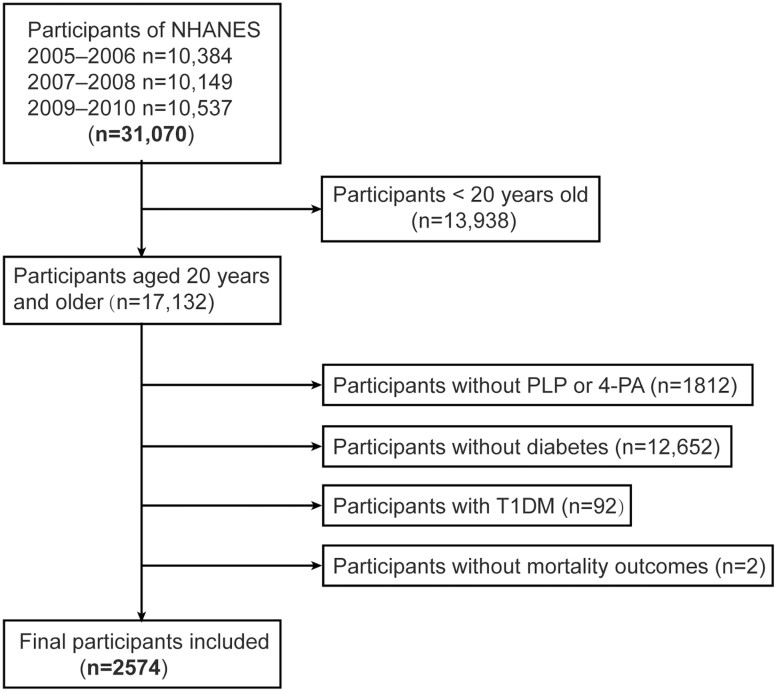
Methods: This prospective cohort study involved 2574 patients with T2DM who participated in the National Health and Nutrition Examination Survey (NHANES) from 2005 to 2010. The serum concentrations of PLP and 4-PA were used to assess the serum level of vitamin B6. Mortality status was determined by routine follow-up using the National Death Index through December 31, 2015.
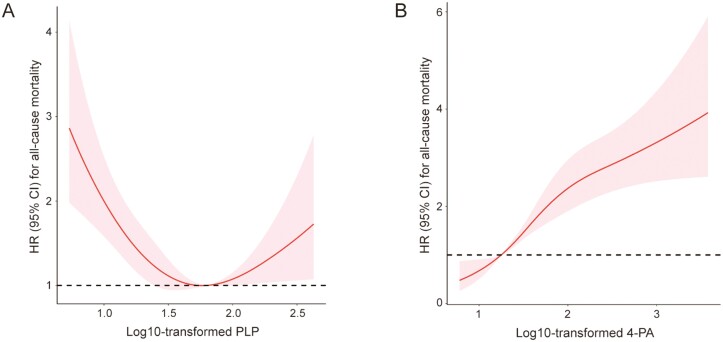
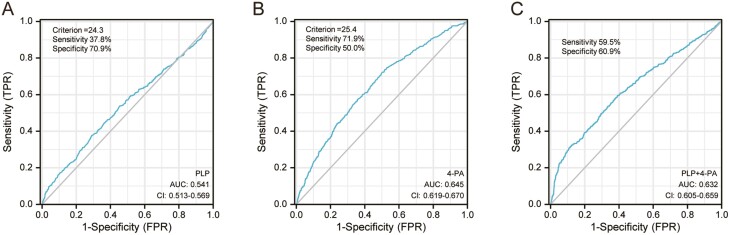
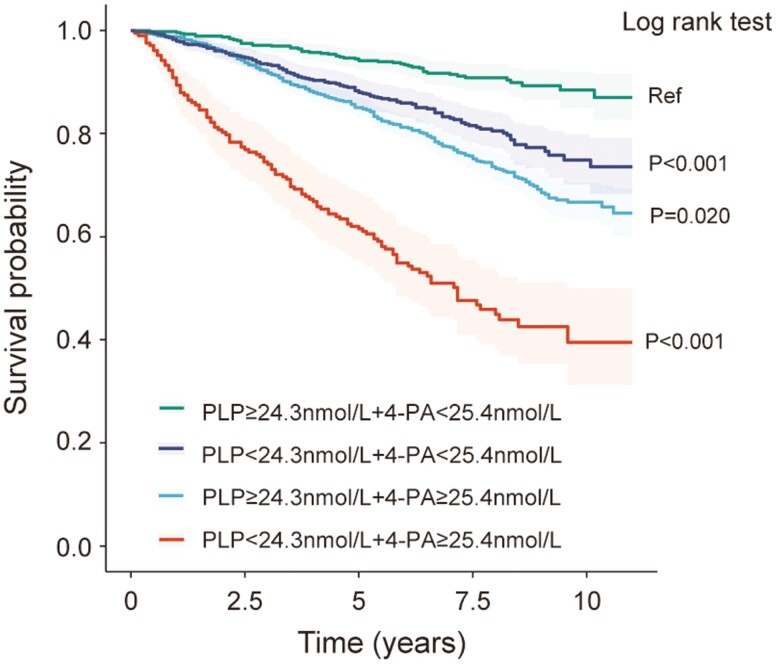
Results: Over a median follow-up of 85 months, there were 588 deaths. The fully adjusted Cox model indicated that the highest serum PLP concentrations (> 63.6 nmol/L) were associated with a decrease in all-cause mortality (hazard ratio [HR], 0.74; 95% CI, 0.55-0.99, P trend = .035). The risk for all-cause mortality was 59% higher for participants with the highest quartile of 4-PA level compared with the lowest quartile (HR, 1.62; 95% CI, 1.12-2.35; P trend = .003). The sensitivity and specificity of the combination of PLP and 4-PA levels for the prediction of all-cause mortality were 59.5% and 60.9%, respectively (area under the receiver operating characteristic curve = 0.632). The Kaplan-Meier method was used to estimate overall survival for patients based on different combinations of PLP level and 4-PA level. Patients with PLP less than 24.3 nmol/L and 4-PA greater than or equal to 25.4 nmol/L had the worst outcomes (log-rank P < .001).
Conclusion: Overall, our data suggest that a low serum level of PLP and high serum level of 4-PA, which represent the serum level of vitamin B6, increases the risk of all-cause mortality significantly in patients with T2DM.
Keywords: 4-pyridoxic acid (4-PA); NHANES; all-cause mortality; pyridoxal 5′-phosphate (PLP); serum vitamin B6; type 2 diabetes mellitus.
© The Author(s) 2022. Published by Oxford University Press on behalf of the Endocrine Society.
Figures
References
-
- Saeedi P, Petersohn I, Salpea P, et al. IDF Diabetes Atlas Committee. Global and regional diabetes prevalence estimates for 2019 and projections for 2030 and 2045: results from the International Diabetes Federation Diabetes Atlas, 9th edition. Diabetes Res Clin Pract. 2019;157:107843. doi: 10.1016/j.diabres.2019.107843 - DOI - PubMed
Publication types
MeSH terms
Substances
LinkOut - more resources
Full Text Sources
Medical
Research Materials