


Past, present and future distribution of the yellow fever mosquito Aedes aegypti: The European paradox
- PMID: 35907522
- PMCID: PMC9514036
- DOI: 10.1016/j.scitotenv.2022.157566
Past, present and future distribution of the yellow fever mosquito Aedes aegypti: The European paradox
Abstract
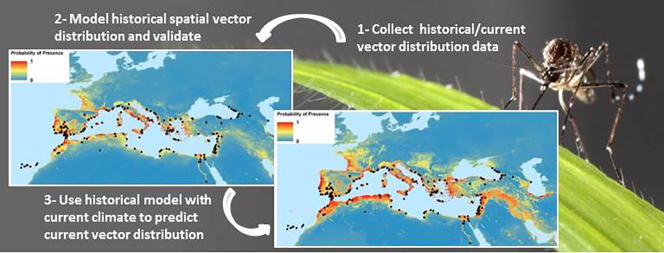
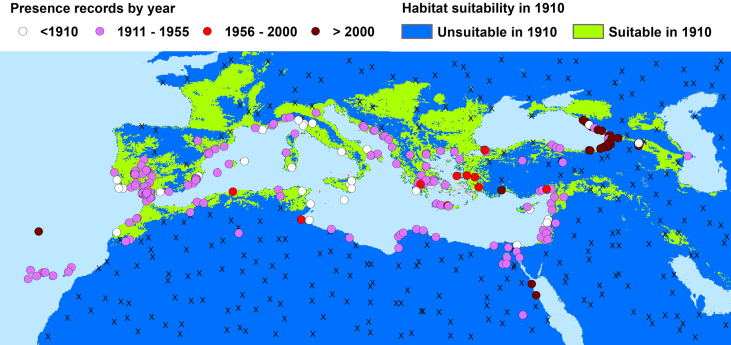
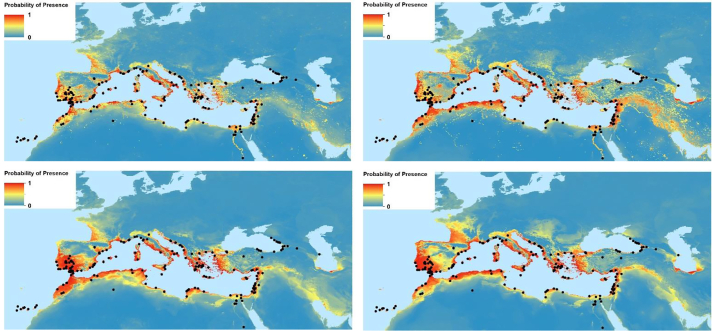
The global distribution of the yellow fever mosquito Aedes aegypti is the subject of considerable attention because of its pivotal role as a biological vector of several high profile disease pathogens including dengue, chikungunya, yellow fever, and Zika viruses. There is also a lot of interest in the projected future species' distribution. However, less effort has been focused on its historical distribution, which has changed substantially over the past 100 years, especially in southern Europe where it was once widespread, but largely disappeared by the middle of the 20th century. The present work utilises all available historical records of the distribution of Ae. aegypti in southern Europe, the Near East within the Mediterranean Basin and North Africa from the late 19th century until the 1960's to construct a spatial distribution model using matching historical climatic and demographic data. The resulting model was then implemented using current climate and demographic data to assess the potential distribution of the vector in the present. The models were rerun with several different assumptions about the thresholds that determine habitat suitability for Ae. aegypti. The historical model matches the historical distributions well. When it is run with current climate values, the predicted present day distribution is somewhat broader than it used to be particularly in north-west France, North Africa and Turkey. Though it is beginning to reappear in the eastern Caucasus, this 'potential' distribution clearly does not match the actual distribution of the species, which suggests some other factors are responsible for its absence. Future distributions based on the historical model also do not match future distributions derived from models based only on present day vector distributions, which predict little or no presence in the Mediterranean Region. At the same time, the vector is widespread in the USA which is predicted to consolidate its range there in future. This contradiction and the implication for possible re-invasion of Europe are discussed.
Keywords: Culicidae; Historical distribution; Spatial modelling; Vector-borne diseases; Western Palaearctic region.
Crown Copyright © 2022. Published by Elsevier B.V. All rights reserved.
Conflict of interest statement
Declaration of competing interest The authors declare that they have no known competing financial interests or personal relationships that could have appeared to influence the work reported in this paper.
Figures
References
-
- Aeger J.M. Yellow fever in France, Italy, Great Britain, and Austria, and bibliography of yellow fever in Europe. Bull. Yellow Fever Inst., US. 1902;8:25–35.
-
- Aïssaoui L., Boudjelida H. Diversity and distribution of culicinae fauna in Tebessa district (North-east of Algeria) Int. J. Mosq. Res. 2017;4:7–12.
-
- Akiner M.M., Demirci B., Babuadze G., Robert V., Schaffner F. Spread of the invasive mosquitoes Aedes aegypti and Aedes albopictus in the Black Sea region increases risk of chikungunya, dengue, and Zika outbreaks in Europe. PLoS Negl. Trop. Dis. 2016;10 doi: 10.1371/journal.pntd.0004664. - DOI - PMC - PubMed
MeSH terms
LinkOut - more resources
Full Text Sources
Medical
Miscellaneous
