


JNK pathway-associated phosphatase illustrates low expression and negative correlations with inflammation, disease activity, and T-helper 17 cells in inflammatory bowel disease children
- PMID: 35908771
- PMCID: PMC9459247
- DOI: 10.1002/jcla.24488
JNK pathway-associated phosphatase illustrates low expression and negative correlations with inflammation, disease activity, and T-helper 17 cells in inflammatory bowel disease children
Abstract
Background: C-Jun N-terminal kinase pathway-associated phosphatase (JKAP) modulates the T cell receptor and mitogen-activated protein kinase pathway-mediated autoimmunity, thus participating in the pathogenesis of autoimmune diseases. This study aimed to explore the clinical implication of JKAP in inflammatory bowel disease (IBD) children.
Methods: C-Jun N-terminal kinase pathway-associated phosphatase, tumor necrosis factor-α (TNF-α), interleukin-23, interferon-γ (T-helper 1 secreted cytokine), and interleukin-17A (T-helper 17 secreted cytokine) in serum samples from 140 IBD children (including 60 Crohn's disease (CD) children and 80 ulcerative colitis (UC) children) were detected by ELISA. Meanwhile, JKAP from serum samples of 10 healthy controls (HCs) was also detected by ELISA.
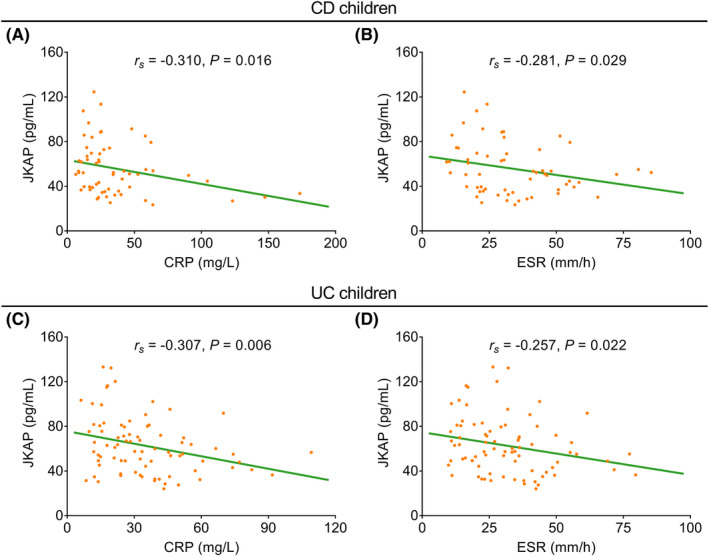
Results: C-Jun N-terminal kinase pathway-associated phosphatase was reduced in CD children (median (interquartile range (IQR)): 51.6 (36.8-69.5) pg/ml) and UC children (median (IQR): 57.5 (43.4-78.5) pg/ml) compared with HCs (median (IQR): 101.8 (70.0-143.2) pg/ml) (both p < 0.05). In CD children, JKAP was negatively correlated with C-reactive protein (CRP) (p = 0.016) and erythrocyte sedimentation rate (ESR) (p = 0.029); while in UC children, JKAP was also negatively correlated with CRP (p = 0.006) and ESR (p = 0.022). Regarding the correlation of JKAP with disease activity, it presented negative correlations with PCDAI (p = 0.001) and PUCAI (p = 0.002). Besides, JKAP was negatively related to TNF-α (both p < 0.05) but not interleukin-23 (both p>0.05) in CD and UC children. Additionally, JKAP was not correlated with interferon-γ in CD or UC children (both p>0.05), while negatively correlated with interleukin-17A in CD and UC children (both p < 0.05).
Conclusion: C-Jun N-terminal kinase pathway-associated phosphatase shows low expression and negative correlations with inflammation, disease activity, and T-helper 17 cells in IBD children.
Keywords: C-Jun N-terminal kinase pathway-associated phosphatase; T-helper 17; disease activity; inflammation; inflammatory bowel disease children.
© 2022 The Authors. Journal of Clinical Laboratory Analysis published by Wiley Periodicals LLC.
Conflict of interest statement
The authors have no relevant financial or non‐financial interests to disclose.
Figures



References
-
- Rubalcava NS, Gadepalli SK. Inflammatory bowel disease in children and adolescents. Adv Pediatr. 2021;68:121‐142. - PubMed
-
- Flynn S, Eisenstein S. Inflammatory bowel disease presentation and diagnosis. Surg Clin North Am. 2019;99(6):1051‐1062. - PubMed
-
- Fuller MK. Pediatric inflammatory bowel disease: special considerations. Surg Clin North Am. 2019;99(6):1177‐1183. - PubMed
MeSH terms
Substances
LinkOut - more resources
Full Text Sources
Medical
Research Materials
Miscellaneous
