


Mechanistic insights into the primary and secondary alterations of renal ion and water transport in the distal nephron
- PMID: 35909256
- PMCID: PMC10087581
- DOI: 10.1111/joim.13552
Mechanistic insights into the primary and secondary alterations of renal ion and water transport in the distal nephron
Abstract
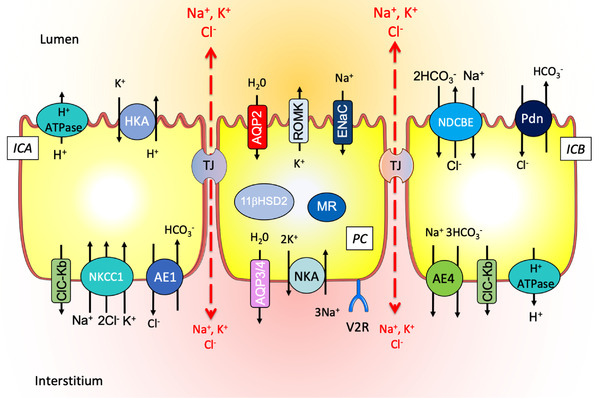
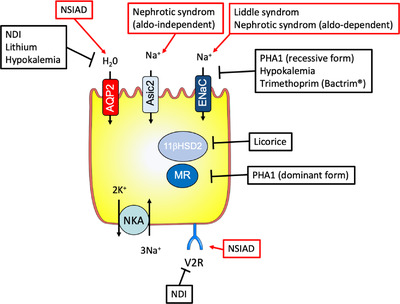
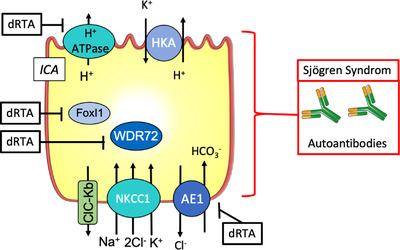
The kidneys, by equilibrating the outputs to the inputs, are essential for maintaining the constant volume, pH, and electrolyte composition of the internal milieu. Inability to do so, either because of internal kidney dysfunction (primary alteration) or because of some external factors (secondary alteration), leads to pathologies of varying severity, leading to modification of these parameters and affecting the functions of other organs. Alterations of the functions of the collecting duct (CD), the most distal part of the nephron, have been extensively studied and have led to a better diagnosis, better management of the related diseases, and the development of therapeutic tools. Thus, dysfunctions of principal cell-specific transporters such as ENaC or AQP2 or its receptors (mineralocorticoid or vasopressin receptors) caused by mutations or by compounds present in the environment (lithium, antibiotics, etc.) have been demonstrated in a variety of syndromes (Liddle, pseudohypoaldosteronism type-1, diabetes insipidus, etc.) affecting salt, potassium, and water balance. In parallel, studies on specific transporters (H+ -ATPase, anion exchanger 1) in intercalated cells have revealed the mechanisms of related tubulopathies like distal renal distal tubular acidosis or Sjögren syndrome. In this review, we will recapitulate the mechanisms of most of the primary and secondary alteration of the ion transport system of the CD to provide a better understanding of these diseases and highlight how a targeted perturbation may affect many different pathways due to the strong crosstalk and entanglements between the different actors (transporters, cell types).
Keywords: acid and base balance; blood pressure; kidney; potassium; tubulopathies.
© 2022 The Authors. Journal of Internal Medicine published by John Wiley & Sons Ltd on behalf of Association for Publication of The Journal of Internal Medicine.
Conflict of interest statement
The authors report no conflict of interest in relation to this publication.
Figures
References
Publication types
MeSH terms
Substances
LinkOut - more resources
Full Text Sources
