


Association Between Type of Infertility and Live Birth in Couples With a Single Intrauterine Insemination Resulting in Pregnancy: A Propensity Score Matching Cohort Study
- PMID: 35909526
- PMCID: PMC9329630
- DOI: 10.3389/fendo.2022.926183
Association Between Type of Infertility and Live Birth in Couples With a Single Intrauterine Insemination Resulting in Pregnancy: A Propensity Score Matching Cohort Study
Abstract
Background: Few studies have described the relationship between the type of infertility and live birth in patients treated with intrauterine insemination (IUI). We focused on this issue and attempted to explore it.
Methods: This retrospective study enrolled 2,256 infertile patients who underwent their first IUI cycle and were subsequently diagnosed with a clinical pregnancy at Ji'an Women and Child Health Care Hospital between 2007 and 2018. Inductees were divided into primary infertility (1,680 patients) and secondary infertility groups (876 patients). Following 1:1 propensity score matching to obtain balanced data, the COX proportional hazards model, landmark analysis, and subgroup analysis were used to assess the association between infertility types and live birth rates. Subsequently, a sensitivity analysis was employed to evaluate the potential effect of unmeasured confounding on outcomes.
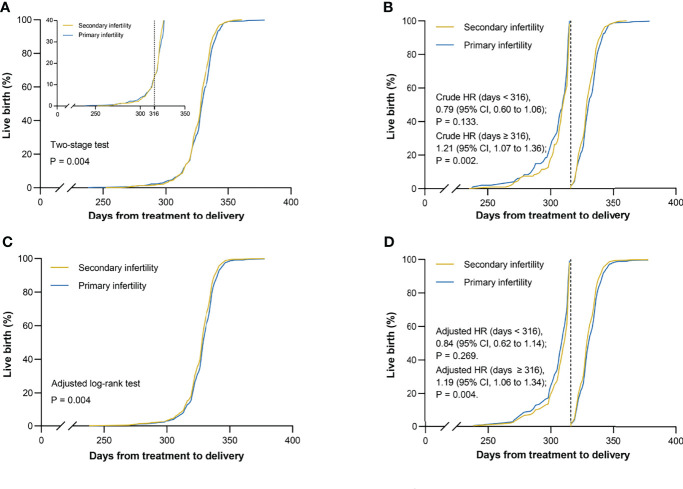
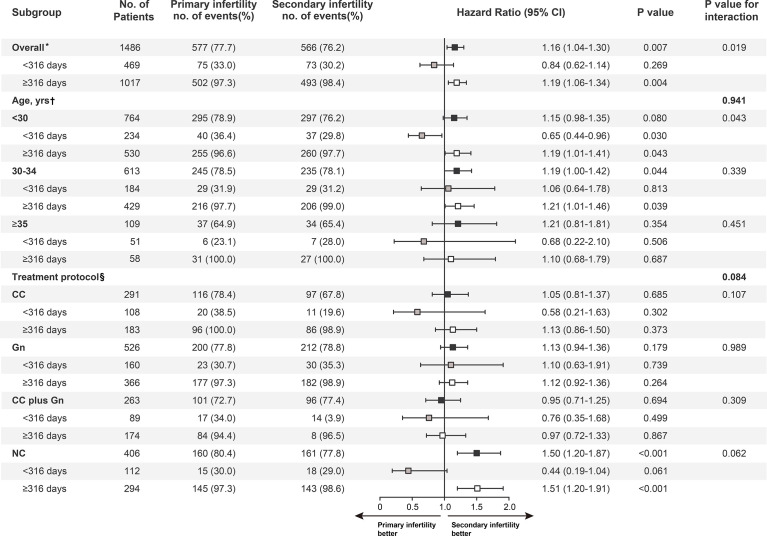
Results: Of the 1,486 patients who were identified as a matched cohort, 743 were in the primary infertility group and the remaining patients were in another group. A total of 1,143 patients had live births during 431,009 person-days of follow-up (average 290.0 days). Throughout the follow-up period, patients with secondary infertility demonstrated more live births than patients with primary infertility (hazard ratio [HR], 1.16; 95% confidence interval [CI], 1.04 to 1.30; P = .007). More details were observed in the landmark analysis. Live birth rates were similar in both groups within 316 days of follow-up (HR, 0.84; 95% CI, 0.62 to 1.14; P = .269), whereas the opposite was found between 316 days of follow-up and delivery day (HR, 1.19; 95% CI, 1.06 to 1.34; P = .004). This was also obtained in a subgroup analysis of patients younger than 35 years old and patients treated with natural cycles (NCs) and IUIs.
Conclusion: Among the infertile patients who underwent a single natural or stimulated cycle followed by IUI and had later pregnancies, full-term young secondary infertility mothers (<35 years of age) had a greater chance of having viable babies than the primary infertility ones. The latter may get more benefits when undergoing ovarian stimulation and IUI rather than NC-IUI.
Keywords: intrauterine insemination; live birth; ovarian stimulation; primary infertility; secondary infertility.
Copyright © 2022 He, Chen, Huang, Zhang, Hu, Xue and Qiu.
Conflict of interest statement
The authors declare that the research was conducted in the absence of any commercial or financial relationships that could be construed as a potential conflict of interest.
Figures
References
MeSH terms
LinkOut - more resources
Full Text Sources
Medical
