


Break-in Period ≤24 Hours as an Option for Urgent-start Peritoneal Dialysis in Patients With Diabetes
- PMID: 35909563
- PMCID: PMC9329536
- DOI: 10.3389/fendo.2022.936573
Break-in Period ≤24 Hours as an Option for Urgent-start Peritoneal Dialysis in Patients With Diabetes
Abstract
Background: The optimal break-in period (BI) of urgent-start peritoneal dialysis (USPD) initiation for patients with end-stage renal disease (ESRD) and diabetes is unclear. We aimed to explore the safety and applicability of a BI ≤24 h in patients with ESRD and diabetes.
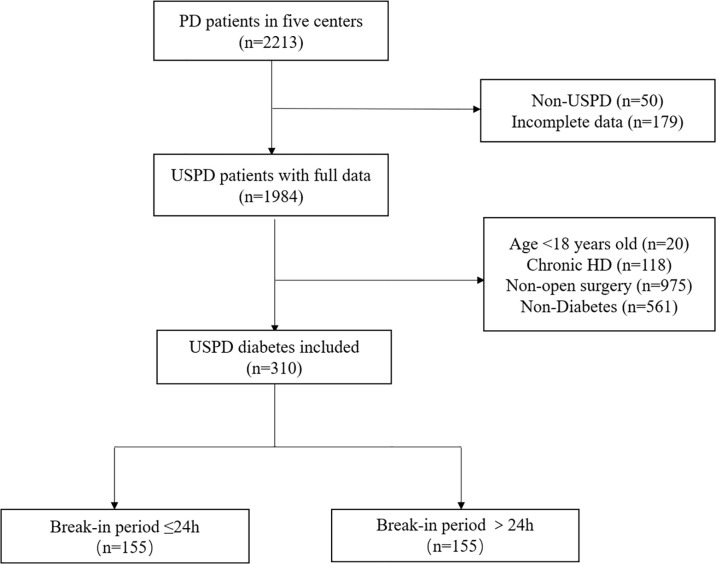
Methods: We used a retrospective cohort design wherein we recruited patients with ESRD and diabetes who underwent USPD at five institutions in China between January 2013 and August 2020. The enrolled patients were grouped according to BI. The primary outcomes were mechanical and infectious complication occurrences, whereas the secondary outcome was technique survival.
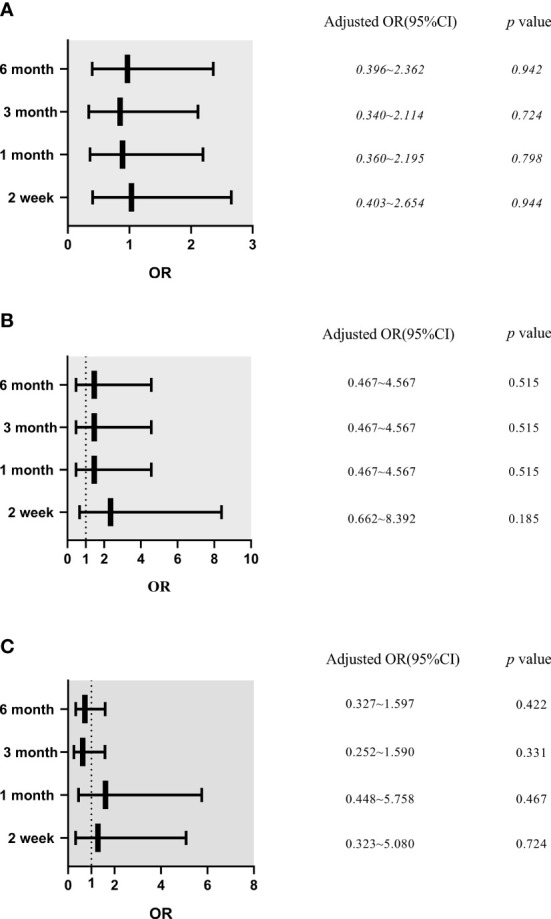
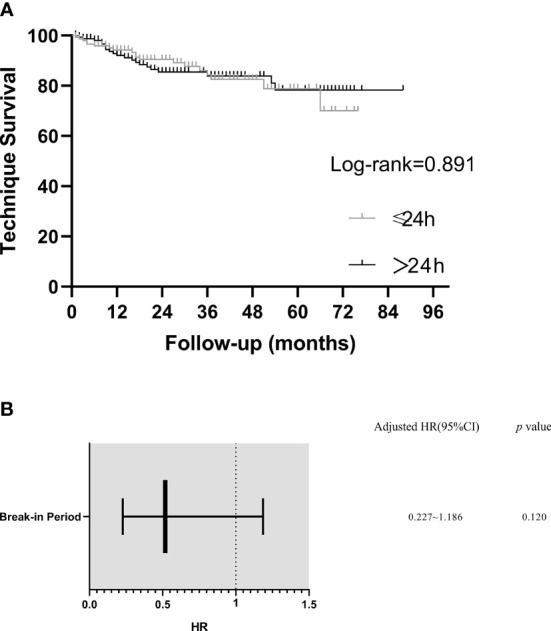
Results: We enrolled 310 patients with diabetes, of whom 155 and 155 patients were in the BI ≤24 h and BI >24 h groups, respectively. The two groups showed a comparable incidence of infectious and mechanical complications within 6 months after catheter insertion (p>0.05). Logistic regression analysis revealed that a BI ≤24 h was not an independent risk factor for mechanical or infectious complications. Kaplan-Meier estimates showed no statistically significant between-group differences in technique survival rates (p>0.05). Cox multivariate regression analysis revealed that a BI ≤24 h was not an independent risk factor for technique failure.
Conclusion: USPD initiation with a BI ≤24 h may be safe and feasible for patients with ESRD and diabetes.
Keywords: break-in period; complications; diabetics; end-stage renal disease; urgent start peritoneal dialysis.
Copyright © 2022 Hu, Yang, Sun, Zhang, Zhu, Zhou, Wen, Liu and Cui.
Conflict of interest statement
The authors declare that the research was conducted in the absence of any commercial or financial relationships that could be construed as a potential conflict of interest.
Figures
References
Publication types
MeSH terms
LinkOut - more resources
Full Text Sources
Medical
